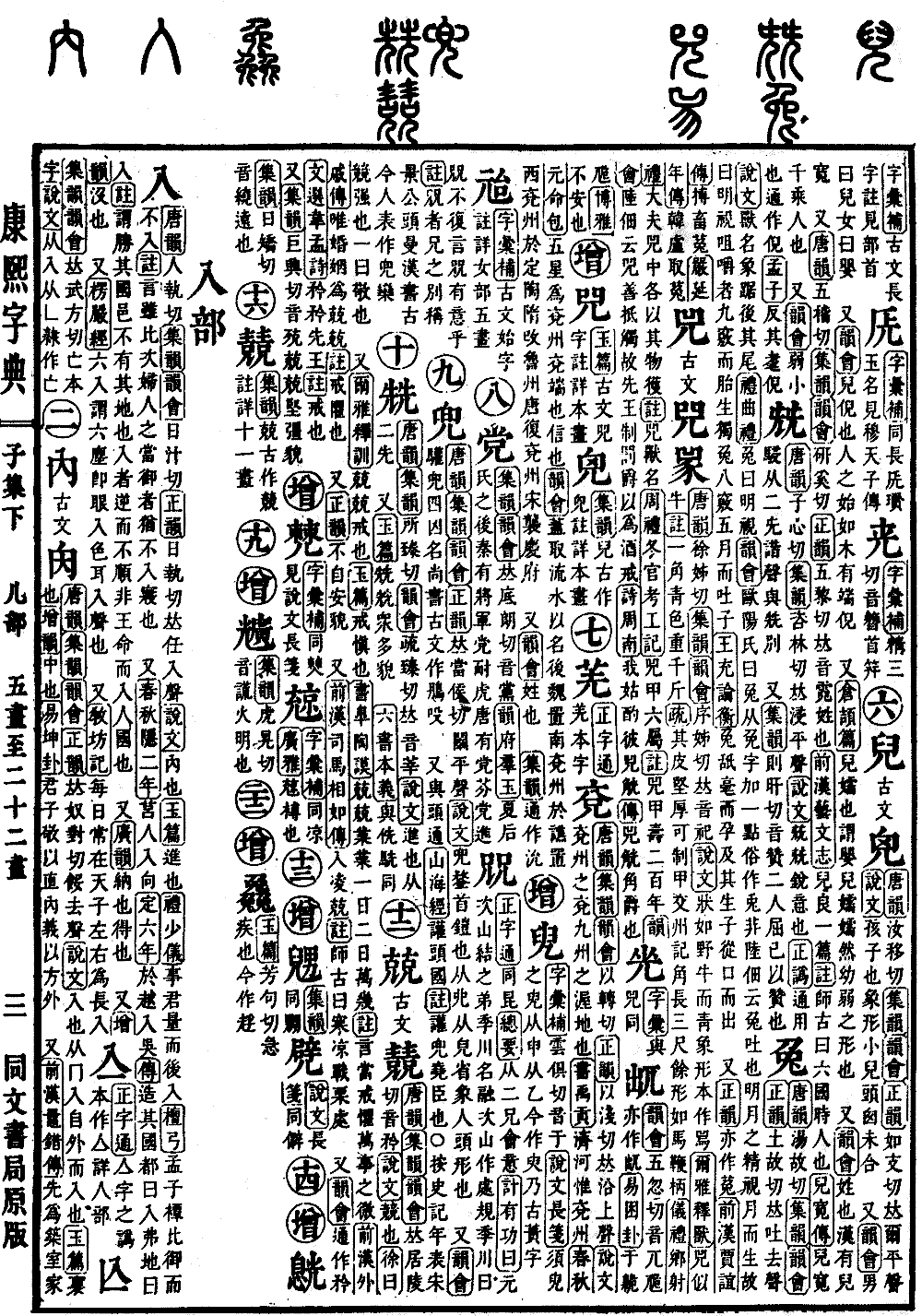
Zi Collection, Page Position: Lower
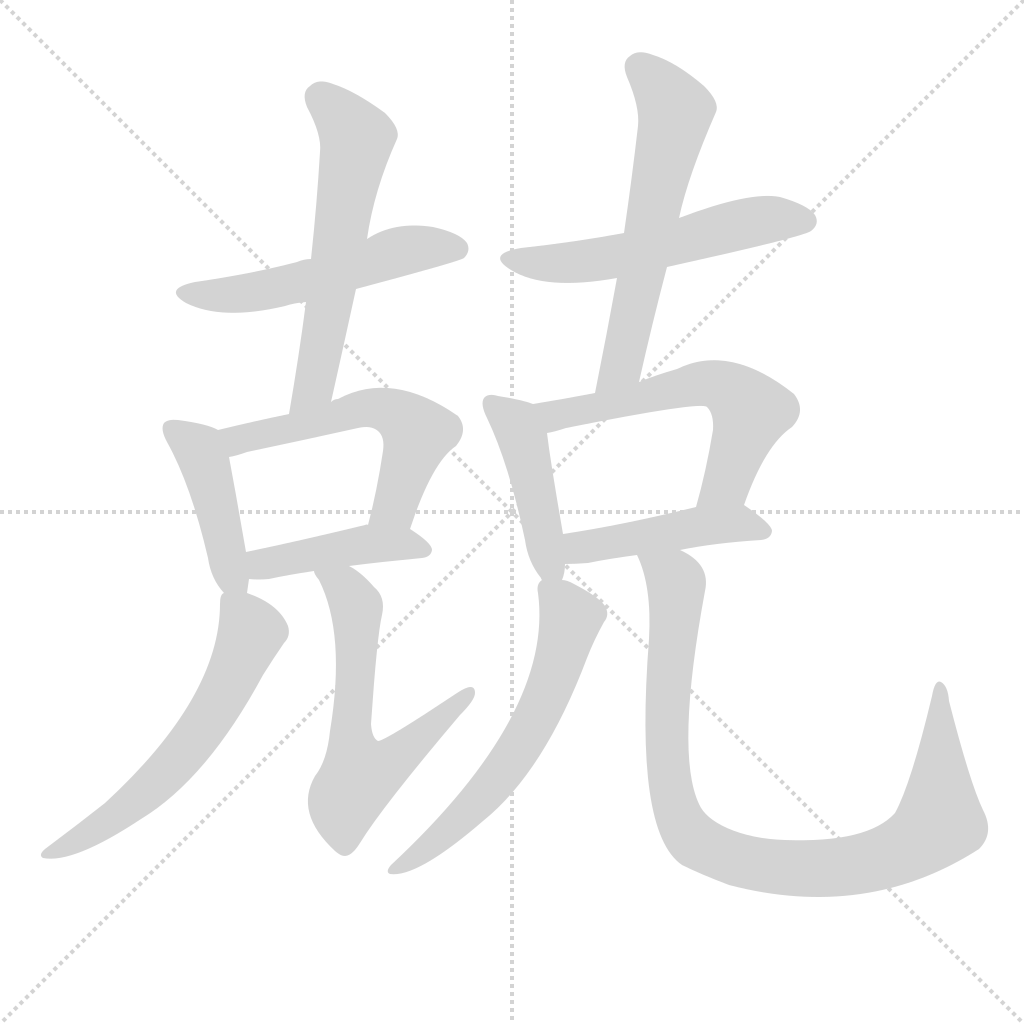
Radical: Legs (ér)
Jing
Kangxi Stroke Count: 14
Page 125, Entry 22
Ancient texts record:
Pronounced ju ling qie (falling tone) in "Tang Yun" (Tang Yun), "Ji Yun" (Ji Yun), and "Yun Hui" (Yun Hui), with the same pronunciation as "jin".
"Shuowen Jiezi" (Shuowen Jiezi) explains it as "jing", and Xu Kai's commentary further clarifies that "jing" means strong. Another interpretation is the meaning of "jing" (respect).
Also, in "Erya - Shixun" (Erya - Shixun), "jing jing" indicates caution.
"Yu Pian" (Yu Pian) explains it as vigilant and cautious.
"Shang Shu - Gao Yao Mo" (Shang Shu - Gao Yao Mo) states, "Jing jing ye ye, yi ri er ri wan ji," with a commentary explaining that one should maintain vigilance and fear towards the subtle details of all matters.
In "Qian Han Shu - Wai Qi Zhuan" (Qian Han Shu - Wai Qi Zhuan), "Wei hun yin wei jing jing," the commentary explains it as fearful caution.
Also, "Zheng Yun" (Zheng Yun) describes it as a state of inner unease.
Furthermore, in "Qian Han Shu - Sima Xiangru Zhuan" (Qian Han Shu - Sima Xiangru Zhuan), "Ren ling jing," Yan Shigu explains this as a state of shivering from cold.
Also, "Yun Hui" (Yun Hui) mentions it is used as a phonetic loan for "jin".
In "Wen Xuan - Wei Meng Shi" (Wen Xuan - Wei Meng Shi), "Jin jin xian wang," the commentary explains it as cautious.
Also, "Ji Yun" (Ji Yun) provides the pronunciation ju xing qie (falling tone), with the same pronunciation as "qing". "Jing jing" describes a state of being firm and strong.