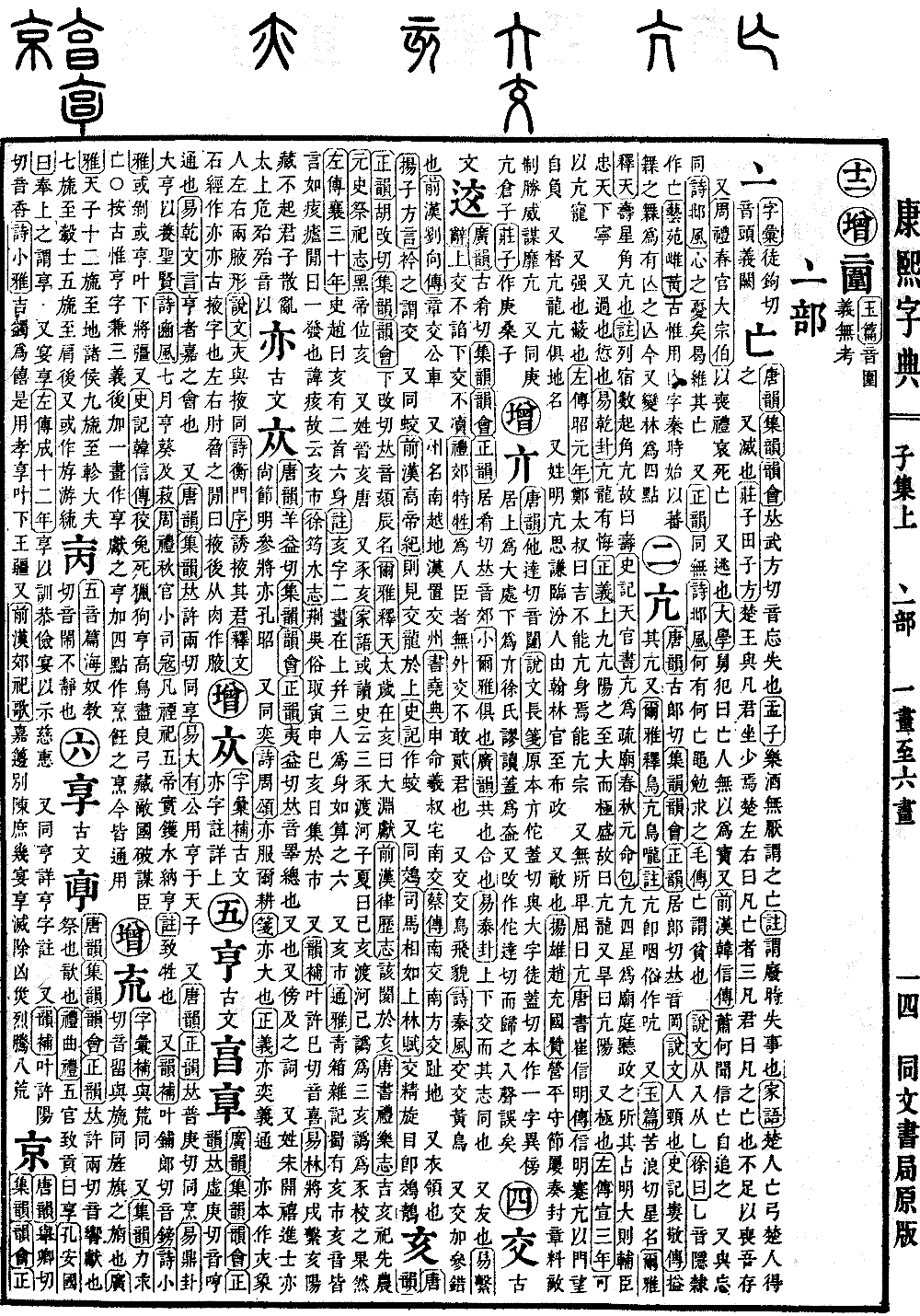
Zi Collection, Page Position: Upper
Radical: Lid (tóu)
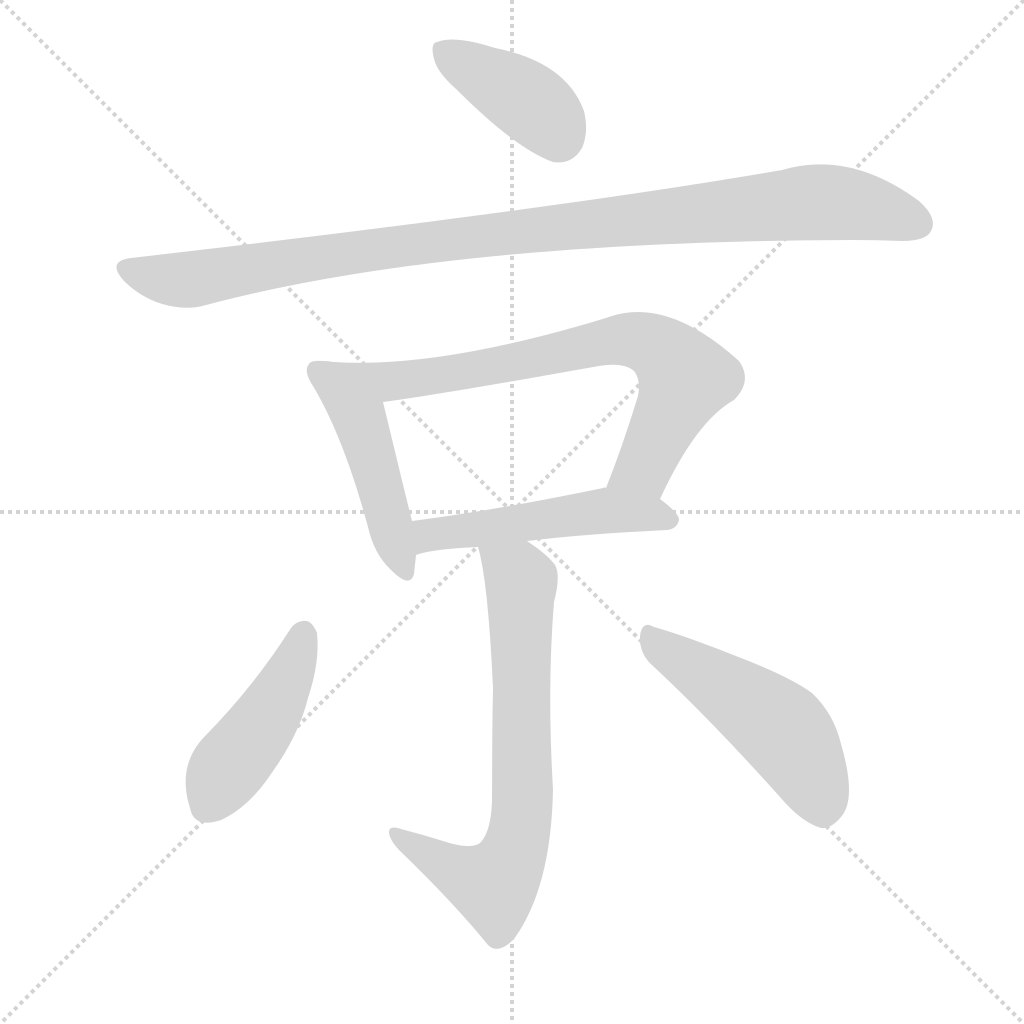
Jing
Kangxi stroke count: 8
Page 88, Entry 19
Pronounced jing. Meaning large.
Yangzi Dialect (Fangyan): In the northern borderlands of Yan and the outskirts of Qi and Chu, anything described as large is called jing.
Also from Erya, Interpretation of Hills (Shiqiu): A hill that is exceptionally high is called jing.
Guangya: That which rises on four sides is called jing.
Also from Cai Yong, Decisive Judgments (Duduan): The residence of the Son of Heaven is called jingshi. Jing means large, and shi means multitude.
Gongyang Commentary (Gongyangzhuan), Year 9 of Duke Huan: The residence of the Son of Heaven must be described with terms denoting a great multitude.
Also a name for a number. Ten hundred million is a zhao, and ten zhao is a jing.
Also a surname. Jing Fang of the Han dynasty, Jing Tang of the Song dynasty.
Also the same as yuan.
Book of Rites (Liji), Tan Gong: Zhao Wenzi said: "This is to preserve the waist and neck, to follow the former grand officers to the Nine Jing."
Commentary: Nine Jing is the name of a mountain, located in present-day Jiangzhou. The burial grounds of the Jin officers were at Nine Jing. Jing is the same as the character for yuan.
Also a personal name.
History of the Later Han (Houhan-shu), Biography of Yao Qi: Defeated the Gengshi General Jing.
Records of the Eastern Pavilion (Dongguan hanji): Jing is written as yuan. In ancient times, they were used interchangeably.
Also the same as jing (whale).
Book of the Former Han (Qianhan-shu), Biography of Yang Xiong: Riding a jing fish.
Also the same as qiang.
Classic of Mountains and Seas (Shanhaijing): The name of a northern deity is Yuqiang.
Commentary to Zhuangzi: Written as Yujing.
Also, from the Supplement to the Rhymes (Yunbu), rhyming with liang, pronounced jiang.
Book of Odes (Shijing), Lesser Odes (Xiaoya): My worried heart is agitated (jing jing). Rhymes with shang and yang.
Zuo Commentary (Zuozhuan), Year 22 of Duke Zhuang: For five generations it will prosper, equal to that of a high minister (qing). After eight generations, none will be able to equal (jing) it.
Commentary: Jing means to be equal to. Qing is pronounced qiang.
Textual Research: Yangzi Dialect (Fangyan) states: In the northern borderlands of Yan and the outskirts of Qi and Chu, anything described as large is called jing. Corrected according to the original text to read: In the northern borderlands of Yan and the outskirts of Qi and Chu, anything described as large is called jing.