Xu Collection, Middle Volume
Radical: Mound (fù)
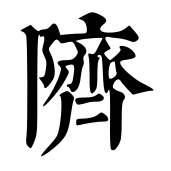
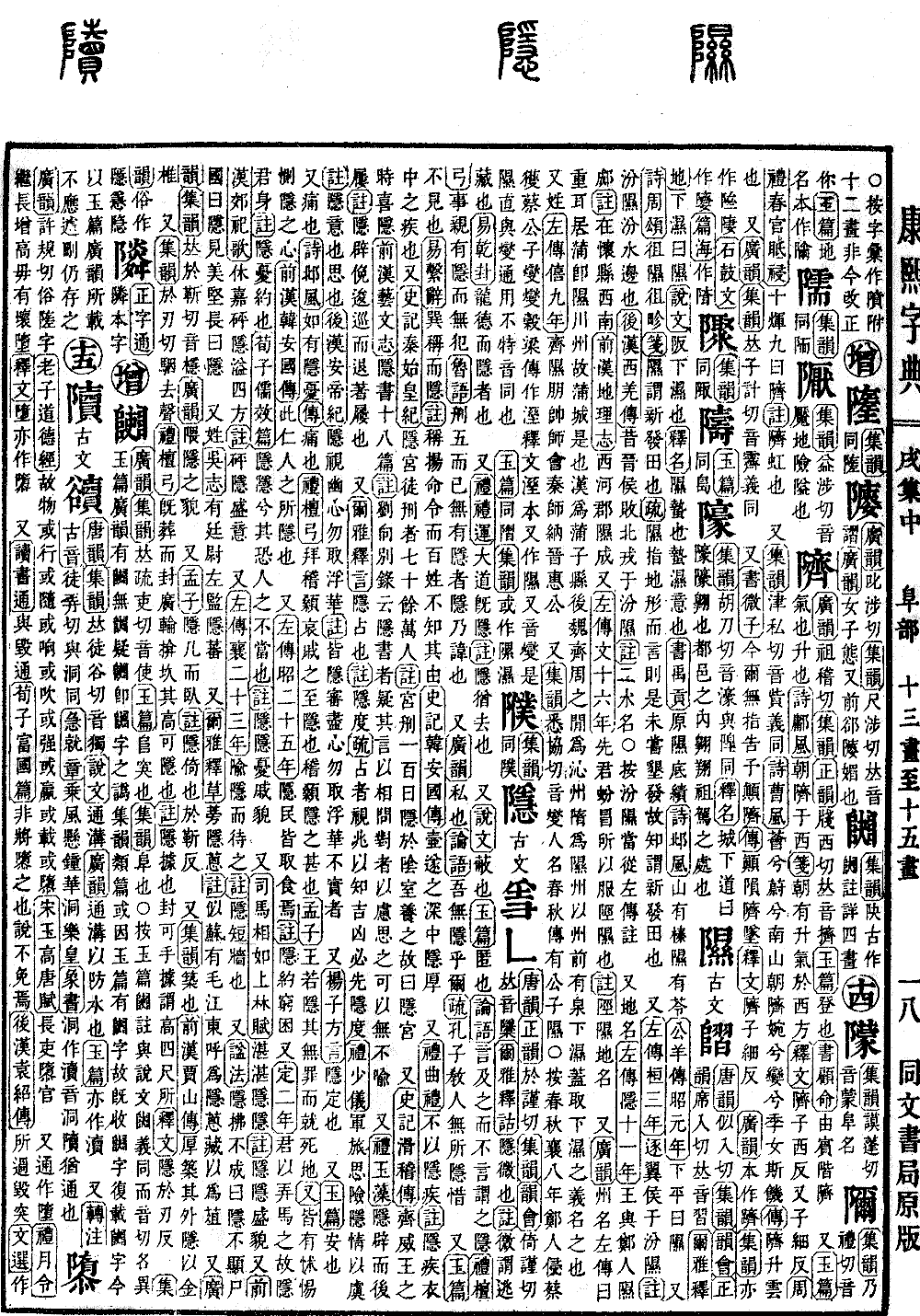
The character jī; Kangxi strokes: 22; Page: 1362, entry 08
Pronounced jǐ, based on the fanqie spellings zǔjī qiè from the Guangyun (Guangyun), and jiānxī qiè from the Jijun (Jijun) and Zhengjun (Zhengjun).
According to the Yupian (Yupian), it means to ascend. From the 'Counsels of Gu' chapter of the Book of Documents (Shujing): "ascending the steps with the guest."
Also, from the Yupian, it means vapor or to rise. From the Book of Odes (Shijing), 'Airs of Yong' section: "In the morning, it ascends in the west." The commentary explains: "In the morning, there is rising vapor in the west." The Shiwén (Shiwen) indicates that jī is pronounced with initial zǐ and final xī, and also with initial zǐ and final xì.
From the Rites of Zhou (Zhouli), 'Spring Offices', 'Observing Auspicious Signs' section: "Among the ten types of gleam, the ninth is called jī." The commentary notes: "Jī refers to a rainbow."
Also, according to the Jijun, it is pronounced with initial jīn and final sī, sounding like zī. The meaning is the same. From the Book of Odes, 'Airs of Cao' section: "Dense and lush, the southern mountain ascends in the morning. Elegant and beautiful, the youngest daughter is hungry." The commentary explains: "Jī means rising clouds."
Also, according to the Guangyun and Jijun, it is pronounced with initial zǐ and final jì, sounding like jì. The meaning is the same.
Also, from the Book of Documents, 'Viscount Wei' chapter: "Now, you have no guidance, you warn me of falling and tumbling." The commentary explains: "Diān means to fall, jī means to tumble." The Shiwén gives the pronunciation of 'jī' as being derived from initial zǐ and final xì.
The Guangyun states that the original form of the character is jī (a character featuring the Radical: Foot (zú) and meaning 'to ascend'). The Jijun also uses a variant form, jī (another character featuring the Radical: Foot (zú) and meaning 'to ascend').
In the Stone Drum Inscriptions (Shigǔwén), a character pronounced zhuàn is used as a variant. The Pianhai (Pianhai) also uses a variant character pronounced zhuàn.