Supplement
Wu Collection, Middle Volume
Radical: Grain (hé)
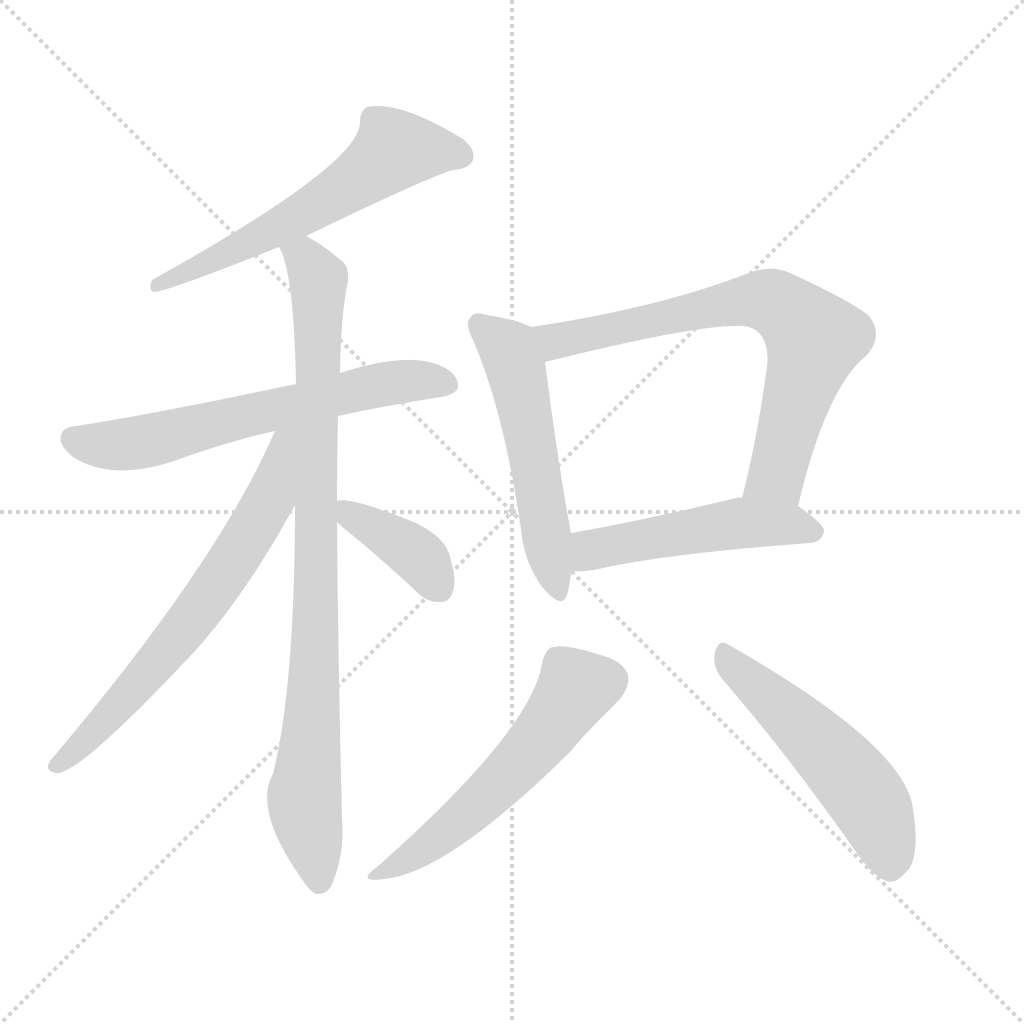
Ji
Kangxi character strokes: 16
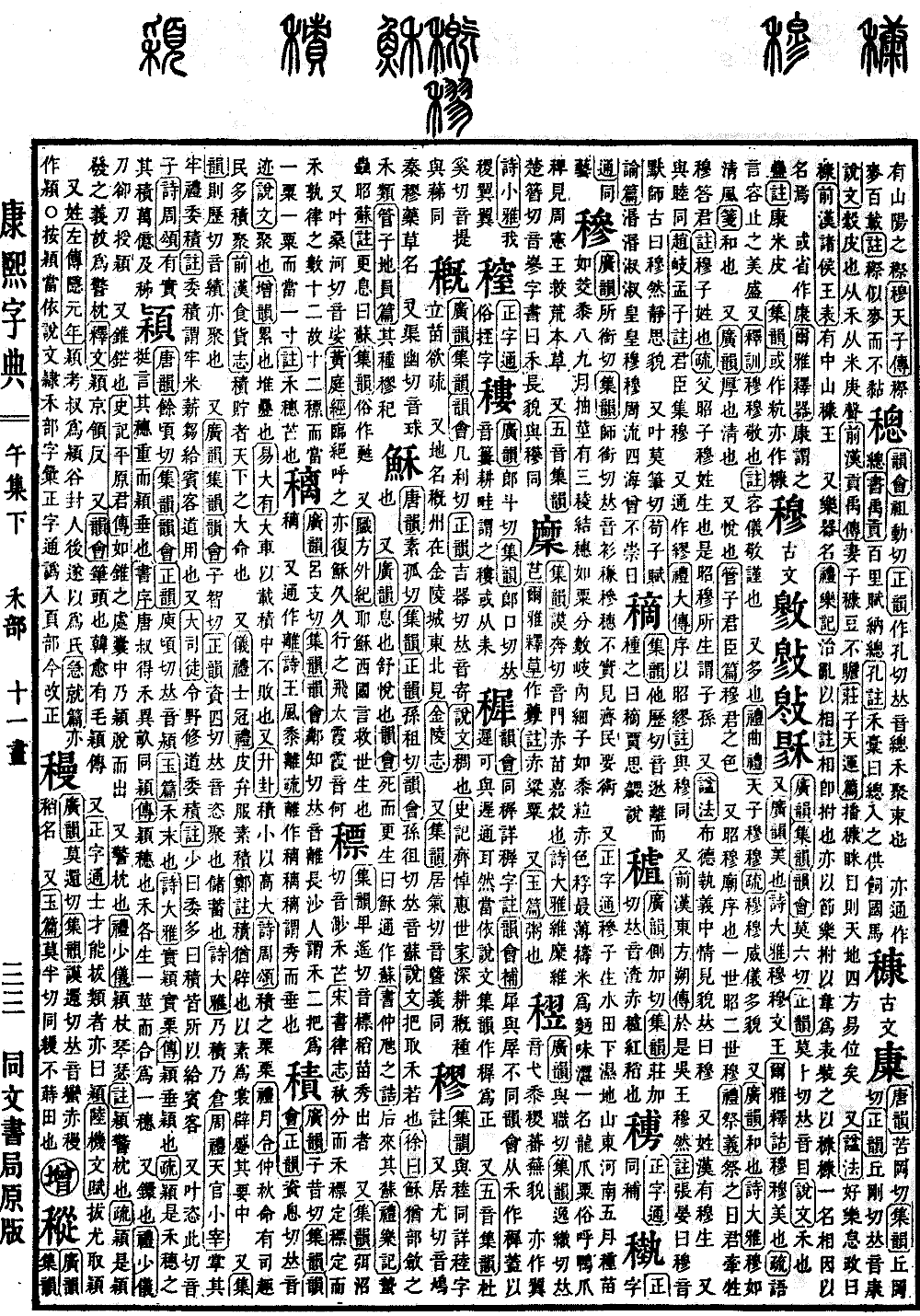
Page 859, Entry 06
According to Comprehensive Collection of Five Sounds (Wuyin Pianhai), pronounced zhi.
Ji
According to Broad Rhymes (Guangyun), pronounced xi. According to Collected Rhymes (Jiyun), Rhyme Meetings (Yunhui), and Orthodox Rhymes (Zhengyun), pronounced xi. Pronounced ji.
Shuowen Jiezi explains it as: to gather.
Expanded Rhymes (Zengyun) explains it as: to accumulate. To pile up.
I Ching (Yijing), Hexagram Dayou, says: Loaded in a large carriage, accumulated in the carriage, it will not scatter or spoil.
Also, I Ching (Yijing), Hexagram Sheng, says: Accumulating the small to achieve the great.
Book of Odes (Shijing), Zhou Odes (Zhousong), says: The accumulated grain is abundant.
Book of Rites (Liji), Monthly Ordinances (Yueling), says: In the middle of autumn, command the officials in charge to urge the people to accumulate much grain.
Book of Han (Hanshu), Treatise on Food and Money (Shihuozhi), says: Accumulation and storage are the lifeblood of the nation.
Also, Book of Etiquette and Ceremonial (Yili), Master’s Capping Ceremony (Shiguanli), mentions: The skin cap attire is matched with a white ji.
Zheng Xuan’s commentary says: Ji is like the meaning of folding; using white fabric to make the lower garment, folded into pleats at the waist.
Also, according to Collected Rhymes (Jiyun), pronounced ji. It also means to gather.
Also, according to Broad Rhymes (Guangyun), Collected Rhymes (Jiyun), and Rhyme Meetings (Yunhui), pronounced zi. According to Orthodox Rhymes (Zhengyun), pronounced zi. It means to gather or save.
Book of Odes (Shijing), Greater Odes (Daya), says: Thus accumulating grain, thus filling the granaries.
Rites of Zhou (Zhouli), Offices of Heaven (Tianguan), Small Administrator (Xiaozai), records: Responsible for managing sacrificial livestock, ritual items, and wei ji.
Commentary says: Wei ji refers to livestock, grain, and firewood supplied for guests on their journey.
Also, Rites of Zhou (Zhouli), Grand Tutor (Dasitu), records: Command the suburban areas to repair roads and set up wei ji.
Commentary says: A small amount is called wei, a large amount is called ji; both are used to supply guests.
Also, phonetically modified to be pronounced zi, pronounced the same as zi.
Book of Odes (Shijing), Zhou Odes (Zhousong), says: The grain in the granary is accumulated and full, reaching tens of billions.