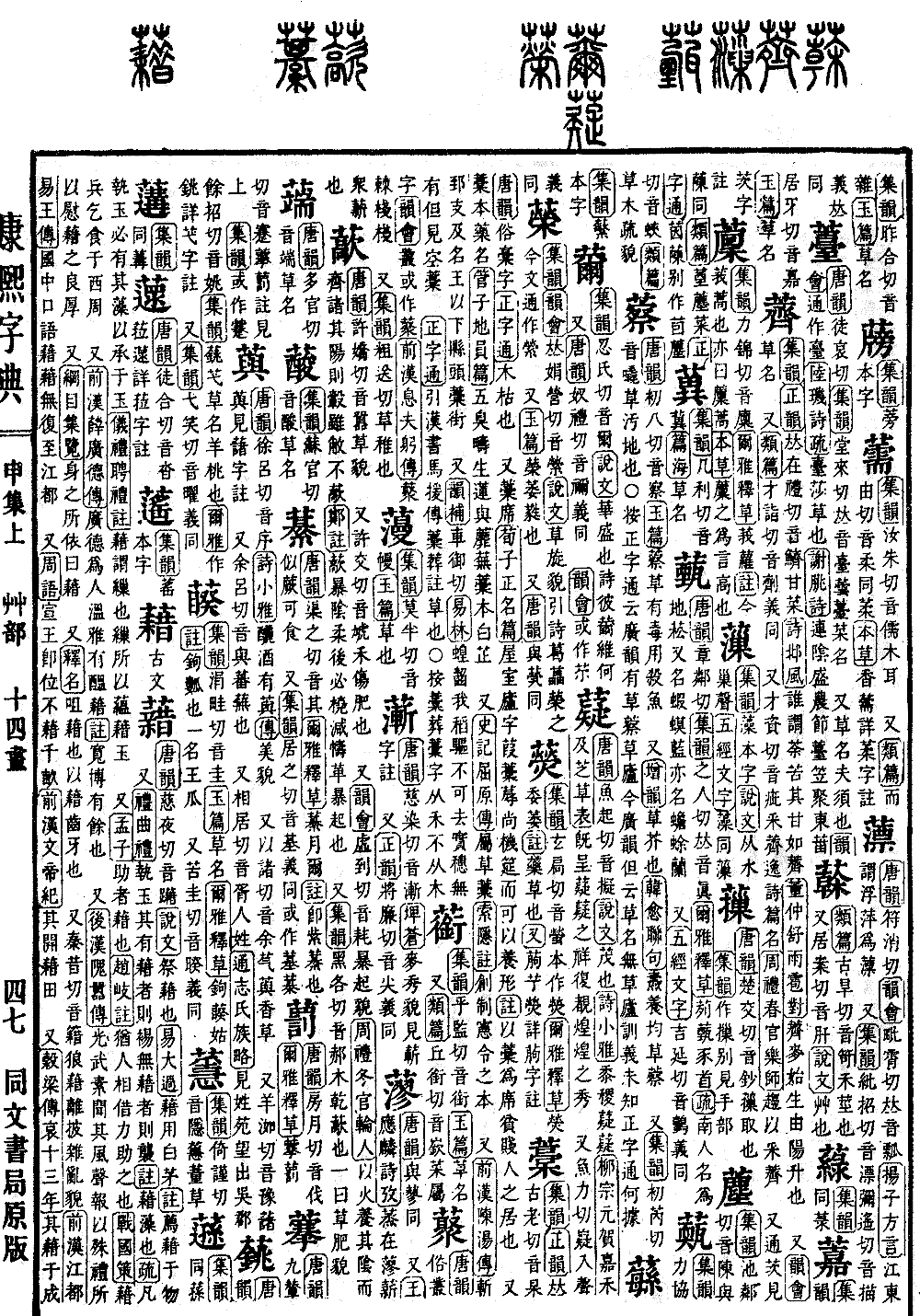
Shen Collection, Upper Volume
Radical: Grass (cǎo)
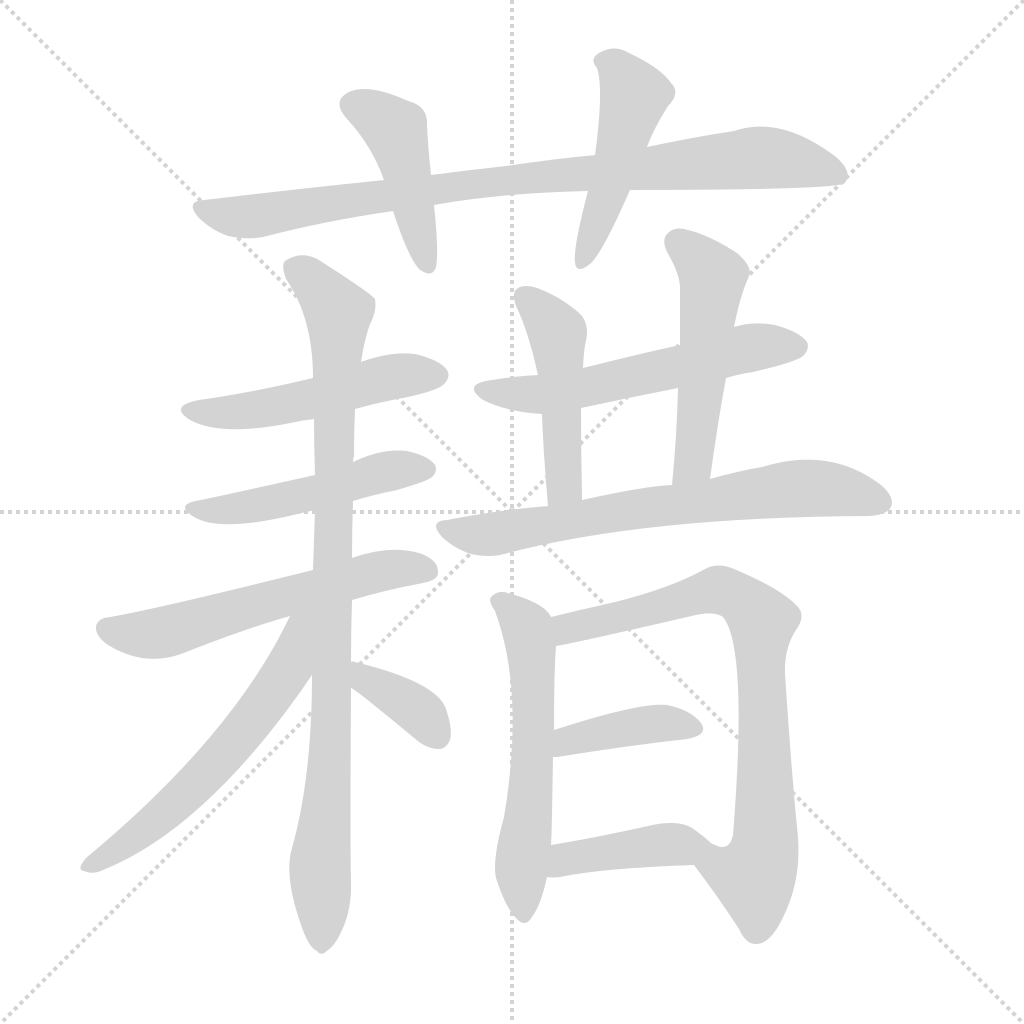
藉
Kangxi Dictionary strokes: 20
Page 1063, Entry 42
Ancient form
Pronounced jie (falling tone)
Shuowen Jiezi (Dictionary of Explanations of Characters): Offerings made during sacrifice.
Book of Changes (Yijing): Using white cogon grass as a cushion.
Commentary: To provide a base for an object.
Also, Book of Rites (Liji): When holding jade, if there is a cushion, one should wear an unlined garment; if there is no cushion, one should cover the garment.
Commentary: Cushion refers to ornamental grass.
Sub-commentary: Generally, when holding jade, there must be a cushion to support the jade.
Book of Etiquette and Ceremonial (Yili), Commentary on the Pinyi chapter: Cushion refers to the silken pad. The pad is used to cushion the jade.
Also, Mencius (Mengzi): Aid is like a cushion.
Zhao Qi commentary: Like one person borrowing strength to help another.
Strategies of the Warring States (Zhanguo Ce): To request troops and food from Western Zhou.
Also, Book of Han (Hanshu), Biography of Xue Guangde: Guangde was gentle and cultured in his manner.
Commentary: Broad-minded and generous.
Also, Book of the Later Han (Houhanshu), Biography of Wei Xiao: Emperor Guangwu had long heard of his reputation and responded with exceptional etiquette, treating him with great comfort and support.
Also, Essential Collection for Comprehensive Mirror (Gangmu Jilanshu): That upon which the body relies is called a cushion.
Also, Explanation of Names (Shiming): To chew is to use a cushion, used to cushion the teeth.
Also, pronounced ji (rising tone).
Disorderly and scattered (langjie): The appearance of things being messy and mixed up.
Book of Han (Hanshu), Biography of Yi, King of Jiangdu: The gossip in the state was rampant, and no one returned to Jiangdu.
Also, Discourses of the States (Guoyu): When King Xuan ascended the throne, he did not conduct the plowing of the thousand-acre field.
Book of Han (Hanshu), Annals of Emperor Wen: Open the fields for the imperial plowing ceremony.
Also, Guliang Commentary (Guliang Zhuan), 13th Year of Duke Ai: Paying tribute to the Chengzhou region to honor the Heavenly King.
Commentary: Tribute refers to offerings.
Also, Zhuangzi, Respoding to Emperors and Kings: The monkey and the macaque, for their own convenience, brought the dog to serve as a cushion.
Commentary: Cushion refers to a rope.
Also, Records of the Grand Historian (Shiji), Biography of Marquis Wu'an: Now that I am still alive, others all rely upon my younger brother.
Commentary: To rely upon or to trample.
Also, a surname.
Discourses of the States (Guoyu): Jie Yan, an official of the Jin state.
Also, according to archaic Tang Dynasty pronunciations, read as zuo.
Records of the Grand Historian (Shiji), Biography of Lord Shang: Commentary citing New Sequence (Xin Xu) theory: The Zhou royal house returned the territory.
Suoyin Commentary: Pronounced zuo.
Also, according to the Rhyme Supplement (Yunbu), pronounced ji (falling tone).
Ban Gu, Western Capital Rhapsody (Xidu Fu): The wilderness is desolate, with the eyes reaching to the four borders. Birds press upon one another, and beasts lie pillowed upon each other.