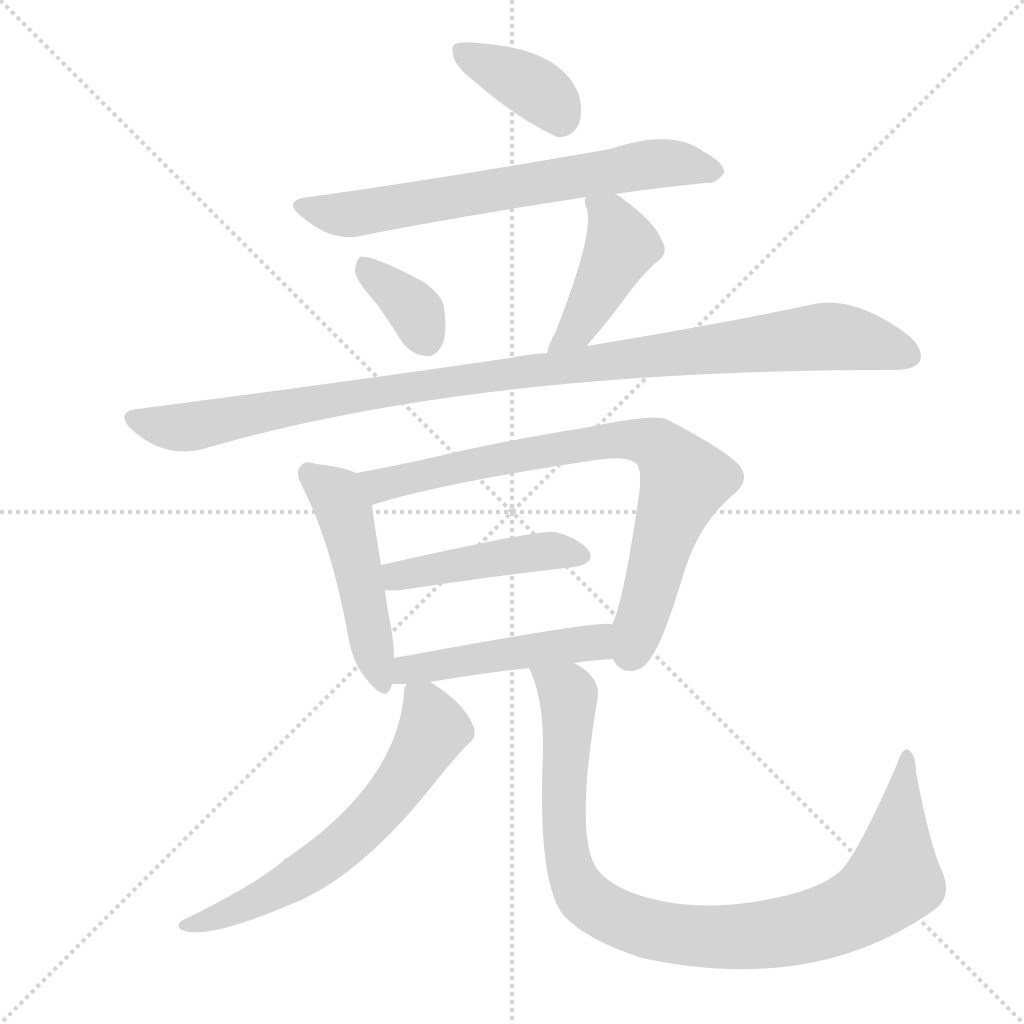
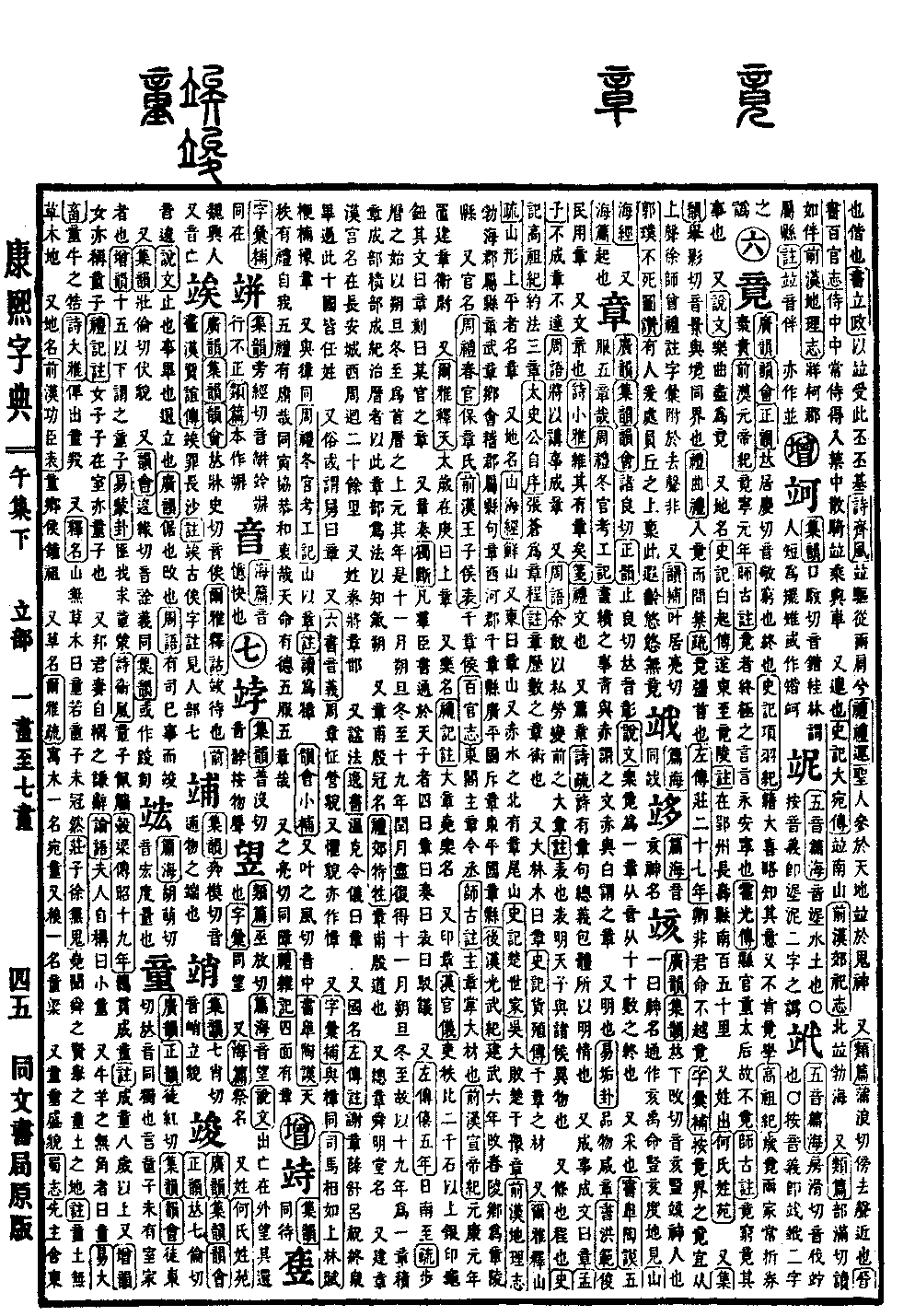
Wu Collection, Lower Volume
Radical: Stand (lì)
Kangxi stroke count: 11
Page 871, Entry 04
Guangyun, Yunhui, and Zhengyun state the pronunciation is jing (falling tone), same as the word for respect. It means to exhaust or to conclude.
Records of the Grand Historian (Shiji), Biography of Xiang Yu: Xiang Ji was very pleased, having generally understood the meaning, yet he was unwilling to study to the end.
Records of the Grand Historian (Shiji), Biography of Emperor Gaozu: At the end of the year, the two families often broke their bonds and renounced their debts.
History of the Former Han (Qianhan Shu), Biography of Emperor Yuandi: The first year of the Jingning era.
Commentary by Yan Shigu: Jing signifies the final meaning, speaking of eternal peace.
Biography of Huo Guang: The Emperor, because of the Empress Dowager, did not pursue the matter to the end.
Commentary by Yan Shigu: Jing refers to thoroughly investigating that matter.
Also, in the Shuowen Jiezi (Shuowen), the conclusion of a musical piece is called jing.
It also refers to a place name. Records of the Grand Historian (Shiji), Biography of Bai Qi: Consequently, he traveled east to reach Jingling.
Commentary: It is located one hundred and fifty li south of Changshou County in Ying Prefecture.
It is also a surname, originating from the He Shi Xing Yuan (He Family Register of Surnames).
Also, according to Jiyun, the pronunciation is jing (rising tone), same as the word for view. It is equivalent to the word for boundary.
Book of Rites (Liji), Qu Li: Upon entering the borders of another state, one must inquire about its prohibitions.
Commentary: Jing means a boundary.
Zuo Tradition (Zuo Zhuan), 27th Year of Duke Zhuang: A high official may not cross the state boundary without the order of the ruler.
Zihui Bu: Note: Jing, when signifying a boundary, should be pronounced in the rising tone. Xu Shizeng, in his commentary on the Book of Rites, says that the Zihui dictionary classifying it under the falling tone is incorrect.
Also, in Yunbu, it rhymes with the sound juliang (falling tone). Guo Pu, Praise for the Map of the Immortal: There are people who reside here, upon the Yuanqiu mountain. They receive this long life, which is vast and without end.
Verification: In the Book of Rites (Liji), Qu Li, the text says: Entering the border and inquiring about prohibitions. The commentary states: Jing is the boundary. We have carefully amended the term boundary in accordance with the original text of the Kong commentary.