Wu Collection, Middle Volume
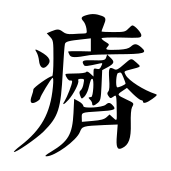
Radical: Sickness (bì)
Kangxi strokes: 19
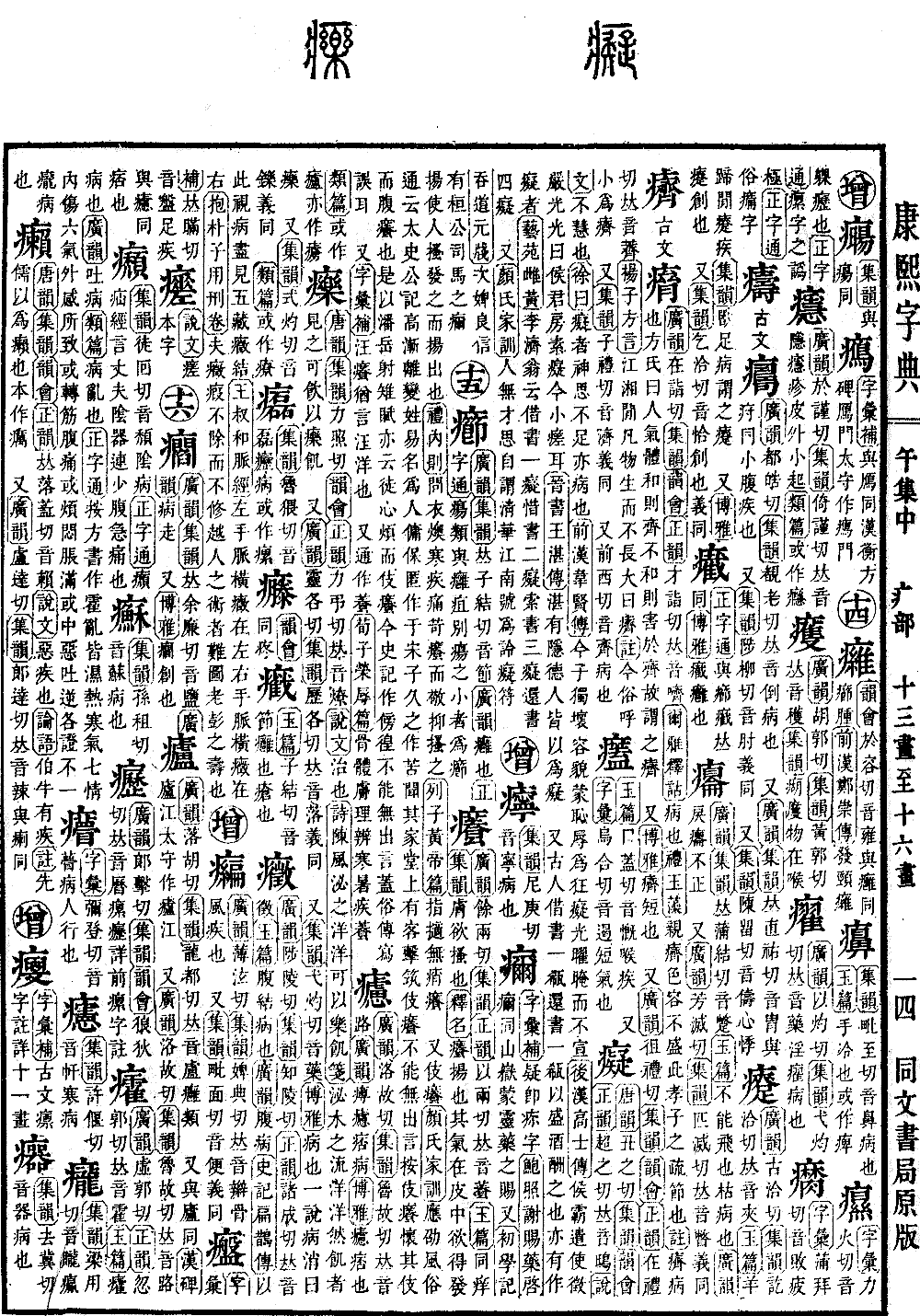
Page 782, Entry 15
Ancient citations:
Broad Rhymes (Guangyun): Pronounced zài (falling tone)
Collected Rhymes (Jiyun), Rhymes Collection (Yunhui), Correct Rhymes (Zhengyun): Pronounced cái (rising tone); sound similar to jì.
Literary Expositor (Erya): Explains this as disease.
Book of Rites (Liji): Records that when parents are ill, if a child appears haggard and neglects their appearance, this is an indication that the filial child is neglecting proper etiquette.
Note: This term refers to illness. Master Fang states: When the body’s energy and blood are in harmony, one is at ease; when they are not in harmony, it impairs one’s ease, thus it is called this term.
Also, Broad Expositions (Boya) explains: This term means small or stunted.
Also, Broad Rhymes (Guangyun): Pronounced cú (rising tone)
Collected Rhymes (Jiyun), Rhymes Collection (Yunhui), Correct Rhymes (Zhengyun): Pronounced zài (rising tone); sound similar to jì.
Dialects (Fangyan) by Yang Xiong: Records that in the Jiang and Xiang regions, any living thing that grows but does not reach full size is called by this term.
Note: In modern common parlance, small things are called by this term.
Also, Collected Rhymes (Jiyun): Pronounced zǐ (rising tone); sound similar to jì. The meaning is the same.
Also: Pronounced qián (level tone); sound similar to qí. It means disease.