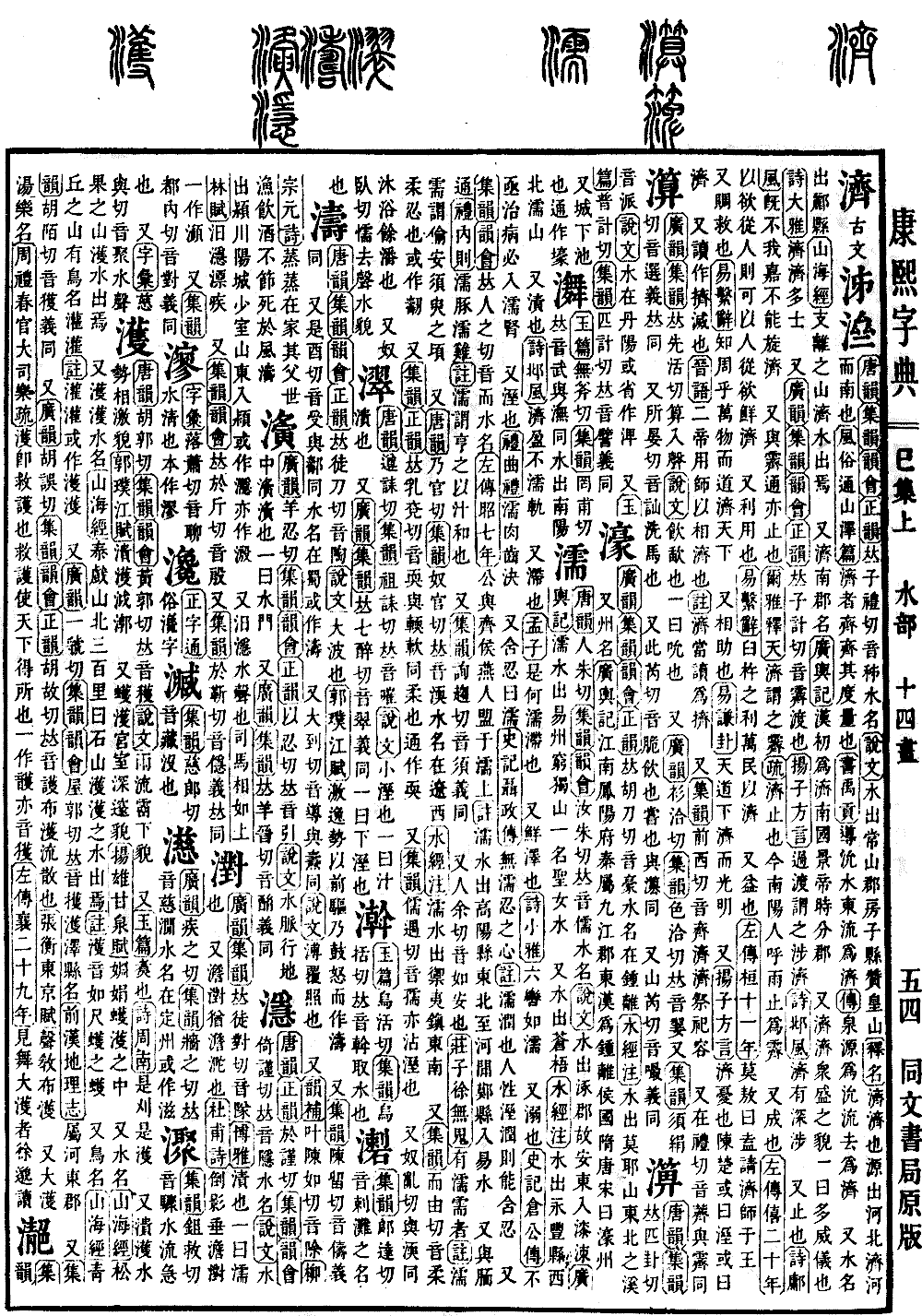
Si Collection, Upper Volume
Radical: Water (shuǐ)
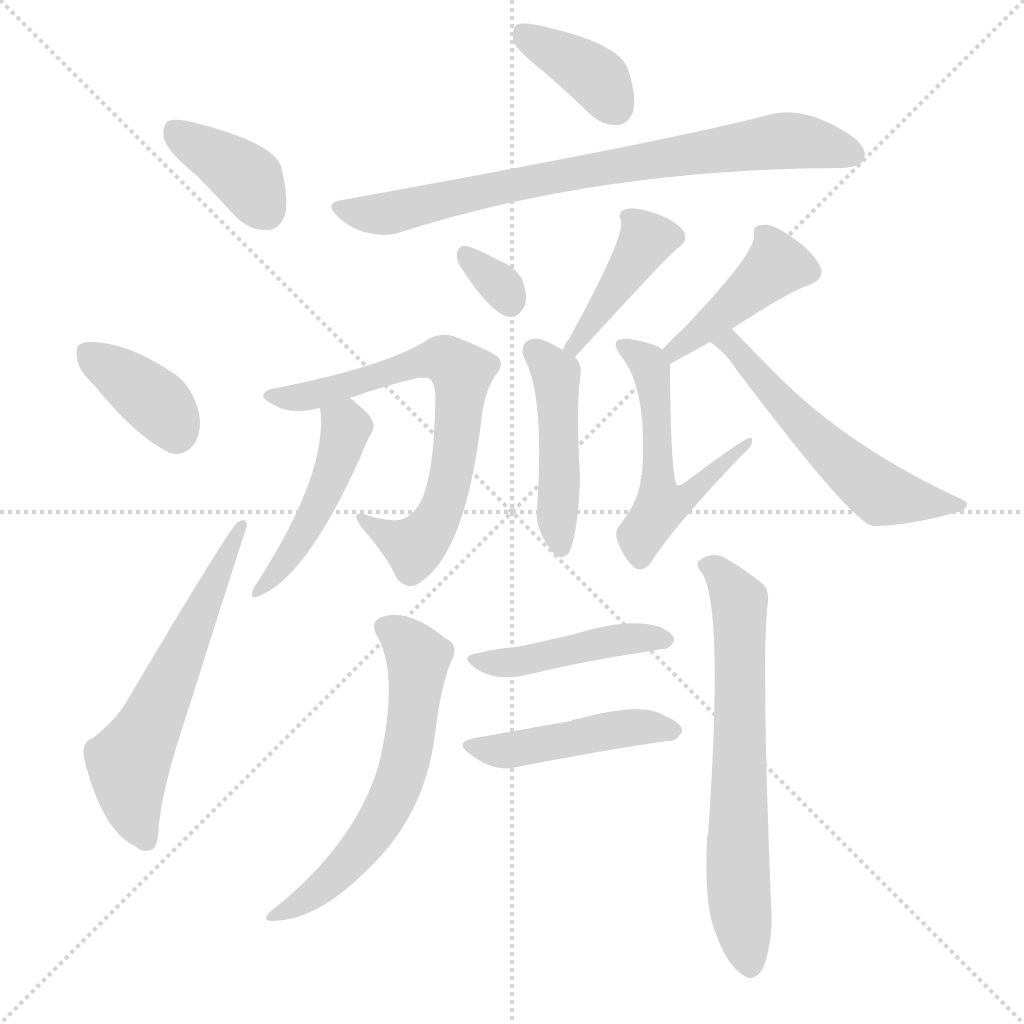
Ji
Kangxi stroke count: 18
Page 656, Entry 01
Archaic form: Ji
Pronounced zi (rising tone). Name of a river.
Shuowen (Explaining Graphs and Analyzing Characters): The river originates from Zanhuang Mountain in Fangzi County, Changshan Commandery.
Shiming (Explanation of Names): Ji means to regulate, as the source flows from the north of the Yellow River and moves southward.
Fengsu Tong (Comprehensive Customs), section on Mountains and Marshes: Ji means to regulate, regulating measures and standards.
Book of Documents (Shangshu), Tribute of Yu: It guides the Yan River, flowing east to become the Ji River.
Commentary: The source is called Yan, and as it flows away it is called Ji.
Also the name of a river originating from Li County.
Classic of Mountains and Seas (Shanhaijing): The Ji River originates from Zhili Mountain.
Also Jinan, name of a commandery.
Guangyu Ji (Record of the Extensive Territory): Early Han dynasty was the Jinan State, divided into a commandery during the reign of Emperor Jing.
Also the appearance of a numerous and flourishing crowd. One source says it means having many dignified manners.
Book of Odes (Shijing), Great Odes: Numerous are the many gentlemen.
Pronounced ji (falling tone). To cross.
Yangzi Fangyan (Regional Dialects): Crossing is called sheji.
Book of Odes (Shijing), Odes of Bei: To cross, whether shallow or deep.
Also to stop.
Book of Odes (Shijing), Odes of Yong: Since you do not favor me, I cannot return or stop.
Also synonymous with ji (to clear up, as weather). Also means to stop.
Erya (Approaching Elegance), Explaining Heaven: Ji is called ji.
Commentary: Ji means to stop. Now, people in Nanyang call the stopping of rain ji.
Also to complete.
Zuo Commentary (Zuozhuan), 20th year of Duke Xi: If one wishes to follow others, it is acceptable, but if one follows one's desires by using others, success is rare.
Also to utilize.
Book of Changes (Yijing), Appended Remarks: The benefit of the mortar and pestle, by which the myriad people are helped.
Also to benefit.
Zuo Commentary (Zuozhuan), 11th year of Duke Huan: Mo Ao said: Why not request relief troops from the King.
Also to provide relief.
Book of Changes (Yijing), Appended Remarks: Knowledge reaches all things, and the Way provides relief to the world.
Also to assist.
Book of Changes (Yijing), Humility Hexagram: The heavenly way descends to assist and shines with light.
Also Yangzi Fangyan (Regional Dialects): Ji means sorrow. In Chen and Chu, some call it shi, others call it ji.
Also read as ji (to push/extinguish). To extinguish.
Discourses of Jin (Jinyu): The two emperors used military force to mutually extinguish each other.
Commentary: Ji should be read as ji (to push).
Pronounced qi.
Ji-ji, the demeanor during sacrificial rituals.
Pronounced ji (falling tone).
Same as ji (to clear up).