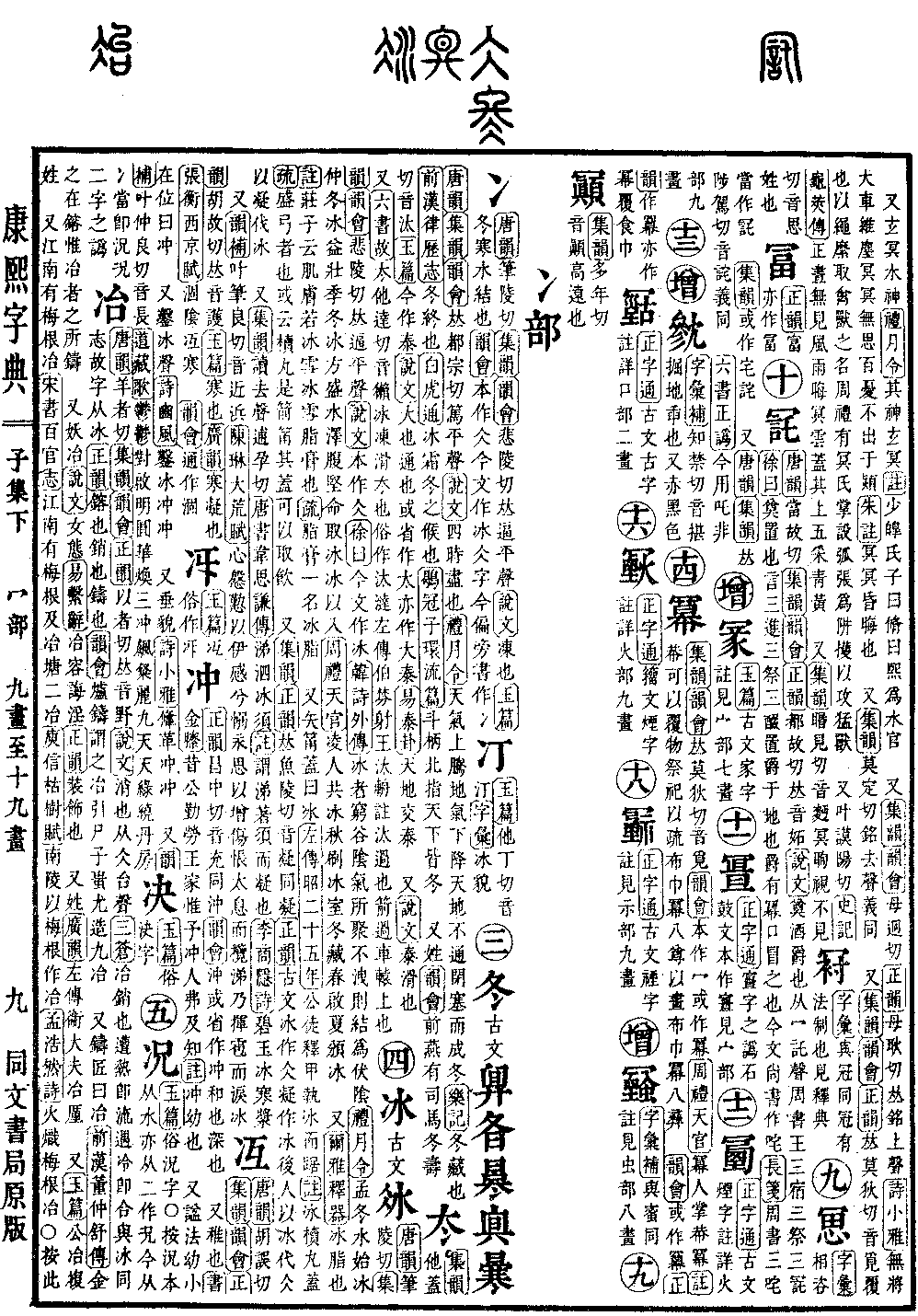
Zi Collection, Page Position: Lower. Radical: Ice (bing). Character: Jue. Kangxi Stroke Count: 8. Page 131, Number 29.
Jade Chapters (Yupian) states this is a common form of the character jue.
Jue. Broad Rimes (Guangyun), Collected Rimes (Jiyun), and Collected Rhymes (Yunhui) all give the fanqie pronunciation gu plus xue, pronounced the same as jue.
1. Name of a river. The Classic of Water (Shuijing) records that the Jue River originates from Mount Dabie (Dabie Shan) in the south of Yulou County, Lujiang Commandery. The commentary states that it is commonly called Mount Tanshan (Tanshan Xian), which is likely an alias for Mount Dabie. This water winds along the mountains through the county and flows northwest past the old city of Liao County, where the Guan River flows into it. Therefore, the Treatise on Geography (Dilizhi) states that the Jue River flows north into the Liao River and joins the Guan River, while the Guan River also joins the Jue River in Liao County. There is also Juejue, which is the name of a northern river. The Classic of Mountains and Seas (Shanhaijing) records that at Mount Longhou (Longhou Shan), the Juejue River originates and flows east into the Yellow River.
2. Refers to dredging or the flowing of water. The Book of Master Guan (Guanzi) in the chapter Monarch and Ministers, Part 2 (Junchen Xia) says that to dredge it is to make it flow, and to block it is to make it stop. The Commentary of Zuo (Zuo Zhuan) in the 31st year of Duke Xiang says that it is better to make a small opening to let it flow.
3. Refers to judgment or decision. The Book of Rites (Liji) in the Summary of Rules of Propriety (Quli) says that rites are used to determine relations and judge matters of doubt. It also says that in disputes and litigation, without rites, no decision can be made.
4. Also refers to biting off something with the teeth. The Book of Rites in the Summary of Rules of Propriety says that moist meat is bitten through with the teeth, but dried meat is not bitten through. The Rites of Zhou (Zhouli) in the Record of Artificers (Kaogongji) says that the woodworkers (ziren) make bird-shaped vessels with pointed and open beaks. The sub-commentary states that since birds have long beaks and use the part near the root to peck things open, it is called juewen. Jue is pronounced in its original tone, and also as wu plus xue.
5. Also refers to opening. The Book of Etiquette and Ceremonial (Yili) in the District Archery Ritual (Xiangsheli) says to bare the left arm and put on the thumb ring and arm guard. The commentary says that jue is like kai, meaning to open. It is made of ivory and worn on the right thumb to hook and release the bowstring. Kai is pronounced like kai. The Classic of Poetry (Shijing) in the Minor Odes (Xiaoya) says that the thumb ring and arm guard are prepared.
6. Also refers to parting ways, same as the character jue. The Book of the Former Han (Qianhanshu) in the Biography of Su Wu records that Li Ling and Su Wu bid farewell and parted. The commentary says that jue means to separate.
7. Juecao, an official title for an official in charge of criminal law. The Book of the Later Han (Houhanshu) in the Biography of Huang Chang records that he was well-versed in legal statutes and served as a judicial officer (juecao) in the commandery.
8. Also, Broad Rimes, Collected Rimes, and Correct Rimes (Zhengyun) give the fanqie pronunciation hu plus xue, pronounced the same as xue. It describes a state of being swift, or according to one theory, the appearance of a small bird flying. It is interchanged with the variant form xue. The Zhuangzi in the chapter Free and Easy Wandering (Xiaoyaoyou) says that it suddenly flies up and heads for the elm and sandalwood trees. Jue is sometimes also written in a variant form pronounced xue.
9. Also, Collected Rimes gives the fanqie pronunciation ku plus xue, pronounced the same as que. It is the same as the character for missing or gap (que). It is sometimes written in a variant form with the blood (xue) radical, and also written as jue. The Records of the Grand Historian (Shiji) in the Annals of Qin Shi Huang (Qin Shi Huang Benji) says that it is like driving six steeds across a gap.
10. Also pronounced juan plus hui, pronounced the same as gui. it describes a state of being swift. The Zhuangzi in the chapter On the Equality of Things (Qiwulun) says that elk and deer will run away swiftly upon seeing it. The commentary says that jue is pronounced by Xu Miao as gu plus hui.