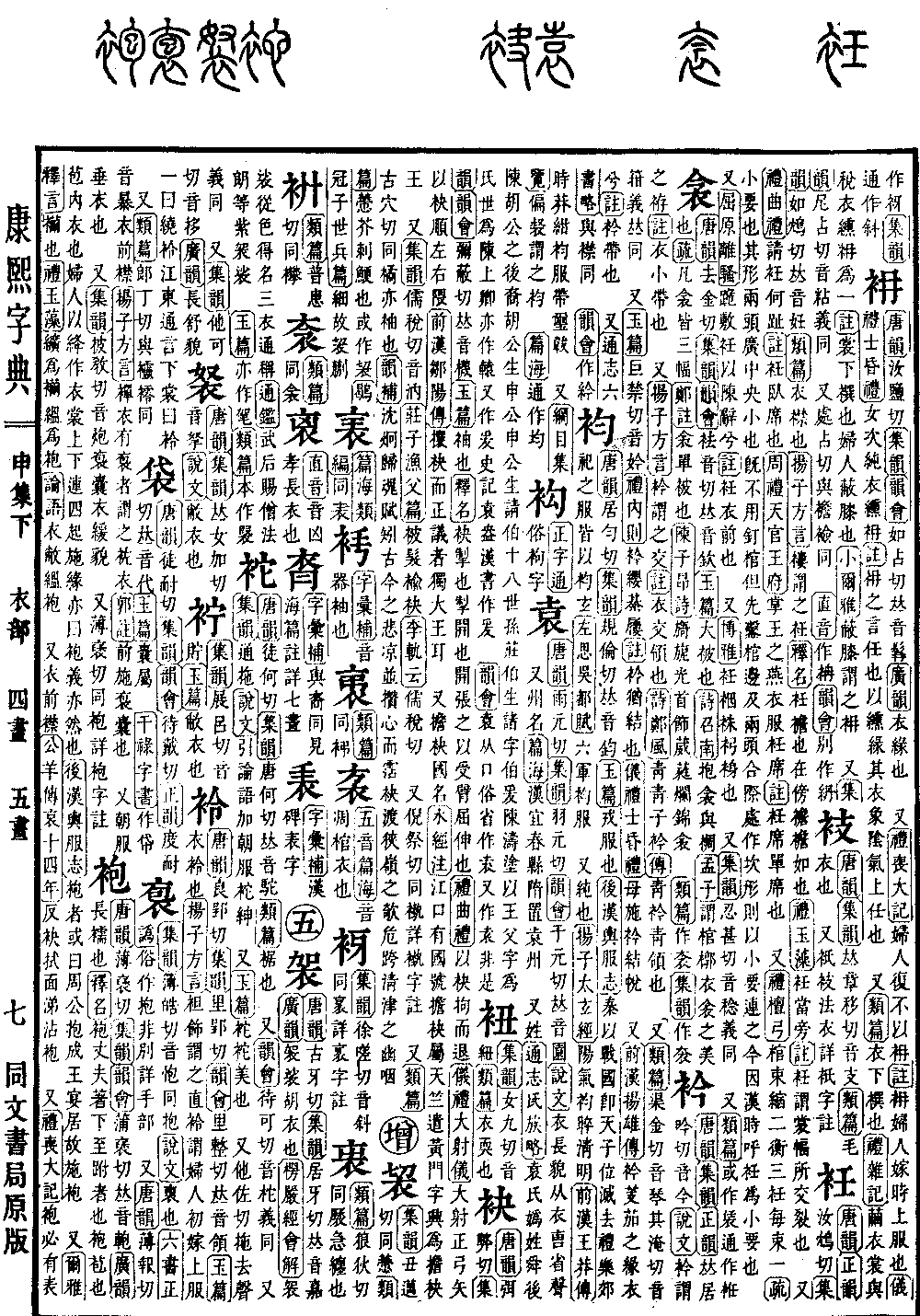
Shen Collection, Lower Volume
Radical: Clothing (yī)
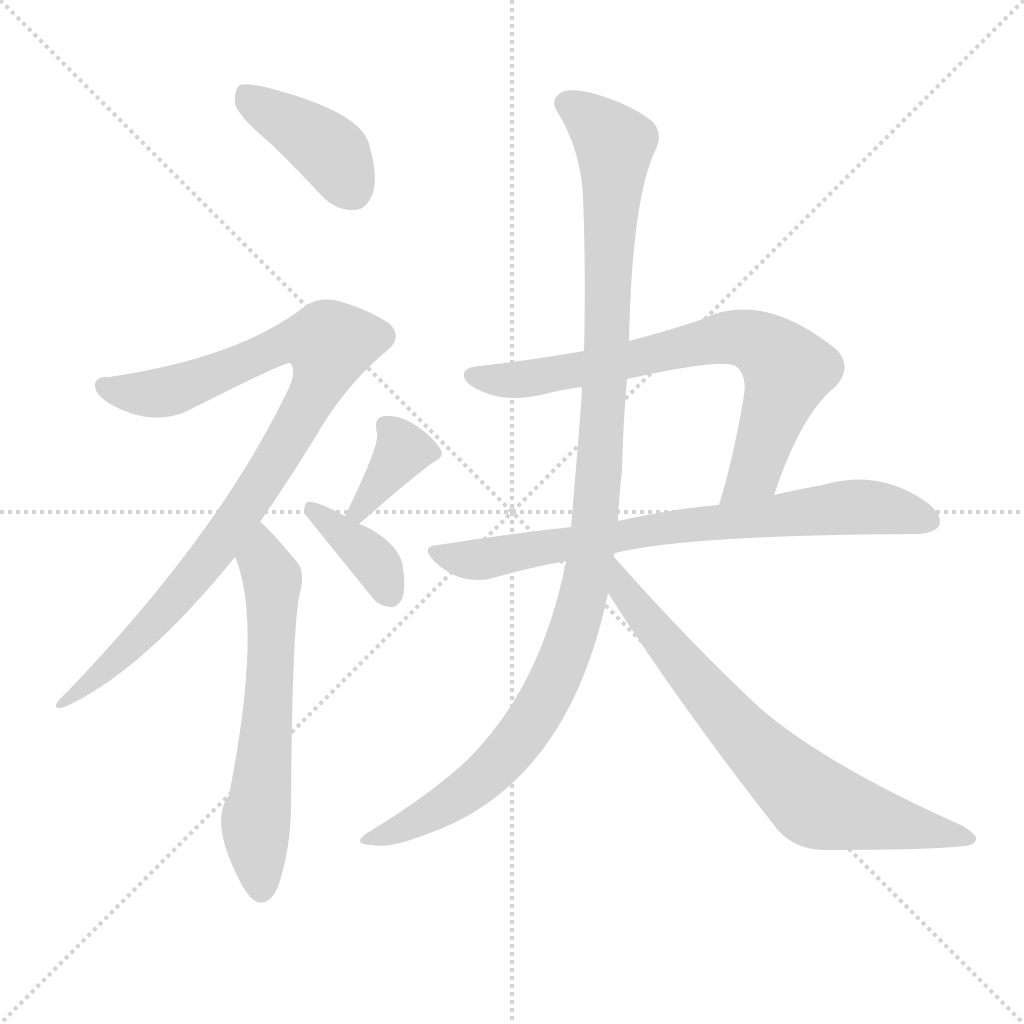
袂
Kangxi Stroke Count: 10
Page 1113, Entry 10
Pronounced mie (falling tone).
Jade Chapters (Yupian): The sleeve.
Explanation of Names (Shiming): The term mei (sleeve) refers to the act of pulling. Pulling means opening. One spreads the sleeve open to allow the arm to bend and stretch.
Book of Rites (Liji), Songs of Propriety (Quli): Using the sleeve to cover oneself while retreating.
Book of Etiquette and Ceremonial (Yili), Great Archery Rites (Dasheyi): The official in charge of archery wipes along the left and right nocks of the bow with his sleeve.
History of the Former Han (Qianhan Shu), Biography of Zou Yang: The only one who rolls up his sleeves to speak candidly is you, Great King.
Also Danmei, which is a country name.
Commentary on the Water Classic (Shuijing Zhu): There is a country at the mouth of the river named Danmei, belonging to India. An imperial attendant named Zixing was dispatched to serve as the King of Danmei.
Pronounced rui (falling tone).
Zhuangzi, The Fisherman (Yufu): With hair disengaged and sleeves waving.
Explanation of the Text (Shiwen): The character mei, Li (Gui) reads as rui.
Pronounced ni (falling tone). Same as the character ni. See the entry for ni for details.
Pronounced xue (rising tone). Same as the character. Also signifies a sleeve.
Supplement to the Rhymes (Yunbu): Shen Jiong, Rhapsody on the Returning Soul: How much more so for the desolation of past and present, all gathered in the heart and moistening the sleeves. Crossing the tilted, perilous cliffs of steep mountains, passing over the deep sobbing of clear fords.
Textual Research:
Zhuangzi, The Fisherman: Disheveled hair and waving sleeves.
Li Gui states: Read as rui. According to the original text, the word yu has been changed to yu. Li Gui states the pronunciation as rui, which has been corrected in the Explanation of the Text (Shiwen).