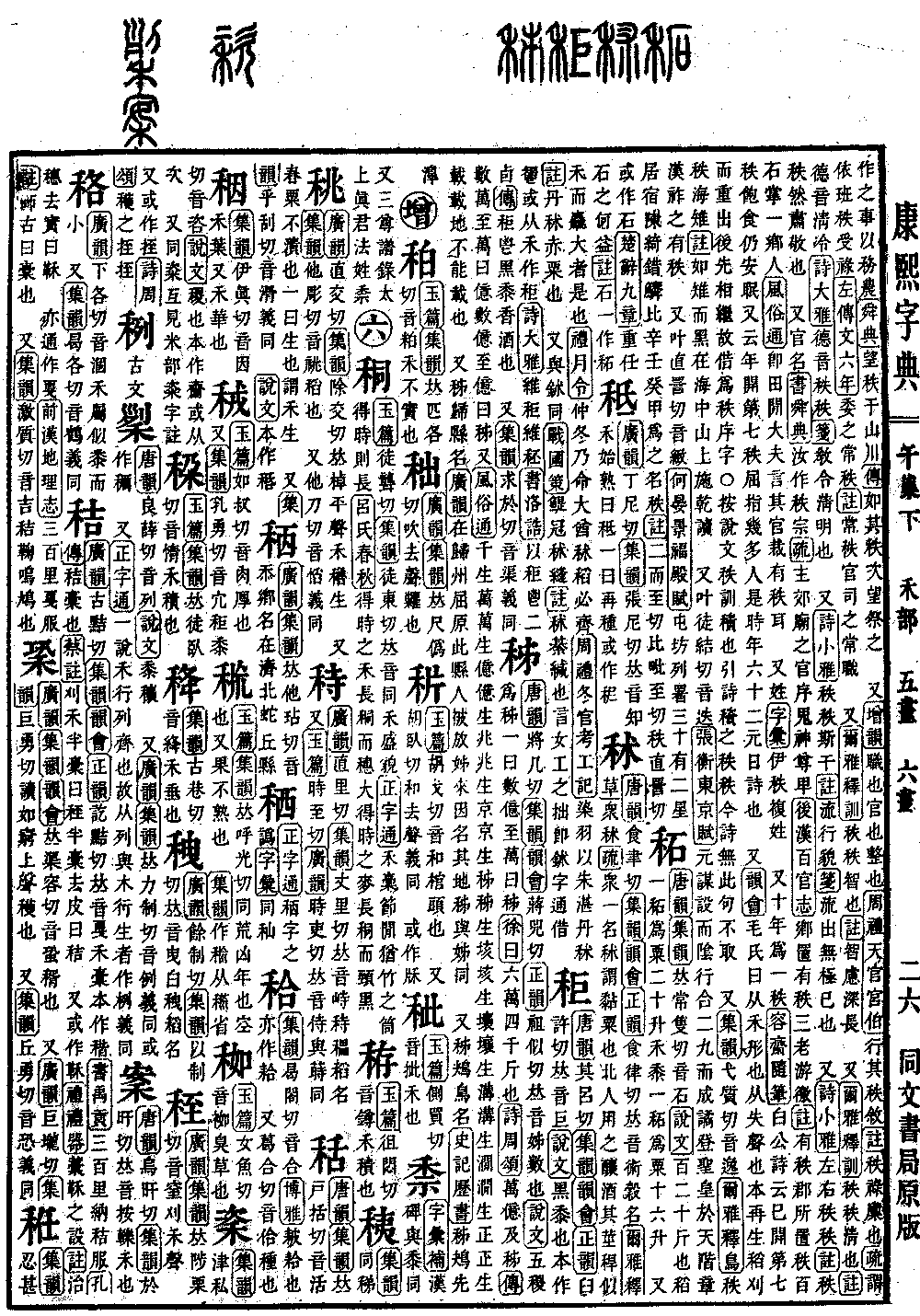
Wu Collection, Lower Volume
Radical: Grain (hé)
Kangxi Strokes: 11
Page 852, Entry 33
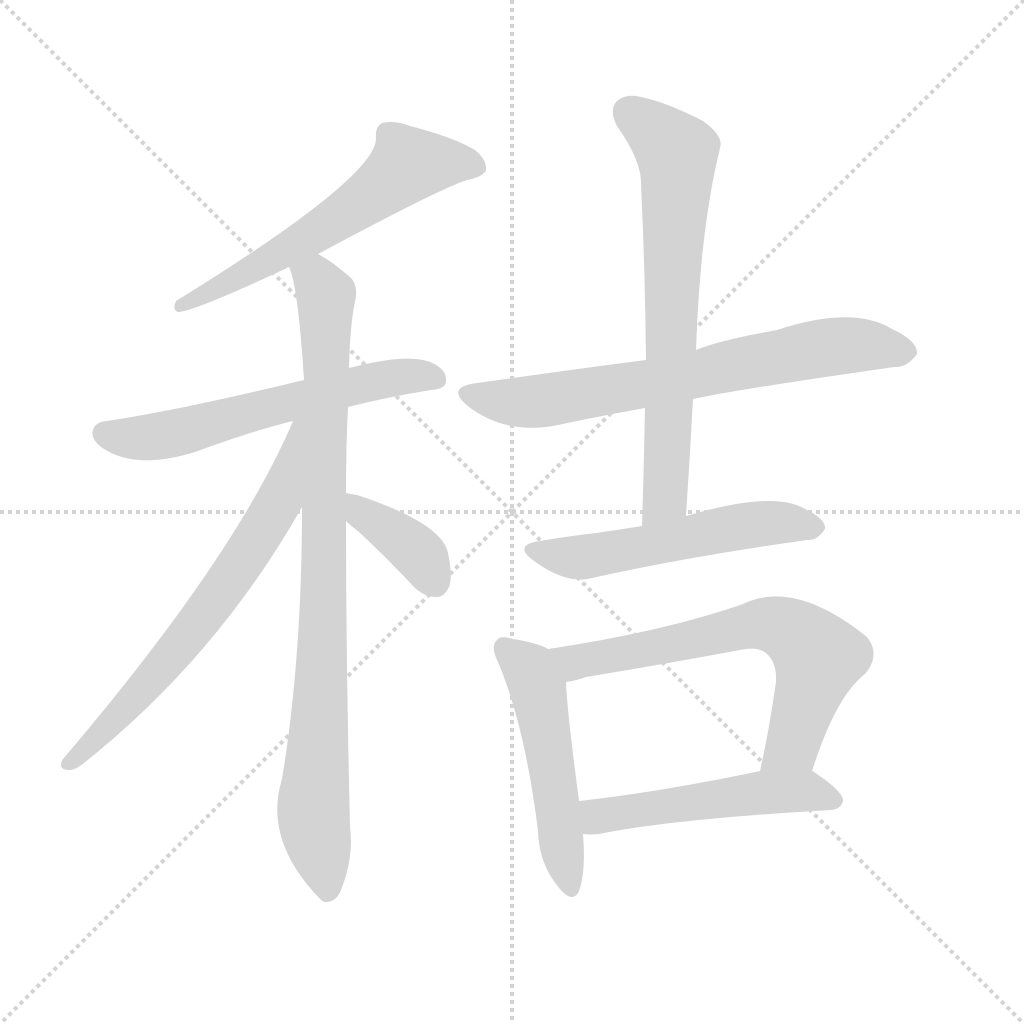
According to the Expanded Rhymes (Guangyun), it is pronounced jia. According to the Collected Rhymes (Jiyun), the Rhyme Assembly (Yunhui), and the Correct Rhymes (Zhengyun), it is pronounced jia. The stalks of grain. Originally written as jie.
In the Book of Documents (Shujing), within the Tribute of Yu (Yu Gong), it is written: Three hundred li away, they pay the tax in the form of grain stalks (jie fu).
According to the Commentary by Kong Anguo: Jie means stalks.
According to the Commentary by Cai Chen: Cutting grain halfway up the stalk is called zhi. Removing the outer layer of the half-stalk is called jie.
Sometimes written in a variant form (ge).
In the Book of Rites (Liji), within the Vessel of Rites (Liqi), it is written: The arrangement of straw (gao ge).
According to the Commentary: Treating the ears of grain and removing the seeds is called ge.
It is also commonly written as jia.
In the History of the Former Han (Qian Hanshu), within the Treatise on Geography (Dili Zhi), it is written: Three hundred li away, they pay the tax in the form of grain stalks (jia fu).
According to the Commentary by Yan Shigu: This means stalks.
Also, according to the Collected Rhymes (Jiyun), it is pronounced ji. Jieju is a type of pigeon.