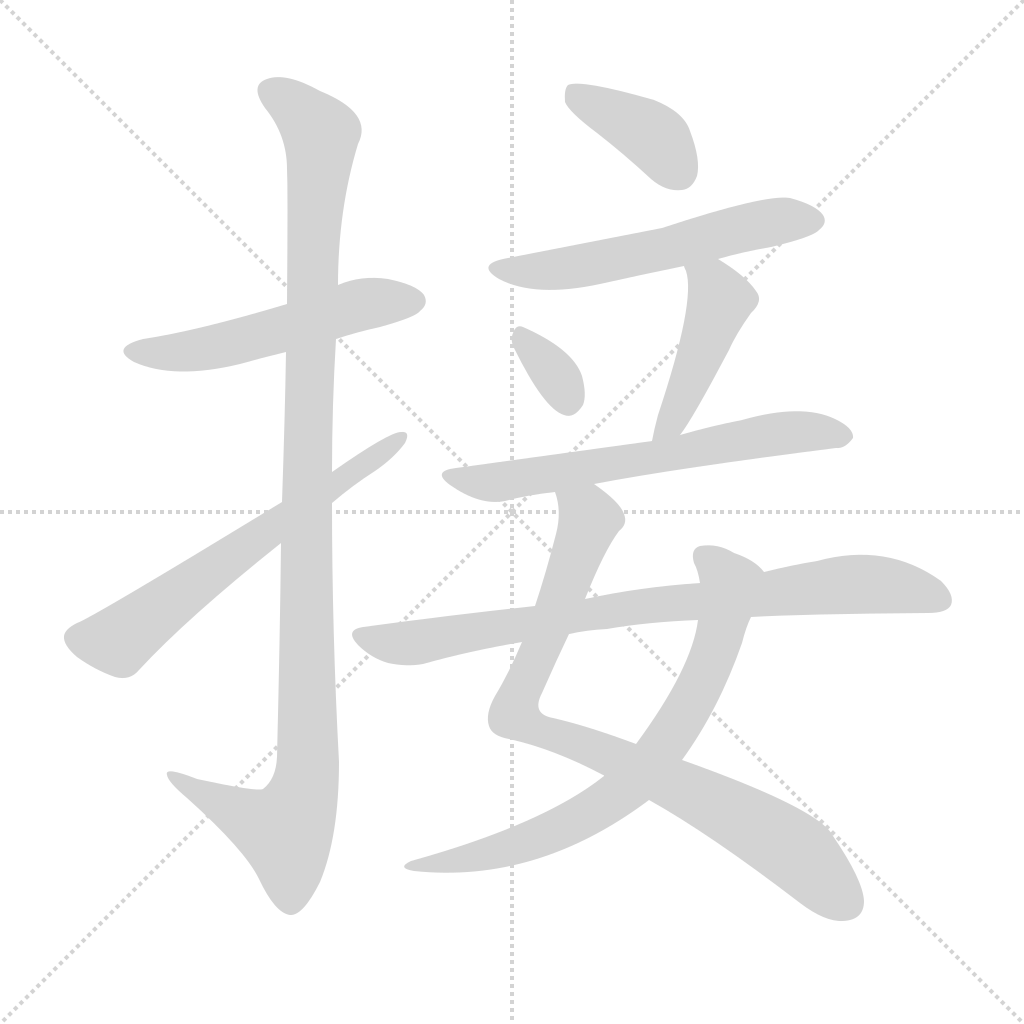
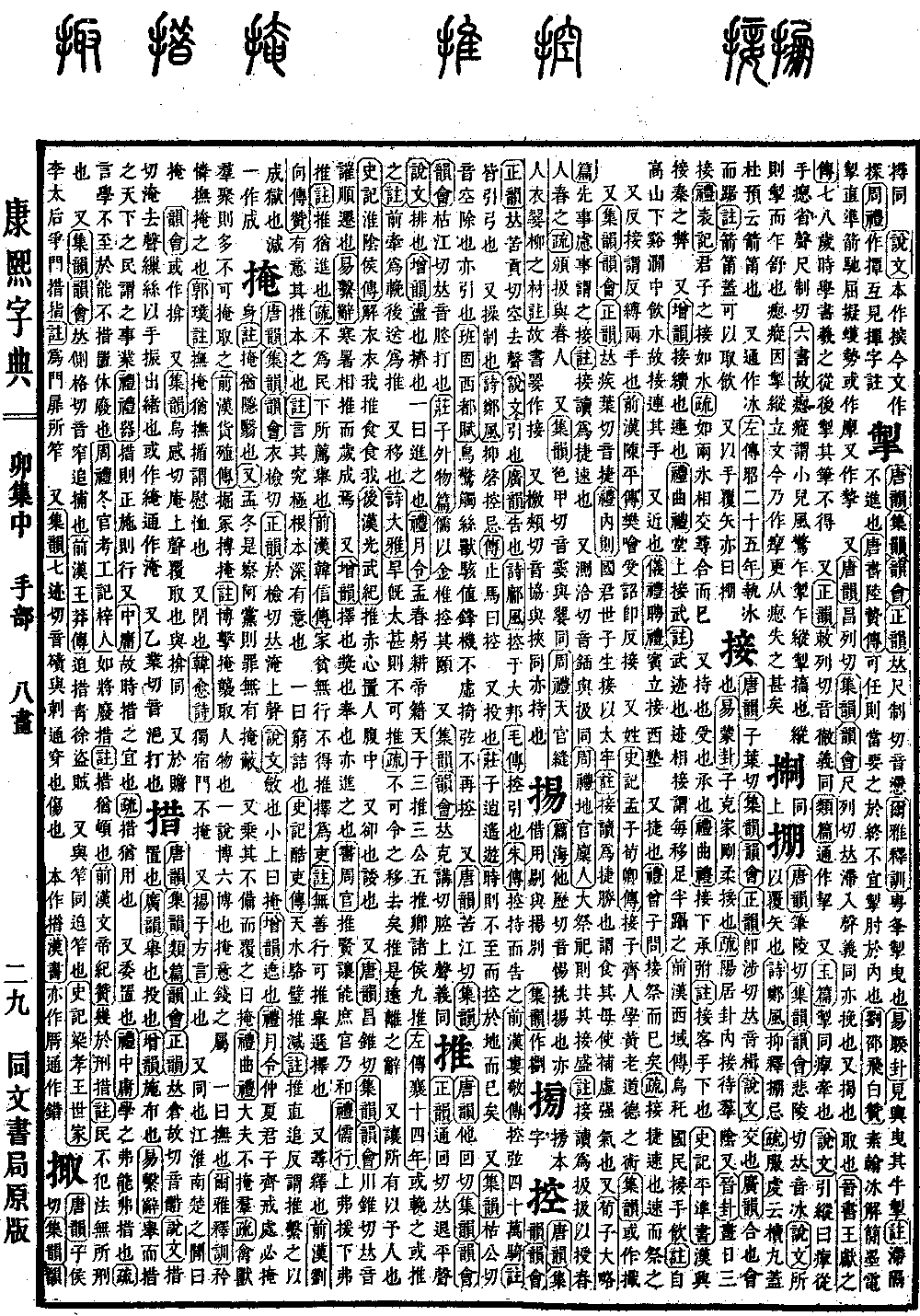
Mao Collection, Middle Volume. Radical: Hand (shǒu). Kangxi strokes: 12. Page 439, Entry 04.
Pronounced jie.
According to the Tang Rhyme (Tangyun), the Jiyun, the Rhyme Collection (Yunhui), and the Correct Rhymes (Zhengyun), it is pronounced jie.
According to the Explaining Graphs and Analyzing Characters (Shuowen), it means to intersect. According to the Broad Rhyme (Guangyun), it means to join or to meet.
In the Book of Changes (Yijing), regarding the Meng hexagram: "The son can manage the family, because the firm and the yielding meet." The sub-commentary states: "The yang resides within the hexagram to receive and meet with the various yin."
Also, in the Jin hexagram: "Three meetings during the daylight hours."
In the Book of Rites (Liji), in the chapter Record of Clothing (Biaoji): "The interaction of a superior person is like water." The sub-commentary states: "Like two streams of water intersecting and simply merging together."
Also means to hold, to receive, or to sustain. In the Book of Rites (Liji), in the chapter Summary of the Rules of Proprietary (Qu-li): "To receive an inferior and hold the bow-grip." The commentary notes: "To receive the guest beneath one's hand."
In the Records of the Grand Historian (Shiji), in the Treatise on the Balancing of Standards (Pingzhunshu): "When the Han dynasty arose, it inherited (received) the corruptions of the Qin."
According to the Added Rhymes (Zengyun), it means to continue or to connect.
In the Book of Rites (Liji), in the chapter Summary of the Rules of Proprietary (Qu-li): "On the hall, one's steps should connect." The commentary notes: "Wu refers to footprints. When footprints connect, it means that with every step, one treads upon half of the previous footprint."
In the History of the Former Han (Qianhan), in the Account of the Western Regions: "The people of Wucha drink by connecting their hands." The commentary notes: "They go down from high mountains to drink water in the streams, hence they connect their hands."
Also means to be near. In the Book of Etiquette and Ceremonial (Yili), in the chapter Record of Envoys (Pinli): "The guest stands near the western lodge."
Also means quick. In the Book of Rites (Liji), in the chapter Questions of Zengzi (Zengzi wen): "Simply make the sacrifice quick." The sub-commentary states: "Jie means quick and rapid. Sacrifice with speed."
Also, "reverse-binding" refers to binding both hands behind the back. In the History of the Former Han (Qianhan), in the Biography of Ping: "Fan Kuai received the order and was immediately bound with hands behind his back."
Also a surname. In the Records of the Grand Historian (Shiji), in the Biography of Mengzi and Xun Qing: "Jie Zi, a man from Qi, studied the arts of the Yellow Emperor and Laozi regarding the Dao and Virtue."
According to the Jiyun, it is sometimes written in a variant form (xie).
Also pronounced jie.
In the Book of Rites (Liji), in the chapter Record of Internal Affairs (Neize): "When the son of a feudal lord is born, he is nourished with a sacrificial ox." The commentary notes: "Jie is read as jie, meaning to prevail or to improve. It refers to feeding the mother to supplement her weakness and strengthen her vitality."
Also, in the Xunzi, in the chapter Great Summary (Dalue): "To consider matters before they arise is called jie." The commentary notes: "Jie is read as jie, meaning quick."
Also pronounced cha. Same as the character (cha).
In the Book of Rites of Zhou (Zhouli), in the Earth Officials section concerning the Granary Official (Linren): "During great sacrifices, provide the grain for the ritual vessels." The commentary notes: "Jie is read as cha, meaning to gather up. Gather it to hand over to the spring officials to husk." The sub-commentary states: "Distribute the gathered grain to the spring officials."
According to the Jiyun, also pronounced sha. Same as the character (sha).
In the Book of Rites of Zhou (Zhouli), in the Heaven Officials section concerning the Seamstress (Fengren), in the commentary regarding the materials for the fan-like ornaments on clothing: "In the old text, the character sha was written as jie."
Also pronounced xie. Same as the character (xie). Also means to hold.