Yin Collection, Upper Volume
Radical: Inch (cùn)
Kangxi Strokes: 11
Page 294, Entry 15
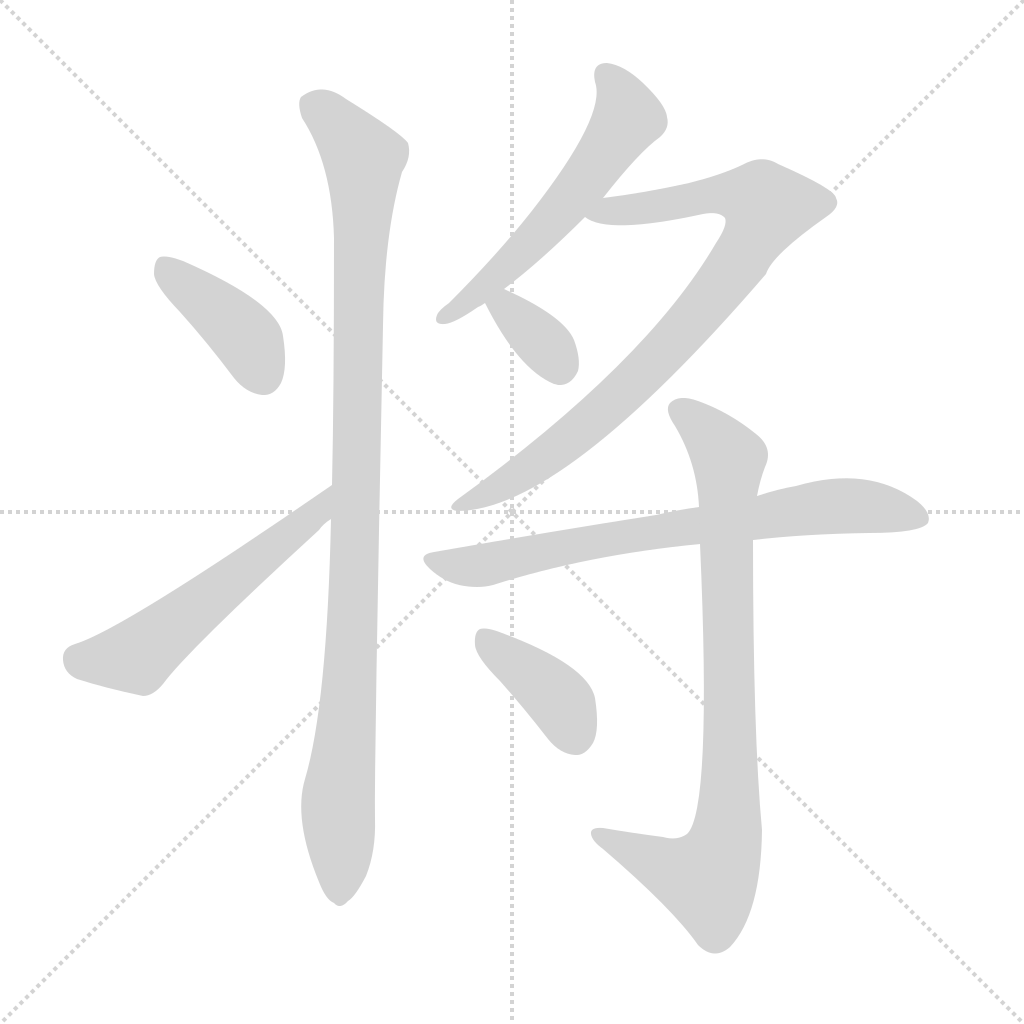
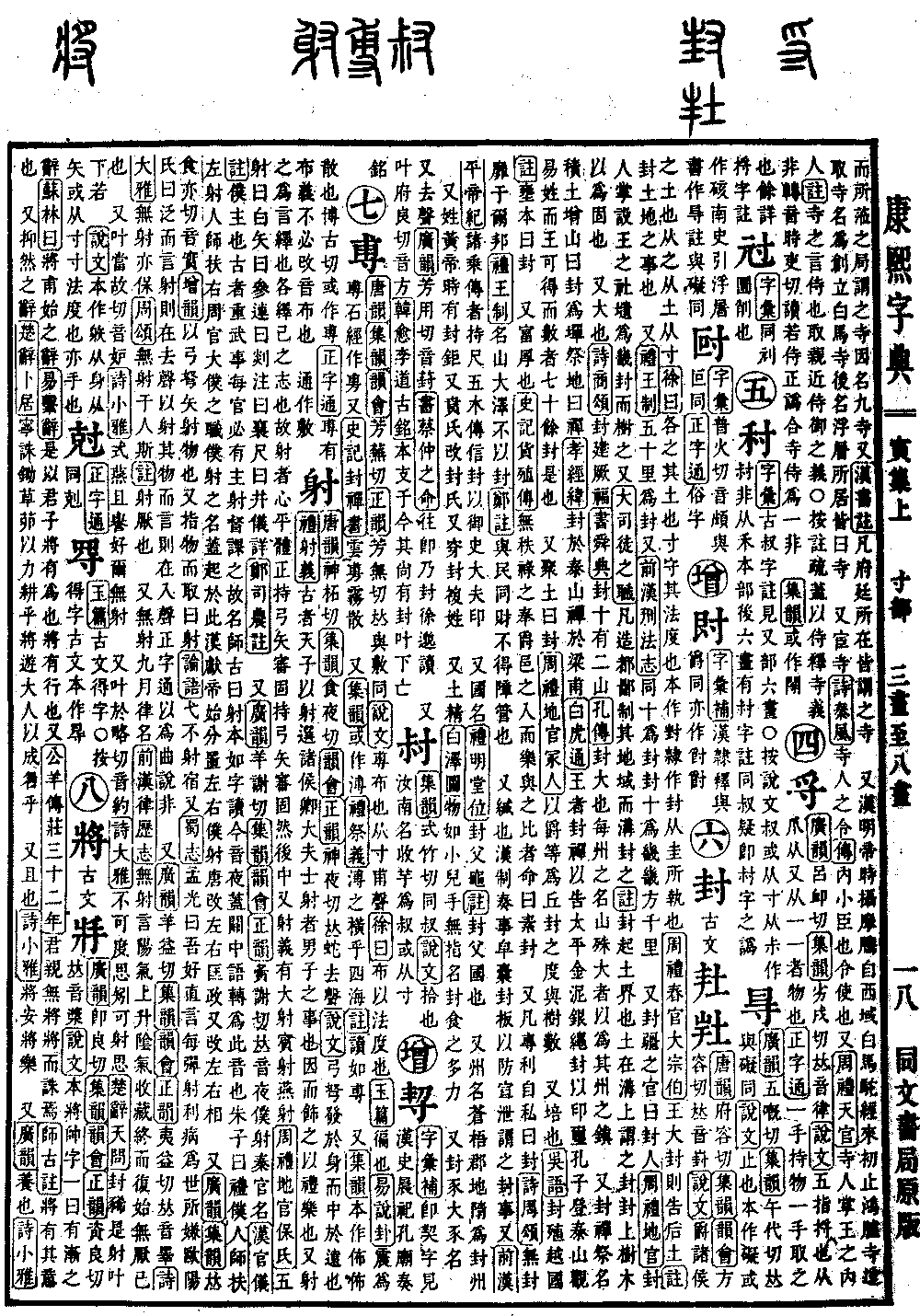
Ancient documentation records: Broad Rimes (Guangyun) states the pronunciation is jiang (level tone). Collected Rimes (Jiyun), Collected Rimes and Phonetic Glossary (Yunhui), and Orthodox Rimes (Zhengyun) state the pronunciation is jiang (level tone), with the same sound as jiang. Analytical Dictionary of Characters (Shuowen Jiezi) explains: Originally, it is the character for a military leader. Another theory suggests it is a word indicating gradual progression. Su Lin says: It means to have just begun. Book of Changes (Yijing), section Appended Remarks (Xici) records: Therefore, when a gentleman is about to do something, he is about to act. Also, Record of the Spring and Autumn Annals (Gongyang Zhuan), 32nd Year of Duke Zhuang records: A ruler and parents cannot be targets of murderous intent; if such intent exists, they must be punished. Master Gu's commentary says: It means to have a certain intent. It also serves as a choice-indicating word, such as or. Songs of Chu (Chuci), Divination (Buju) records: Is it better to hoe the weeds and strive to plow, or to lobby the powerful to achieve fame? It also indicates further or additionally. Book of Odes (Shijing), Lesser Odes of the Kingdom (Xiaoya) records: Both peaceful and happy. Also, Broad Rimes (Guangyun) explains it as to support. Book of Odes (Shijing), Lesser Odes of the Kingdom (Xiaoya) records: No leisure to support my father. It also means to assist. Records of the Grand Historian (Shiji), Biography of Sima Xiangru records: To compensate for errors and assist in achieving virtue. It also means to escort. Book of Odes (Shijing), Odes of Zhao (Zhaonan) records: Use a hundred carriages to escort her. Odes of Bei (Beifeng) records: This girl is marrying, escorting her to a distant place. It also means great. Book of Odes (Shijing), Lesser Odes of the Kingdom (Xiaoya) records: Also extremely significant. Odes of Shang (Shangsong) records: The decree I received from Heaven is vast and long-lasting. It also means to carry, to serve, or to execute. Book of Odes (Shijing), Odes of Shang (Shangsong) records: This is the execution of the descendants of Cheng Tang. Book of Documents (Shangshu), Punitive Expedition of Yin (Yinzheng) records: Now I lead you all to execute the punishment of Heaven. The commentary says: It means to execute. Also, Added Rimes (Zengyun) explains it as to bestow, to hold, or to be with. Orthodox Rimes (Zhengyun) explains it as to support. Book of Odes (Shijing), Lesser Odes of the Kingdom (Xiaoya) records: Do not push that great carriage. Zuo Commentary (Zuozhuan), 21st Year of Duke Zhuang records: The Earl of Zheng supported the King of Zhou and entered through the Yu Gate. It also means to advance. Book of Odes (Shijing), Odes of Zhou (Zhousong) records: Accomplishment daily, advancement monthly. It also means to follow or to accompany. History of the Former Han (Qian Hanshu), Hymns for the Suburban Sacrifices records: The Nine Yi tribes all came to submit and follow. Also, Book of Odes (Shijing), Lesser Odes of the Kingdom (Xiaoya) records: Just when we were robust. The commentary says: It means robust. Also, Songs of Chu (Chuci), Nine Arguments (Jiubian) records: I fear my life will not be long. The commentary says: It means long. Also, Book of Odes (Shijing), Greater Odes of the Kingdom (Daya) records: Beside the Wei River. The commentary says: It means side. It also means to depart. Xunzi, On the Discussion of Rhapsodies (Fulunpian) records: The opportunity is about to pass. The commentary says: Meaning the trend has already departed and cannot return. It is also a surname. In the Later Zhao dynasty, there was a Prefect of Changshan named Jiang Rong. There is also Ganjiang, an ancient sword smith. Zhang Yi says: He was the sword master of the King of Han, and now the sword is called Ganjiang. Also, Collected Rimes (Jiyun) and Orthodox Rimes (Zhengyun) state the pronunciation is qiang (level tone), and Phonetic Glossary (Yunhui) states the pronunciation is qiang (level tone), with the same sound as qiang. It denotes a request, a word expressing hope or solicitation. Book of Odes (Shijing), Odes of Wei (Weifeng) records: Please do not be angry. Lesser Odes of the Kingdom (Xiaoya) records: Requesting the elder to help me. It also describes sound. Book of Odes (Shijing), Odes of Zheng (Zhengfeng) records: The jade ornaments clinked. It also describes a solemn appearance. Book of Odes (Shijing), Greater Odes of the Kingdom (Daya) records: The main gate of the royal palace is solemn and magnificent. It also means to gather. Book of Odes (Shijing), Odes of Zhou (Zhousong) records: The sounds of the stone chimes and pipes are harmonious. Also, Tang Rimes (Tangyun) states the pronunciation is jiang (falling tone), and Phonetic Glossary (Yunhui) and Orthodox Rimes (Zhengyun) state the pronunciation is jiang (falling tone), with the same sound as jiang. Broad Rimes (Guangyun) explains it as a military leader. Added Rimes (Zengyun) explains it as to command. Master Fang's commentary on the Book of Rites (Liji) says: Talent sufficient to manage affairs and overcome them is called a leader (jiang), and wisdom sufficient to guide affairs and walk ahead of them is called a general (shuai). Also, with matching rhyme, it is pronounced jiang (rising tone). Book of Odes (Shijing), Greater Odes of the Kingdom (Daya) records: Heaven does not support me. It rhymes with the word wang in the following line.