Yin Collection, Upper Volume
Radical: Inch (cùn)
Kangxi Strokes: 11
Page 294, Entry 16
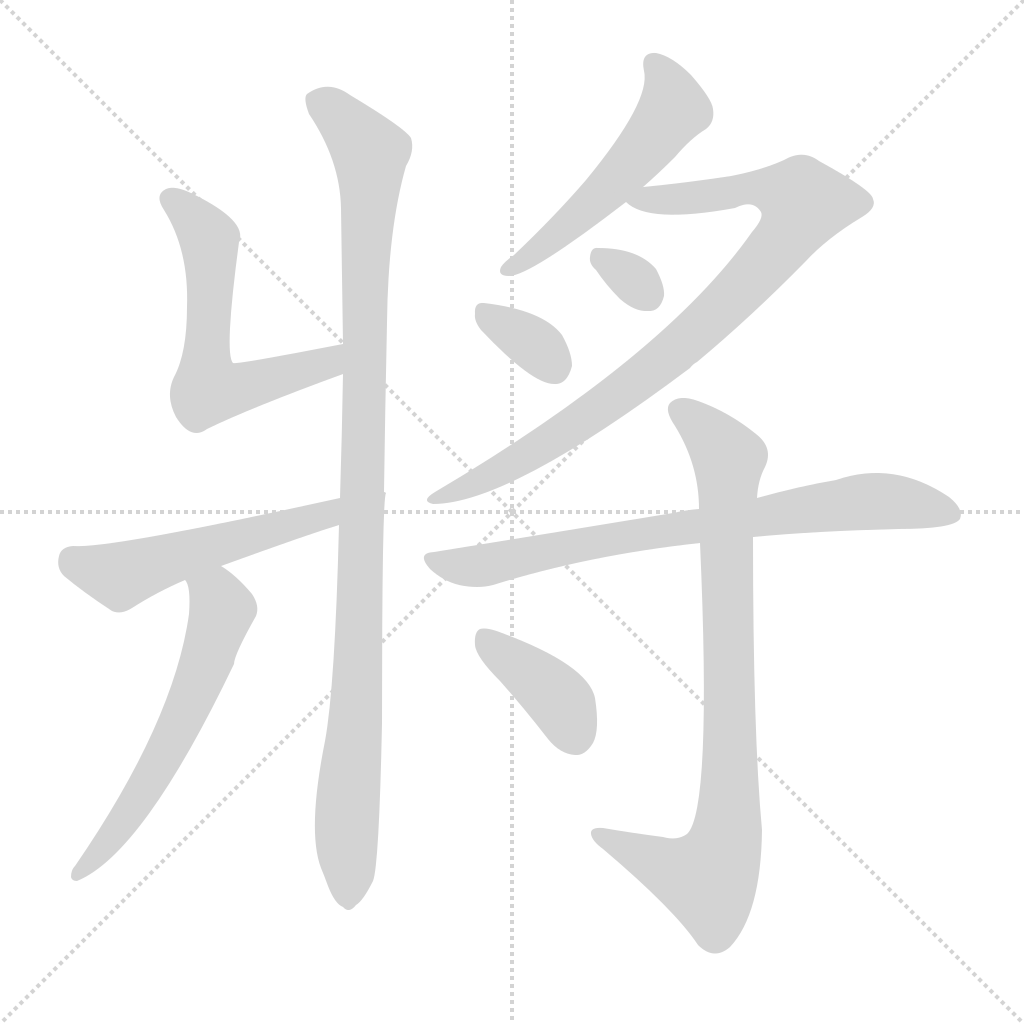
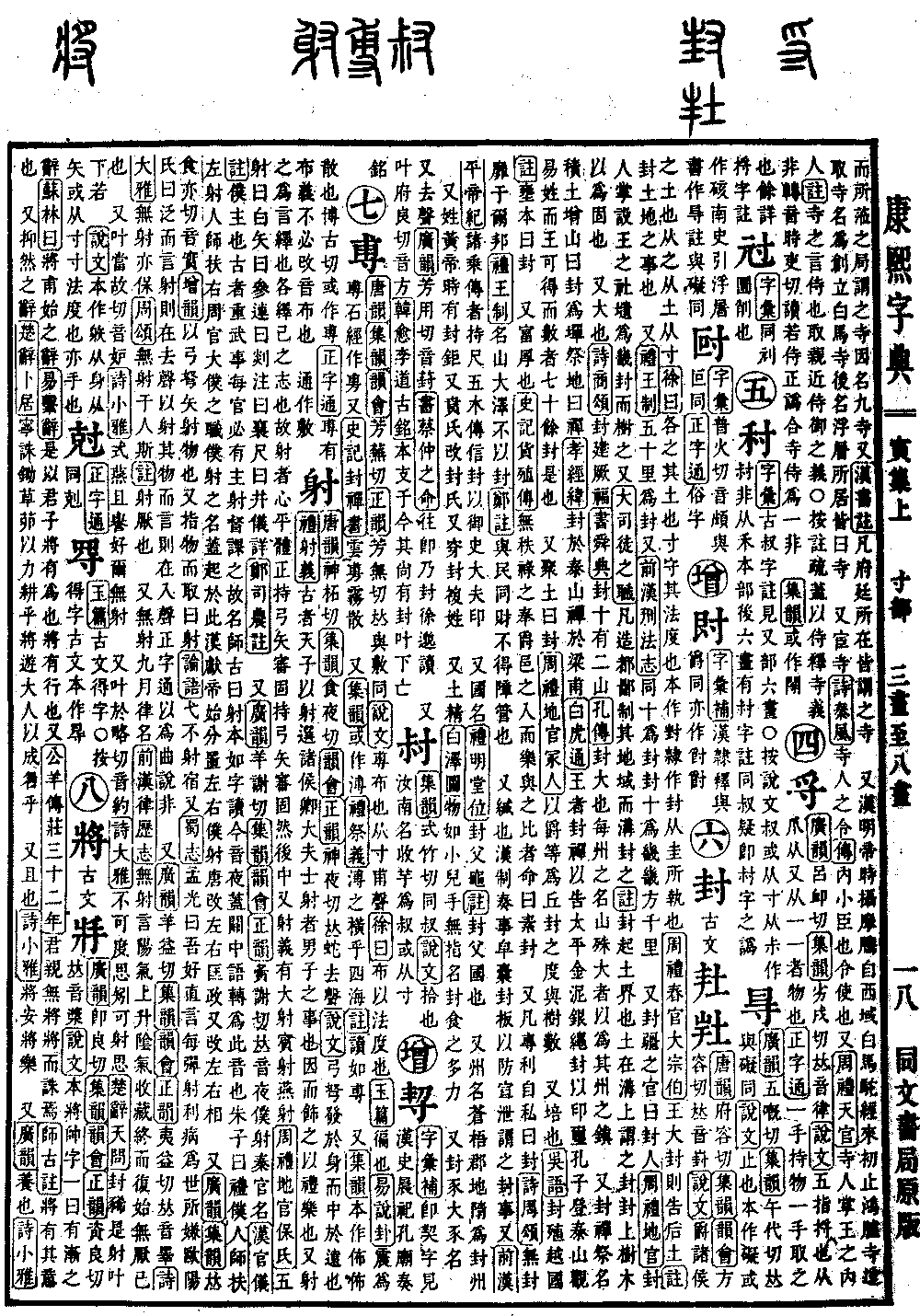
Ancient form. Pronounced jiang. According to the Expanded Dictionary of Sounds (Guangyun), the collected works of rhymes (Jiyun), the compilation of rhymes (Yunhui), and the correct rhymes (Zhengyun), it is pronounced jiang.
According to the Explaining Graphs and Analyzing Characters (Shuowen), this is originally the character for a military leader. It can also function as a modal particle indicating something is about to happen.
Su Lin said: "Jiang" is a modal particle indicating the beginning of an action.
Book of Changes (Yijing), Records of the Appendix: "Therefore, a gentleman is about to undertake something, about to take action."
Also, in the Commentary of Gongyang (Gongyang Zhuan), 32nd Year of Duke Zhuang: "The ruler personally had no intention of usurpation; if there was an intention of usurpation, he would execute them."
Shigu noted: "Jiang" carries this meaning.
It also functions as a transitional modal particle. In the Songs of Chu (Chuci), Divination: "Would one rather pull up weeds and labor in the fields, or go to lobby the powerful and noble to achieve fame?"
It also denotes "furthermore." In the Book of Odes (Shijing), Lesser Odes: "About to be happy and at peace."
Also, according to the Expanded Dictionary of Sounds (Guangyun), it means to provide for. In the Book of Odes (Shijing), Lesser Odes: "No time to provide for one's father."
It also means to help. In the Records of the Grand Historian (Shiji), Biography of Sima Xiangru: "To remedy errors and assist in the completion of virtue."
It also means to see someone off. In the Book of Odes (Shijing), Odes of Shao: "A hundred chariots escorted her." In the Odes of Bei: "This girl is getting married; send her off from afar."
It also denotes "great." In the Book of Odes (Shijing), Lesser Odes: "Also very great." In the Odes of Shang: "I receive the mandate of Heaven, which is vast."
It also means to carry out, practice, or implement. In the Odes of Shang: "The descendants of King Tang carry this out." In the Book of Documents (Shujing), Expedition of Yin: "Now I lead you all to carry out the punishment of Heaven." The commentary states: "Jiang" means to implement.
Also, according to the Additional Rhymes (Zengyun), it means to bestow, to hold, or to accompany. According to the Correct Rhymes (Zhengyun), it means to support. In the Book of Odes (Shijing), Lesser Odes: "Do not push or pull the great carriage." In the Zuo Tradition (Zuo Zhuan), 21st Year of Duke Zhuang: "The Earl of Zheng supported the King of Zhou, entering through the Yu Gate."
It also means to advance. In the Book of Odes (Shijing), Odes of Zhou: "Day by day there is success, month by month there is advancement."
It also means to follow or accompany. In the History of the Former Han (Qianhan), Songs of Suburban Sacrifices: "The nine Yi tribes come as guests to follow."
Also, in the Book of Odes (Shijing), Lesser Odes: "Just when we were at our prime." The note defines it as "prime."
Also, in the Songs of Chu (Chuci), Nine Arguments: "I fear my life will not be long." The note defines it as "long-lasting."
Also, in the Book of Odes (Shijing), Greater Odes: "Beside the Wei River." The note defines it as "side."
It also means to depart. In the Xunzi, Treatise on Odes: "The opportunity is about to pass." The note says it refers to time having passed, unable to be regained.
It is also used as a surname. Hou Zhao, Administrator of Changshan, Jiang Rong.
Also, Ganjiang was an ancient sword-making artisan. Zhang Yi said: "The name of the King of Han's sword master; now swords are called Ganjiang."
Also, according to the Collected Rhymes (Jiyun) and the Correct Rhymes (Zhengyun), it is pronounced qiang. It is a modal particle used in requests or to express hope. In the Book of Odes (Shijing), Odes of Wei: "I request that you do not be angry." In the Lesser Odes: "I request that an elder help me."
It is also an onomatopoeia. In the Book of Odes (Shijing), Odes of Zheng: "The jangling sound of jade pendants."
It also describes a stern and upright appearance. In the Book of Odes (Shijing), Greater Odes: "The gate of the palace is stern and upright."
It also means to gather. In the Book of Odes (Shijing), Odes of Zhou: "The sound of stone chimes and pipes is harmonious."
Also, according to the Tang Rhymes (Tangyun), it is pronounced jiang. According to the Compilation of Rhymes (Yunhui) and the Correct Rhymes (Zhengyun), it is pronounced jiang. According to the Expanded Dictionary of Sounds (Guangyun), it means a general. According to the Additional Rhymes (Zengyun), it means to command. In the Record of Rites (Liji) notes, Master Fang says: "If one's talent is sufficient to control things and surpass them, it is called a general; if one's wisdom is sufficient to lead things and walk in front, it is called a commander."
Also, rhyming with jiang. In the Book of Odes (Shijing), Greater Odes: "Heaven does not support me."