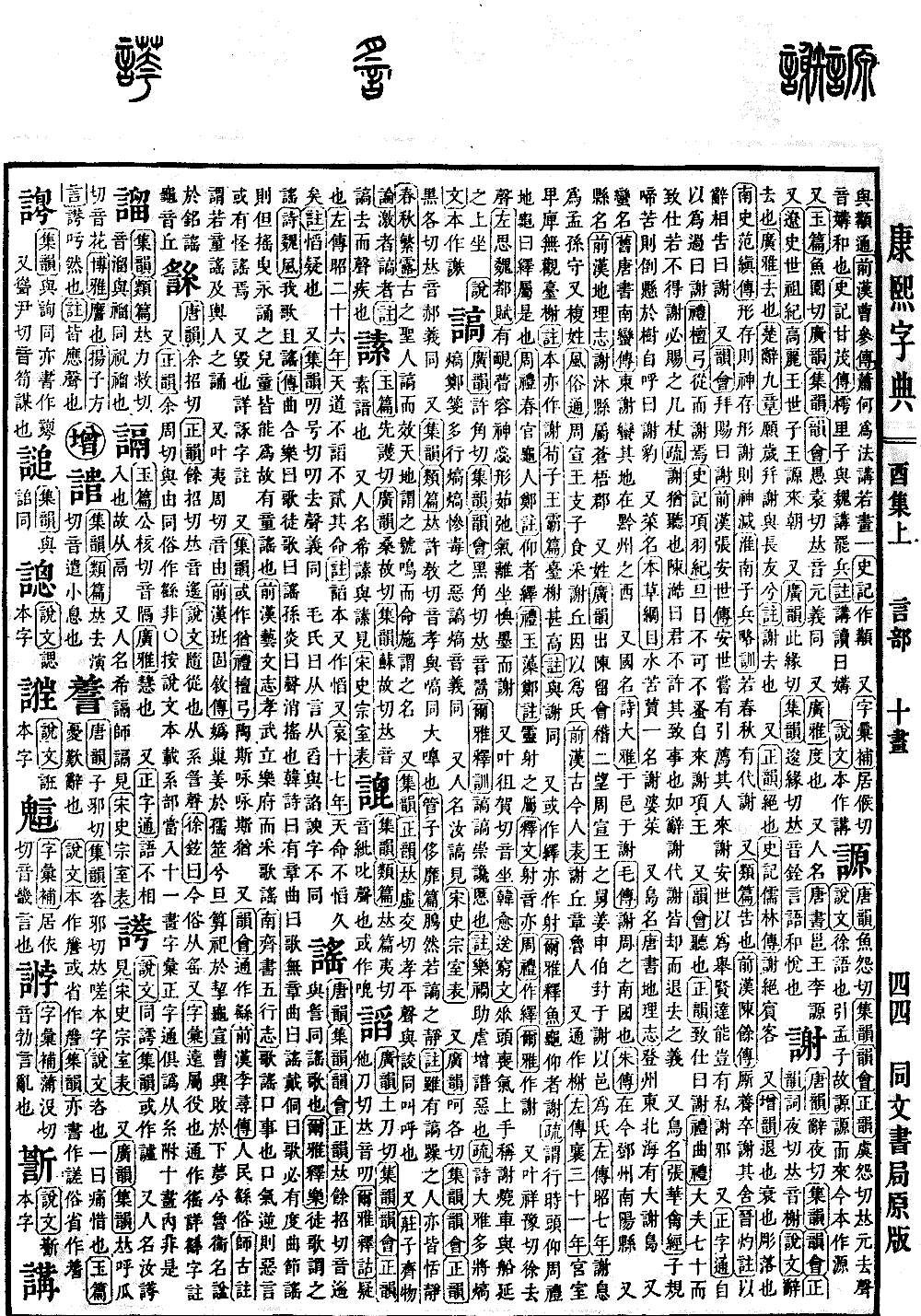
You Collection, Upper Volume
Radical: Speech (yán)
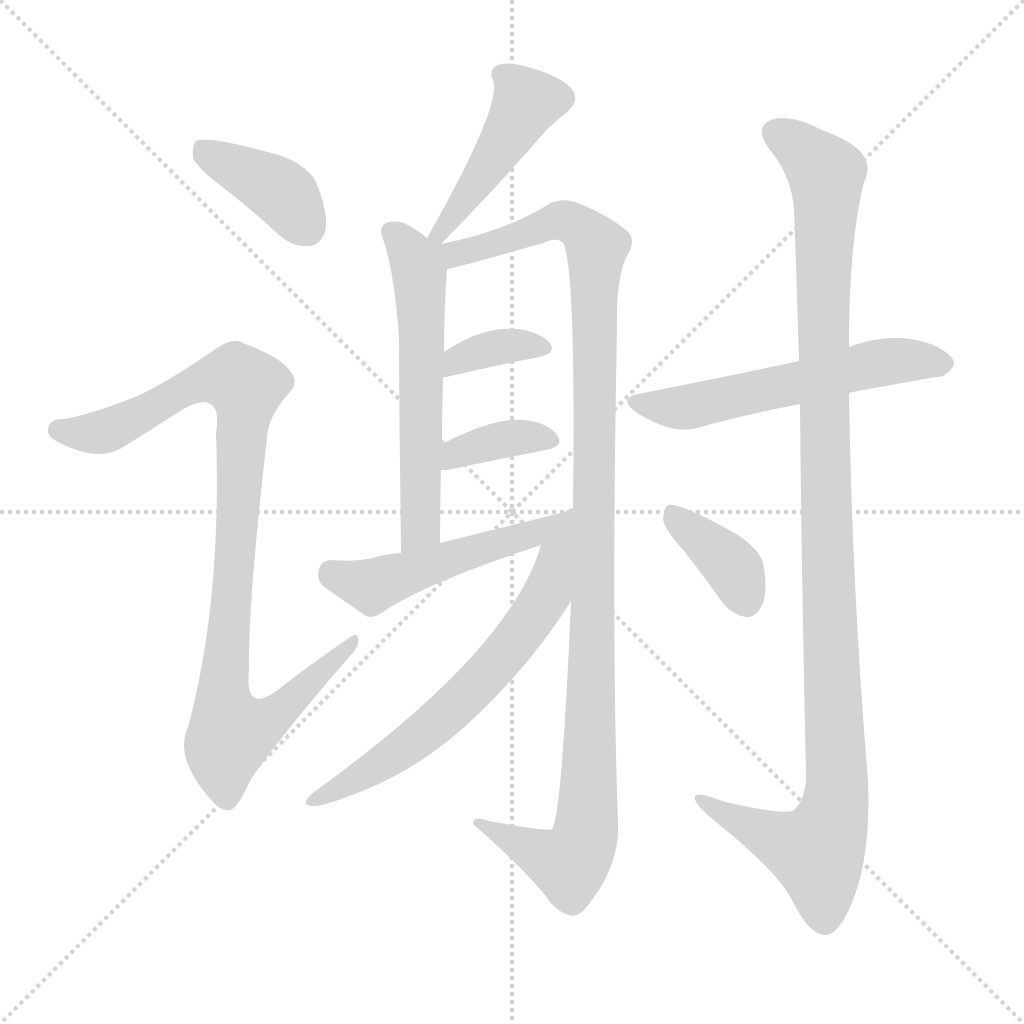
Xie
Kangxi strokes: 17
Page 1176, Entry 12
Tangyun, Jiyun, Yunhui, Zhengyun: Pronounced xie.
Shuowen: To decline and depart.
Guangya: To depart.
Chu Ci (Elegies of Chu), Nine Chapters (Jiuzhang): Wishing to decline the years together and remain friends for a long time. Commentary: Xie means to depart.
Zhengyun: To sever.
Records of the Grand Historian (Shiji), Biographies of Confucian Scholars: To sever ties with guests.
Zengyun: To retreat, to decline, to wither and fall.
History of the Southern Dynasties (Nanshi), Biography of Fan Zhen: If the physical form persists, the spirit persists; if the form withers, the spirit is extinguished.
Huainanzi, Military Strategy (Binglue Xun): Like the seasonal cycle of replacement and decline.
Leipian: To inform.
Book of Han (Hanshu), Biography of Chen Yu: The servant informed his master. Jin Zhuo commentary: Using words to inform one another is called xie.
Yunhui: To express gratitude for a favor is called xie.
Book of Han (Hanshu), Biography of Zhang Anshi: Anshi once offered a recommendation; the person came to thank him. Anshi believed that because he had merely promoted talent and ability, there was no need for personal thanks.
Zhengzitong: To admit one's own fault is called xie.
Book of Rites (Liji), Tan Gong: Following that, he apologized for it.
Records of the Grand Historian (Shiji), Annals of Xiang Yu: Tomorrow morning, one must come early to personally apologize to King Xiang.
Yunhui: To listen/accept.
Zhengyun: To resign from office is called xie.
Book of Rites (Liji), Qu Li: When an official reaches seventy, he should resign from service. If he is not permitted to retire, he must be granted a stool and a staff. Commentary: Xie means to listen. Hao says: The ruler does not permit him to retire. Such instances as declining an invitation or seasonal replacement all convey the meaning of withdrawing and retreating.
Bird name. Zhang Hua, Classic of Birds (Qin Jing): When the cuckoo cries bitterly, it hangs itself upside down on a tree and calls itself xiebao.
Vegetable name. Compendium of Materia Medica (Bencao Gangmu): The water sow thistle is also called xiepo vegetable.
Island name. Book of Tang (Tangshu), Treatise on Geography: To the northeast of Dengzhou in the sea is the Great Xie Island.
Name of a barbarian tribe. Old Book of Tang (Jiutangshu), Records of the Southern Barbarians: The Eastern Xie barbarians; their land is west of Qianzhou.
Name of a state. Book of Odes (Shijing), Daya: In the city of Xie. Mao commentary: Xie is a southern state of the Zhou dynasty. Zhu commentary: Located in present-day Nanyang County, Dengzhou.
Name of a county. Book of Han (Hanshu), Treatise on Geography: Xiemu County, under the jurisdiction of Cangwu Commandery.
Surname. Guangyun: Originates from the two noble lineages of Liu and Kuaiji. King Xuan of Zhou enfeoffed his uncle, Jiang Shenbo, in Xie, who then took the place name as his clan name.
Zuo Tradition (Zuo Zhuan), Seventh Year of Duke Zhao: Xie Xi served as a guard for Mengsun.
Compound surname. Customs and Traditions (Fengsu Tong): A descendant of King Xuan of Zhou held Xieqiu as a fief and used it as his surname.
Book of Han (Hanshu), Table of Ancient and Modern People: Xieqiu Zhang, a man from Lu.
Commonly written as xie (a terrace).
Zuo Tradition (Zuo Zhuan), Thirty-First Year of Duke Xiang: The palace buildings were low, with no viewing terraces. Commentary: Originally also written as xie.
Xunzi, Regulations of a True King (Wangba Pian): The terrace was very high. Commentary: Same as xie.
Sometimes written as yi or she.
Erya, Explaining Fishes: A turtle with its head facing upward is called xie. Commentary: Referring to its head being raised while moving. The Book of Rites (Zhouli), Earth Turtle, refers to this as a type of yi.
Book of Rites (Zhouli), Spring Offices, Zheng commentary on Turtle-diviner: Facing upward is called yi.
Book of Rites (Liji), Jade Pattern (Yuzao), Zheng commentary: A type of ling-she. Explanatory text: She is pronounced yi. In the Book of Rites (Zhouli) it is written as yi, in Erya it is written as xie.
Also rhymes with xiang and yu; pronounced with an entering tone by Xu.
Zuo Si, Rhapsody on the Capital of Wei (Wei Du Fu): With a shy and confused expression, spirit withered and form weary. Relaxing one's composure, turning away, silent and apologizing.
Also rhymes with cu and he; pronounced zuo.
Han Yu, Sending Off Poverty (Song Qiong Wen): With drooping head and spiritless, one offers thanks with hands held high. Burning the carriage and boat, and offering a seat.