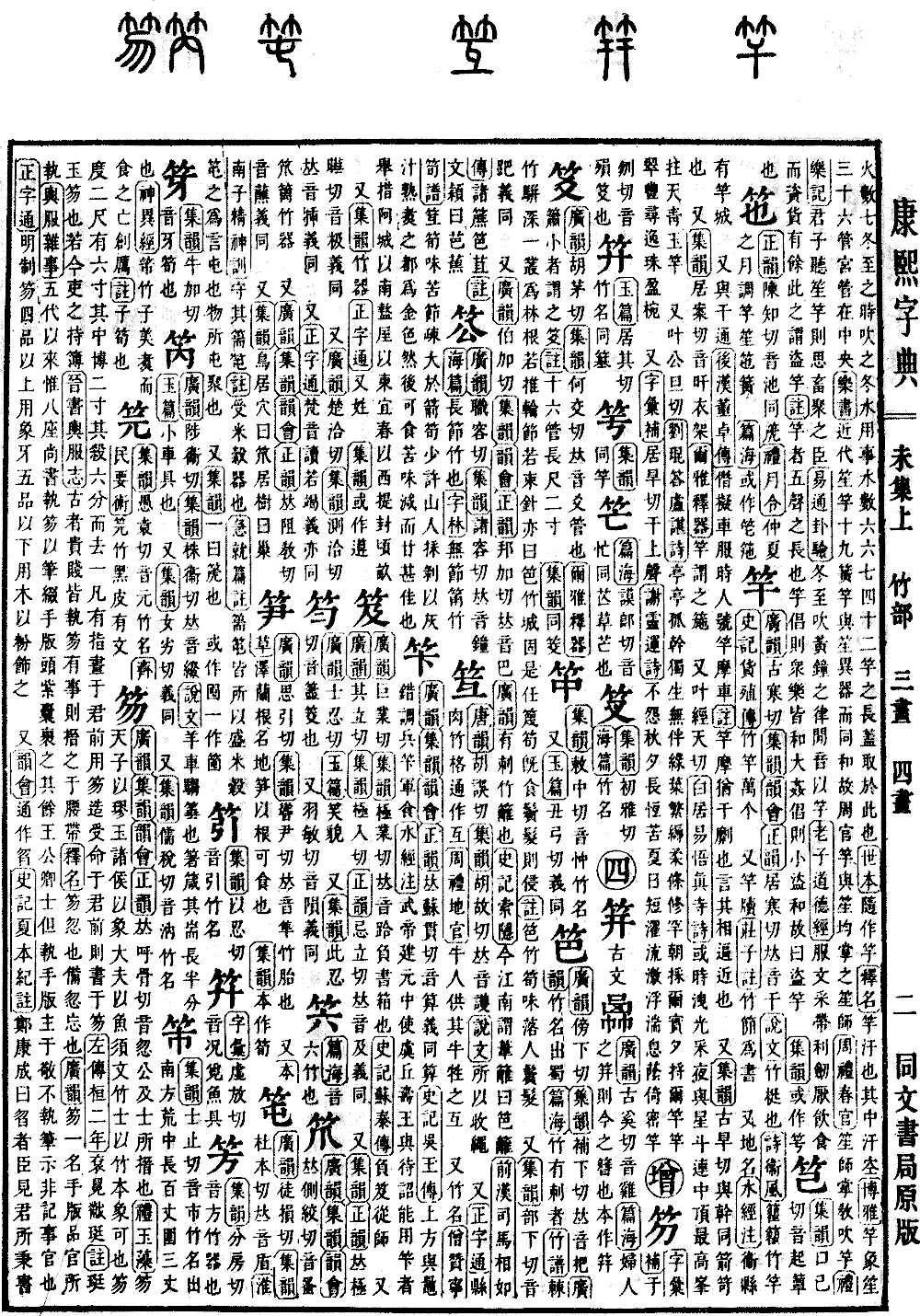
Wei Collection, Upper Volume
Radical: Bamboo (zhú)
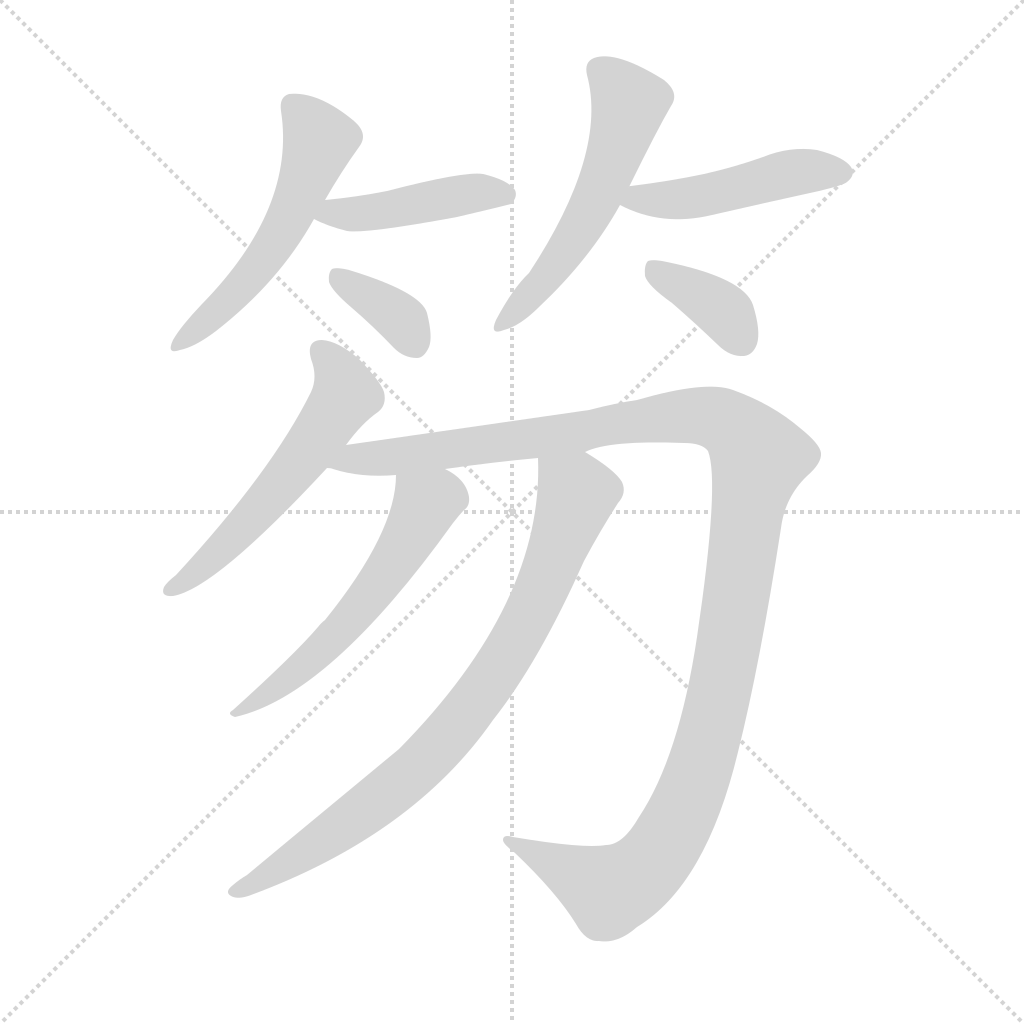
笏
Kangxi strokes: 10
Page 878, Entry 30
Broad Rhymes (Guangyun), Collected Rhymes (Jiyun), Rhyme Meetings (Yunhui), Correct Rhymes (Zhengyun): Pronounced hu. A hand tablet inserted and used by dukes, ministers, and scholars.
Book of Rites (Liji), Jade Pattern (Yuzao): The hu tablet; the Son of Heaven uses fine jade, the feudal lords use ivory, grand masters use bamboo with fish-scale patterns, and scholars may use bamboo or ivory. The length of the hu is two feet and six inches, the middle is three inches wide, and both ends narrow by one-sixth. Whenever one makes gestures in the presence of the monarch, a hu is used, and when receiving the monarch's commands, they are written upon the hu.
Zuo Tradition (Zuozhuan), Second Year of Duke Huan: Robes of state and jade tablets. Commentary: The ting is a jade hu, similar to the notebooks carried by officials today.
Book of Jin (Jinshu), Records of Carriages and Clothing (Yufu Zhi): In ancient times, regardless of rank, everyone carried a hu; when there was business, it was tucked into the waist belt.
Explanation of Names (Shiming): The hu, meaning to be neglectful, is used to prevent one from suddenly forgetting matters.
Broad Rhymes (Guangyun): The hu, also called a hand tablet, is what officials carry.
Miscellaneous Records of Carriages and Clothing (Yufu Zashi): Since the Five Dynasties period, only the eight presiding ministers (bazuo) carry a hu with a brush inserted into the top of the hand tablet, stored in a purple pouch. Other princes, dukes, and officials carry only the hand tablet, primarily to express respect. Not carrying a brush indicates one is not an official responsible for taking notes.
Correction of Characters (Zhengzitong): According to the Ming dynasty system, for the hu, those of the fourth rank and above used ivory, while those of the fifth rank and below used wood decorated with white powder.
Also, Rhyme Meetings (Yunhui): It is used interchangeably with the character written as hu.
Records of the Grand Historian (Shiji), Annals of Xia, Commentary: Zheng Kangcheng says: The hu is what a subject carries when meeting the monarch, used for recording thoughts, responses, and commands. The monarch also has one.
Also, Collected Rhymes (Jiyun): Pronounced wen. Zhihu, used to describe the appearance of following the finger holes of a flute.
Ma Rong, Rhapsody on the Long Flute (Changdi Fu): Fingers pressing the flute, moving through the various changes.
Also, Collected Rhymes (Jiyun): Pronounced wu. Zhihu, describing something that is dense and numerous.
Textual Research: Book of Rites (Liji), Jade Pattern (Yuzao): The hu, the Son of Heaven uses jade. Following the original text, qiu jade has been corrected to fine jade. The length of the hu is two feet and six inches, and the middle is two inches wide. Following the original text, two inches wide has been corrected to three inches wide.