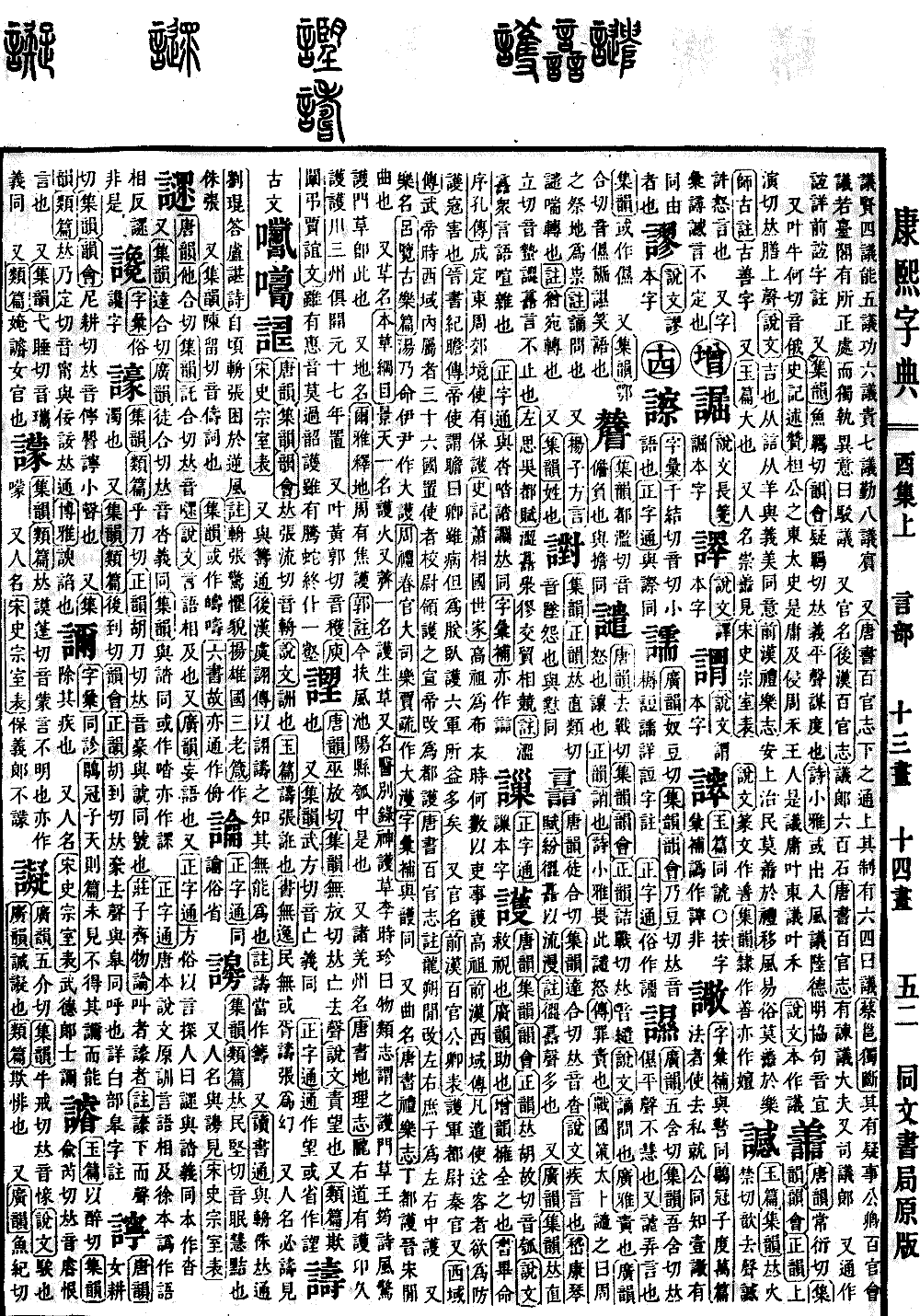
You Collection, Upper Volume
Radical: Speech (yán)
Kangxi Strokes: 21
Page 1184, Entry 17
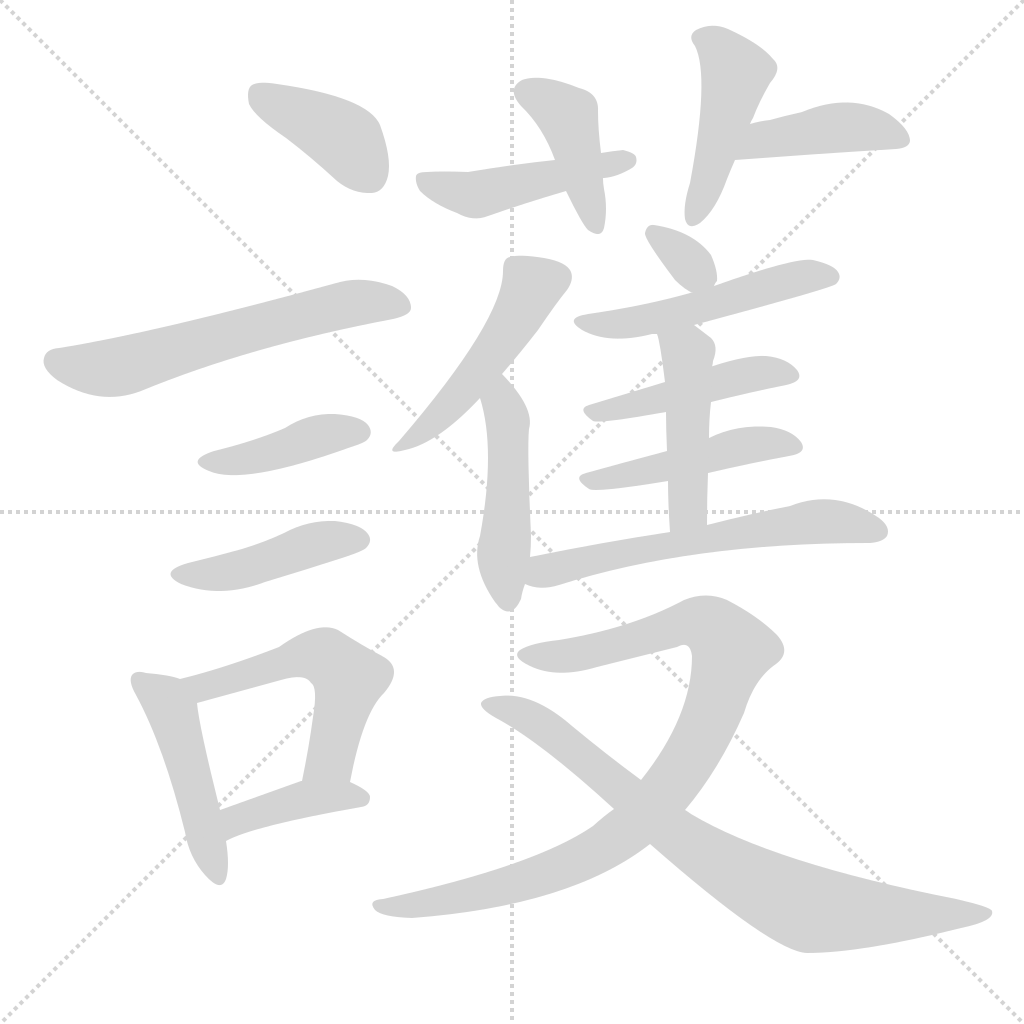
Pronounced hu (falling tone).
Shuowen Jiezi: To assist and look after.
Guangyun: To help.
Zengyun: To support and preserve.
Book of Documents (Shujing), Preface to Bi Ming, Kong Anguo Commentary: King Cheng stabilized the borders of the eastern Zhou territories, ensuring they were protected.
Records of the Grand Historian (Shiji), Biography of Chancellor Xiao: When the Gaozu Emperor was still a commoner, Xiao He often used his official status to shield and protect him.
Book of Han (Hanshu), Account of the Western Regions: Whenever envoys were dispatched to escort guests, it was done to guard against misfortune.
Book of Jin (Jinshu), Biography of Ji Zhan: The Emperor sent someone to tell Ji Zhan: Although you are ill, you only need to lie down and oversee the six armies for me, and the benefits will be great.
Also refers to an official title.
Book of Han (Hanshu), Tables of Government Officials: The Protector of the Army and Commandant was a title established during the Qin dynasty.
Also in the Account of the Western Regions: During the reign of Emperor Wu of Han, thirty-six states in the Western Regions submitted to the Han dynasty; an envoy and commandant were appointed to oversee and protect them, which was changed to Protector General during the reign of Emperor Xuan of Han.
Old Book of Tang (Tangshu), Notes on the Treatise on Officials: During the Longshuo era of Emperor Gaozong of the Tang dynasty, the left and right Heir Apparent Remonstrators were renamed Left and Right Zhonghu.
Also refers to the name of a music and dance performance.
Lüshi Chunqiu, Chapter on Ancient Music: King Tang of Shang then ordered Yi Yin to compose the Da Hu.
Rites of Zhou (Zhouli), Spring Offices, Jia Gongyan Sub-commentary: Written as Da Huo.
Zihui Bu: Identical to the character (hù).
Also refers to the name of a song.
Old Book of Tang (Tangshu), Treatise on Rituals and Music: Ding Du Hu is a piece of music from the Jin and Song dynasties.
Also refers to a type of plant.
Compendium of Materia Medica (Bencao Gangmu): Sedum is also known as Hu Huo. Additionally, shepherd's purse is also known as Hu Sheng grass.
Also, Famous Physician's Records (Mingyi Bielu) records the Shen Hu grass. Li Shizhen states: The Book of Things (Wuleizhi) calls it Hu Men grass; Wang Yun’s poem, which mentions the wind startling the Hu Men grass, refers to this plant.
Also refers to a place name.
Erya, Explanation of Places: During the Zhou dynasty, there was Jiao Hu.
Guo Pu Commentary: This is the current Hu Zhong in Chiyang County, Fufeng Commandery.
Also refers to the names of Qiang ethnic tribal prefectures.
Old Book of Tang (Tangshu), Treatise on Geography: Longyou Circuit had the prefectures of Hu'ang, Jiuhu, and Huchuan, all of which were established in the seventeenth year of the Kaiyuan era.
Also leaf pronunciation, pronounced huo (falling tone).
Yu Chan, Lament for Jia Yi: Even with beautiful music, nothing exceeds the Shao and Hu music. Even with a snake capable of soaring, it will eventually fall into a pit.