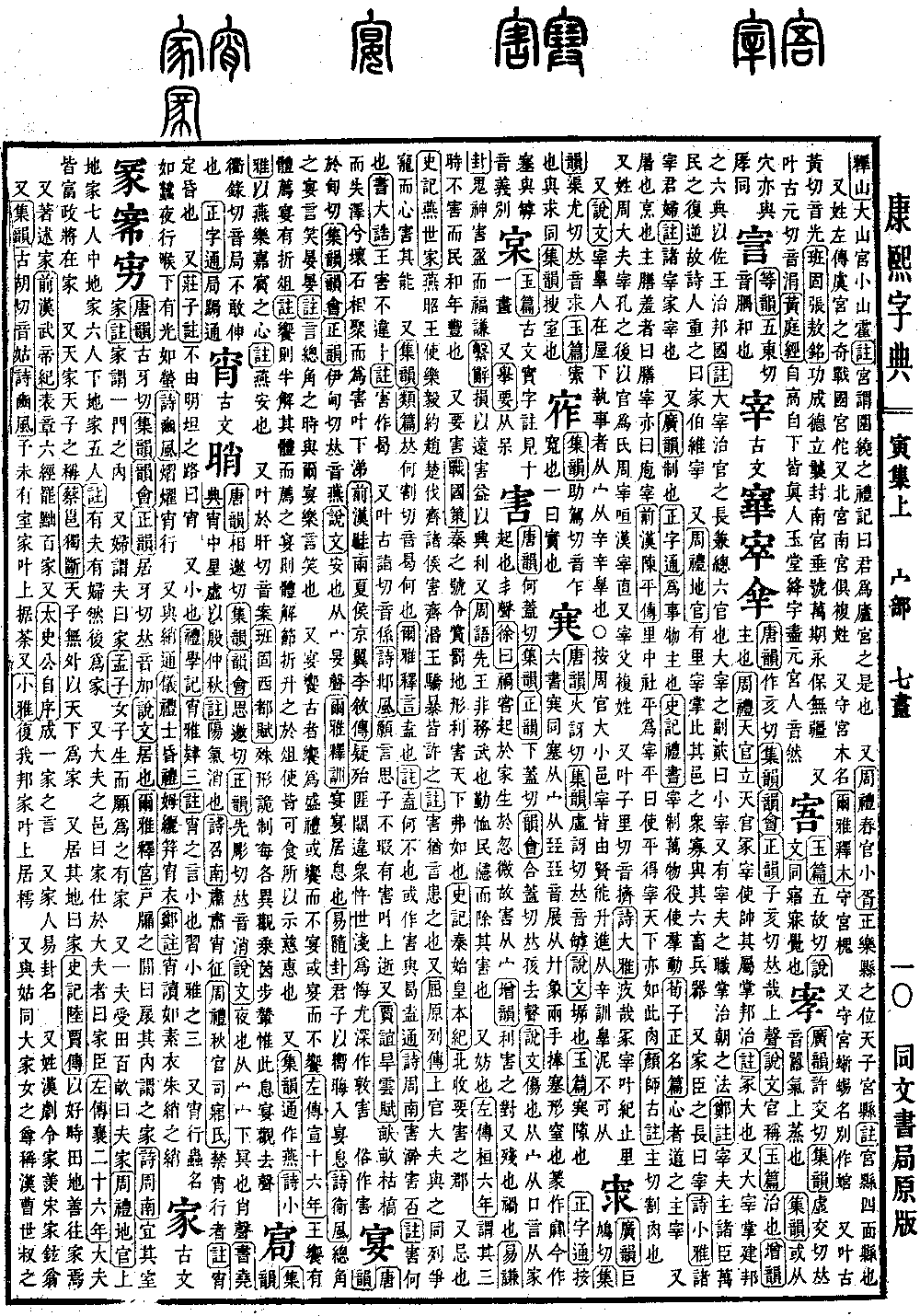
Yin Collection, Upper Volume
Radical: Roof (bù)
Kangxi Strokes: 10
Page 286, Entry 12
Pronounced hai (falling tone).
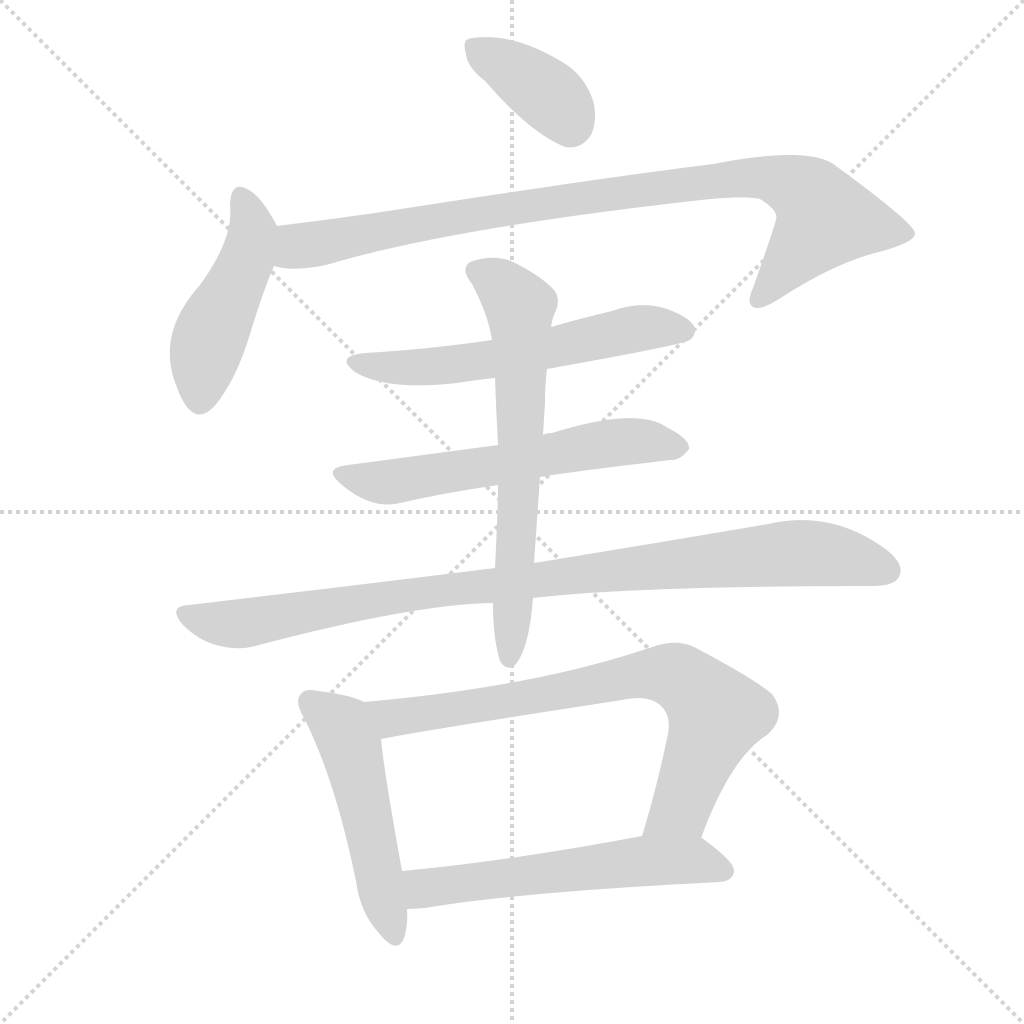
According to the Shuo Wen Jie Zi (Explaining Graphs and Analyzing Characters), the meaning is to injure or harm. The character is composed of the radical for roof and the element for mouth. It indicates that words originate within the home. The element jie is the phonetic component.
Xu Xuan says that disasters often arise from within the home, originating from minor matters, which is why the character for harm is formed with the roof radical.
According to the Zeng Yun (Expanded Rhyme Dictionary), benefit is the opposite of harm. It also carries the meanings of injure, damage, and disaster.
Book of Changes (Yijing), Qian Hexagram: Ghosts and spirits harm those who are full of themselves and bring blessings to those who are humble.
Xici (Appended Remarks): Reduce to avoid harm, and increase to establish what is beneficial.
Also, in the Zhou Yu (Discourses of Zhou), the early kings did not devote themselves to military force, but instead were diligent in empathizing with the suffering of the people and removing the harms that afflicted them.
It also means to hinder or obstruct.
Zuo Tradition (Zuo Zhuan), Sixth Year of Duke Huan: It is said that the spring, summer, and autumn seasons were not obstructed, and therefore the people were harmonious and the harvest was bountiful.
It also refers to a key position or strategic point.
Strategies of the Warring States (Zhanguo Ce): In terms of the decrees, rewards and punishments, and the advantages or disadvantages of the terrain of the Qin state, no one under heaven can compare to it.
Records of the Grand Historian (Shiji), Annals of Qin Shi Huang: Moved northward to capture strategic commanderies and counties.
It also means to envy or be jealous.
Records of the Grand Historian (Shiji), Biographies of the House of Yan: King Zhao of Yan sent Yue Yi to join forces with the states of Zhao and Chu to attack the state of Qi, as the various states were worried about the arrogance and tyranny of King Min of Qi, and all agreed to the alliance.
Note: To treat as a disaster.
Also, in the Biography of Qu Yuan: Official Shangguan held the same rank as Qu Yuan and, competing for favor, envied his talent in his heart.
Also, per Jiyun (Collection of Rhymes) and Leipian (Categorized Dictionary), pronounced he. It indicates the meaning of what or why.
Erya (Approaching Elegance), Explaining Words: It is synonymous with the character he.
Note: He, meaning why not. Sometimes written in a variant form (hai), and is interchangeable with the characters he and he.
Book of Odes (Shijing), Zhou Nan: Which ones should be washed, and which ones should not?
Note: Hai means what.
Book of Documents (Shangshu), Great Announcement: Why does the King not disobey the divination?
Note: Hai functions as he.
Also, rhyming as ji (falling tone).
Book of Odes (Shijing), Bei Feng: Deeply longing for you, could there be anything wrong? Rhymes with the preceding line, which ends in the character shi.
Also, in Jia Yi's Drought Cloud Rhapsody (Han Yun Fu): The fields are parched and have lost their moisture, clods of earth and stones gather together to become a disaster. Rhymes with the following line, which ends in the character ti.
In the History of the Former Han (Qian Hanshu), Biography of Sui, the two Xiahou, Jing, Yi, and Li: Doubt and lack of clarity do not constitute a deficiency, but contradicting the masses and opposing the customs of the world is problematic. Shallow acts result in regret and error, while deep acts cause great disaster.
The common form is written as hai. The character utilizes jie as a phonetic component; the common form uses feng as the phonetic component.