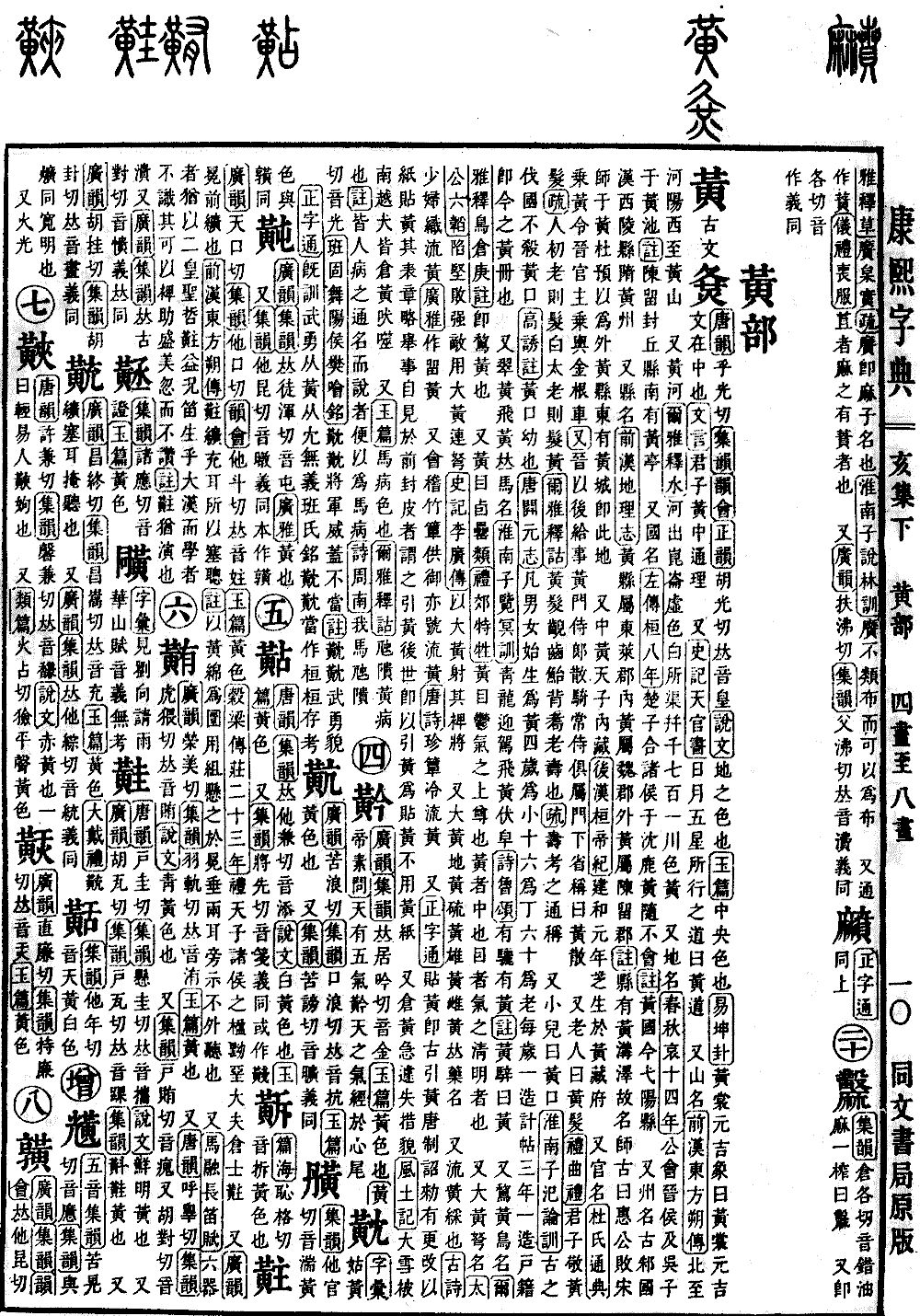
Hai Collection, Lower Volume
Radical: Yellow (huáng)
Page 1516, Entry 03
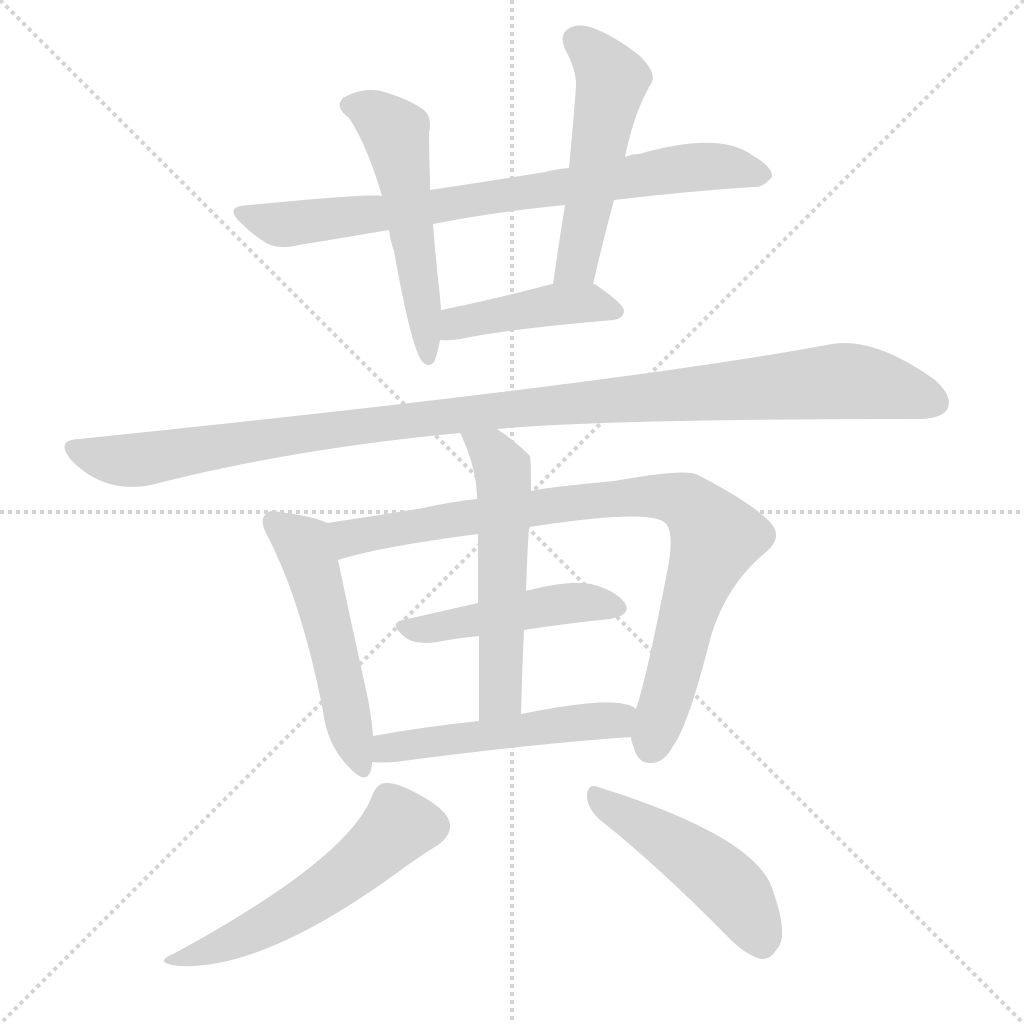
Ancient characters. Pronounced huang. According to Shuowen Jiezi, the color of the earth. According to Yupian, the color of the center. In the Book of Changes (Yijing), regarding the Kun hexagram, it states that a yellow lower garment is the most auspicious. The commentary explains that this is because refined patterns are hidden within. In the Commentary on the Book of Changes (Wenyan), it notes that a noble person’s inner character is as central and enlightened as the color yellow. Also, according to the Records of the Grand Historian (Shiji), in the chapter on Celestial Offices, the paths of the sun, moon, and five planets are called the Yellow Path. Also, a mountain name. According to the Former Han (Qianhan) biography of Dongfang Shuo, it extends north to Chiyang and west to Mount Huang. Also, the Yellow River. According to the Erya, a dictionary of classical Chinese, the Yellow River originates from the Kunlun Mountains; its water is initially white, but after converging with seventeen hundred tributaries, the entire river’s color becomes yellow. Also, a place name. In the Spring and Autumn Annals (Chunqiu), in the fourteenth year of Duke Ai, the Duke held a meeting at Huangchi with the Duke of Jin and the Viscount of Wu. The commentary notes that there is a Huang Pavilion south of Fengqiu County in Chenliu Commandery. Also, a state name. In the Zuo Tradition (Zuozhuan), in the eighth year of Duke Huan, the Viscount of Chu met with the feudal lords at Shenlu, but the states of Huang and Sui did not attend. The commentary notes that the state of Huang was in what is now Yiyang County. Also, a prefecture name. It was the ancient state of Zhu, the Xiling County of the Han dynasty, and was established as Huang Prefecture in the Sui dynasty. Also, a county name. According to the Former Han (Qianhan) Treatise on Geography, Huang County belonged to Donglai Commandery, Neihuang County belonged to Wei Commandery, and Waihuang County belonged to Liu Commandery. The commentary notes that there is a Huang ditch marsh in the county, hence the name Huang County. Shigu states that Duke Hui defeated the Song army at the location of Huang, and Du Yu believed that there was a Huang City east of Waihuang County, which is this place. Also, Zhonghuang, referring to the Emperor’s inner treasury. In the Later Han (Houhan) records of Emperor Huan, in the first year of Jianhe, a spirit mushroom (lingzhi) grew in the Huangcang Treasury. Also, an official title. According to Du’s Comprehensive Statutes (Tongdian), the Cheng-huang Prefect was a Jin dynasty official position responsible for the golden root carriage used by the Emperor. Also, after the Jin dynasty, the positions of Gentleman Attendant at the Yellow Gate and Palace Attendant were both under the Secretariat, collectively referred to as Huangsan. Also, the elderly are called yellow-haired. In the Book of Rites (Liji), it states that a noble person in a carriage should bow and touch the crossbar to show respect upon meeting a yellow-haired elder. The sub-commentary explains that when a person first grows old, their hair turns white, and when they are very old, their hair turns yellow. According to the Erya, yellow hair, child-like teeth, turtle-back skin, and advanced age all signify longevity. The sub-commentary explains that these are general terms for those of great age. Also, children are called yellow-mouths. In the Huainanzi, it states that in ancient times, when attacking other states, they would not kill children. The commentary by Gao You explains that yellow-mouth refers to young children. In the Tang dynasty Kaiyuan records, those newly born are called yellow, at four years old they are called small, at sixteen they are called adults, and at sixty they are called old. A population register was created every year and a household registry every three years; these are the current Yellow Registers. Also, Cuihuang and Feihuang are names of horses. In the Huainanzi, it says a green dragon pulls the carriage forward and Feihuang lies by the manger. In the Book of Odes (Shijing), it mentions horses that are black and horses that are yellow. The commentary states that reddish-yellow horses are called yellow. Also, Lihuang is the name of a bird. The commentary on the Erya entry for the oriole states that this refers to the Lihuang bird. Also, Huangmu is a type of sacrificial wine vessel similar to a you or lei. In the Book of Rites (Liji), it states that the Huangmu is the most revered vessel for containing fragrant aromatic wine. Yellow represents the center; the eye represents the clarity of breath. Also, Dahuang is the name of a crossbow. In the Six Secret Teachings (Liutao), it states that to breach strong positions and defeat powerful enemies, one must use the Dahuang repeating crossbow. In the Records of the Grand Historian (Shiji), it recounts Li Guang using the Dahuang crossbow to shoot an enemy deputy general. Also, Dahuang, Dihuang, sulfur, realgar, and orpiment are all names of medicines. Also, Liuhuang is a type of colorful silk. In an ancient poem, it says a young woman is weaving Liuhuang. The Guangya dictionary writes this as Liuhuang. Also, bamboo mats sent as tribute to the Emperor from Kuaiji are also called Liuhuang. In Tang poetry, it is noted that the precious bamboo mat is cool and has Liuhuang patterns on it. Also, according to the Zhengzitong dictionary, Tiehuang is the ancient Yin-huang. Under the Tang dynasty system, if there were parts of an imperial edict that needed changing, yellow paper was pasted over them to indicate this, and the parts of memorials where the main points were listed on the front cover were called Yin-huang. Later generations called Yin-huang by the name Tiehuang, though they no longer used yellow paper. Also, Canghuang is an appearance of being hurried, panicked, and at a loss. The Fengtuji states that heavy snow covered the Nanyue region, and the dogs were all crying out and biting in a panic. Also, according to the Yupian dictionary, the color of a horse’s coat when it is sick. According to the Erya, hui-tui is the state of being exhausted and ill. The commentary notes that these were originally general terms for human illness, but those who explained them later referred to them as horse illnesses. In the Book of Odes (Shijing), it says my horses are exhausted and ill.