Shen Collection, Upper Volume
Radical: Grass (cǎo)
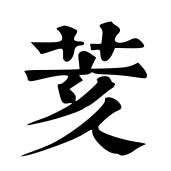
gāi
Kangxi stroke count: 12
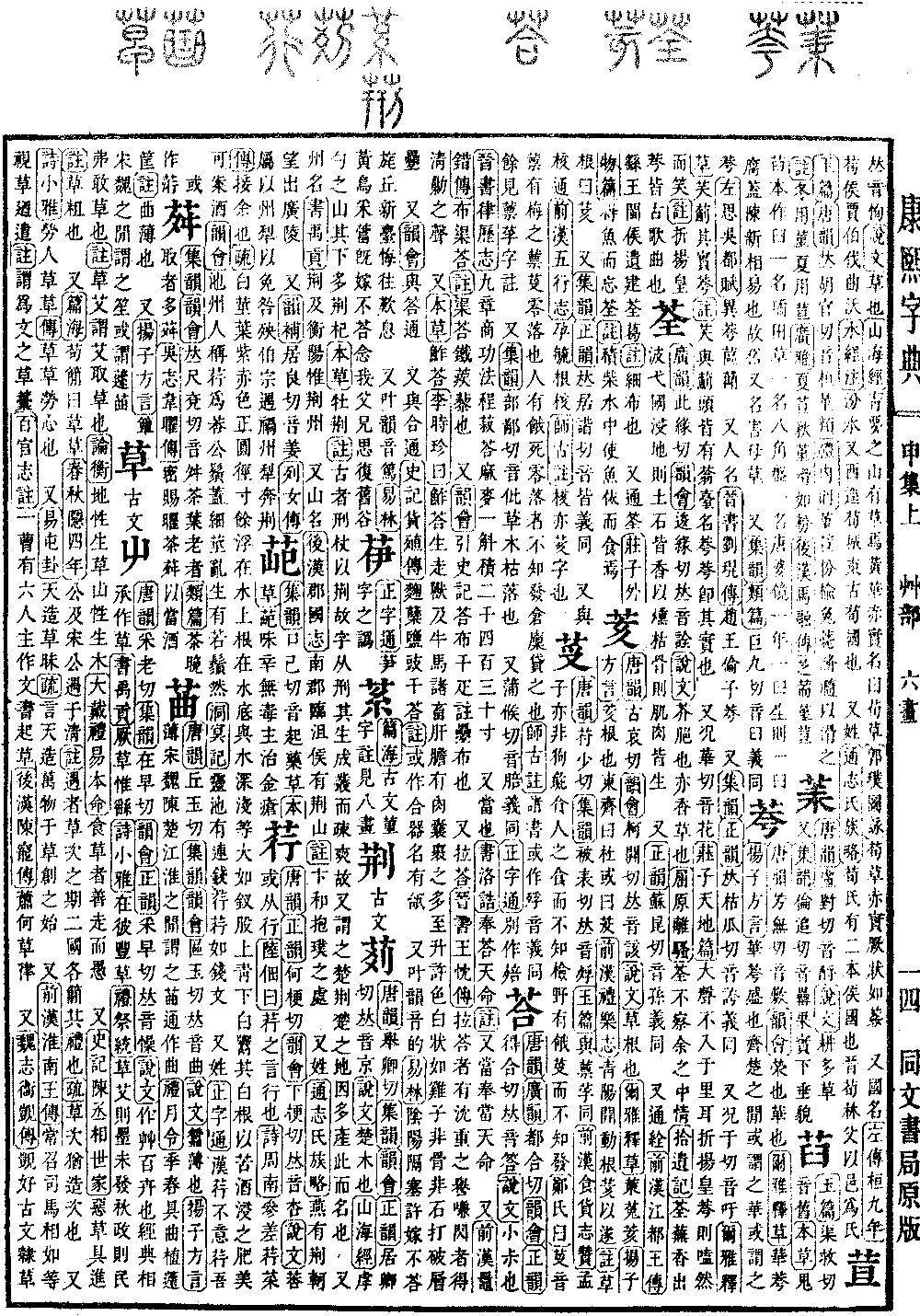
Page 1030, Entry 06
Pronounced gai.
Shuowen Jiezi (Shuowen): The roots of grass.
Erya: Explanations of Plants (Erya): Gai means root.
Yang Xiong, Dialects (Fangyan): Gai means root; in the eastern Qi region it is called du, and sometimes it is called ba.
Book of Han (Hanshu), Treatise on Rites and Music: The green spring initiates movement, and the roots (gai) follow. Commentary: The roots of grass are called gai.
Collected Rimes (Jiyun) and Correct Rimes (Zhengyun): Pronounced jie. The meaning is the same.
Also interchangeable with the character for kernel (he).
Book of Han (Hanshu), Treatise on the Five Elements: To gestate and nourish roots and kernels. Commentary by Yan Shigu: Kernel is also a variant form of gai.
Textual research: Erya, Explanations of Plants mentions the plant name tutugai. We note that tutugai is a plant name, not the term for a grass root. Since the previous section cites the Shuowen definition that gai is a grass root, this section should cite the Erya definition that gai is a root. We have corrected the citation to read: Erya, gai means root.