Zi Collection, Page Position: Lower
Radical: Seal (jié)
Page 159, Entry 23
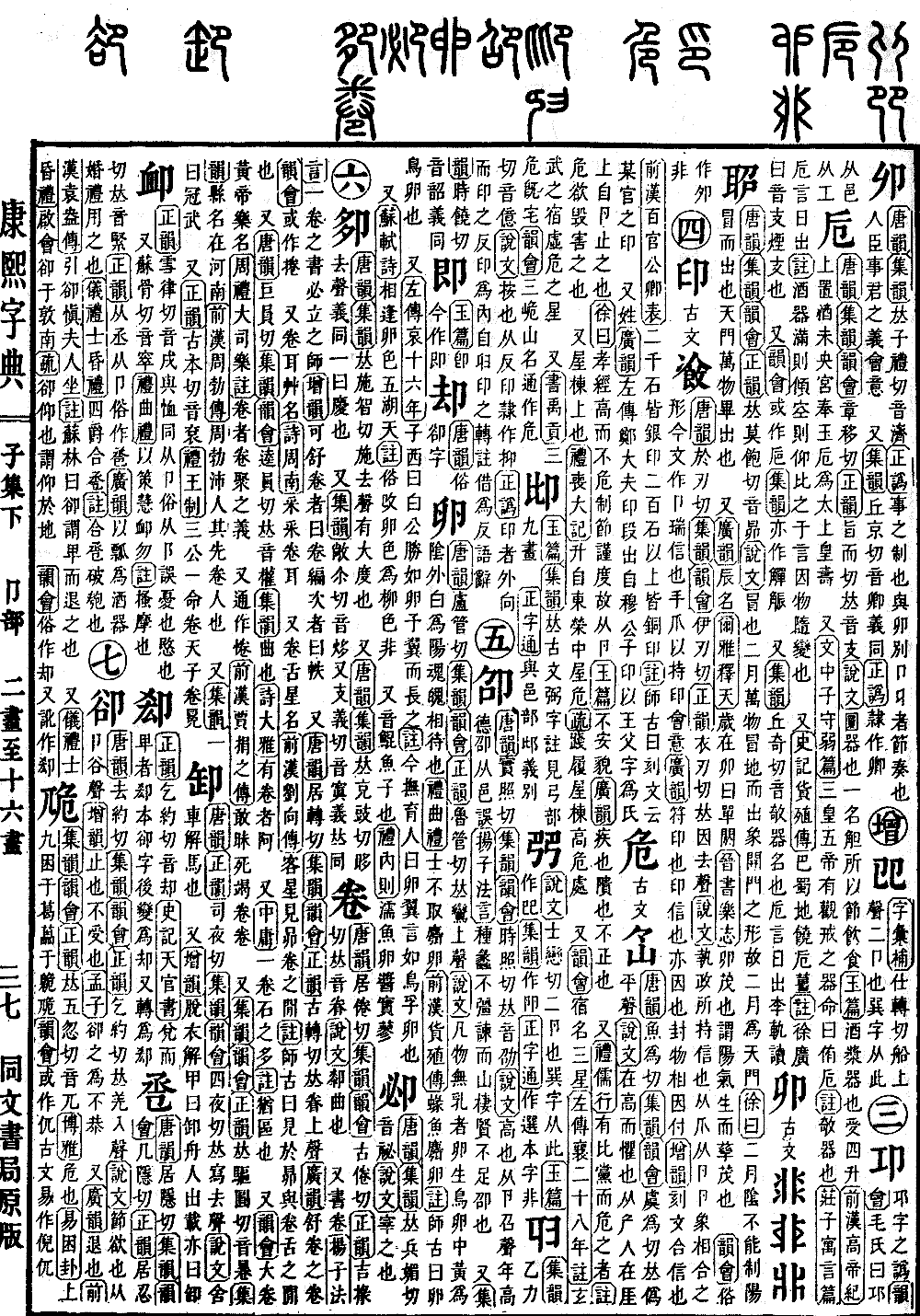
Pronounced juan (falling tone).
In the Shuowen Jiezi (Shuowen), it means to bend the knee. It also refers to a scroll or book. In the Model Sayings (Fayan) by Yang Xiong, it is written: For a single scroll of a book, one must establish a teacher. In the Supplemented Rhymes (Zengyun), that which can be rolled or unrolled is called juan; that which is compiled and arranged is called zhi.
Pronounced juan (rising tone).
In the Extensive Rhymes (Guangyun), it refers to the act of unrolling or rolling up. In the Dictionary of Rhymes (Yunhui), it is sometimes written in a variant form. Also, juan-er is the name of a plant. In the Book of Odes (Shijing), it is written: Picking, picking the juan-er. Also, juan-she is the name of a star. In the History of the Former Han (Qianhan Shu), biography of Liu Xiang, it is written: The guest star appeared between the Mao constellation and the Juan-she star. The commentator Yan Shigu said: It appeared between the Mao and the Juan-she.
Pronounced quan.
In the Collection of Rhymes (Jiyun), it means to be curved. In the Book of Odes (Shijing), it is written: There are curved bends. In the Doctrine of the Mean (Zhongyong), it refers to a small portion of stones. The commentary notes: It is like a small area or compartment.
In the Dictionary of Rhymes (Yunhui), Da-juan is the name of a musical piece from the Yellow Emperor. In the Rites of Zhou (Zhouli), Great Master of Music commentary, it is written: Juan signifies the meaning of gathering together.
It is also used interchangeably with quan (sincere). In the History of the Former Han (Qianhan Shu), biography of Jia Juanzhi, it is written: I dare to risk death to exhaust my sincerity.
Pronounced juan.
In the Collection of Rhymes (Jiyun), it is the name of a county located in Henan. In the History of the Former Han (Qianhan Shu), biography of Zhou Bo, it is written: Zhou Bo was a man from Pei, and his ancestors were from Juan County.
In the Collection of Rhymes (Jiyun), it also means a military cap.
Pronounced gun.
In the Book of Rites (Liji), Royal Regulations, it is written: The Three Dukes receive one decree and wear the guan, while the Son of Heaven wears the guan and the mian ceremonial cap.