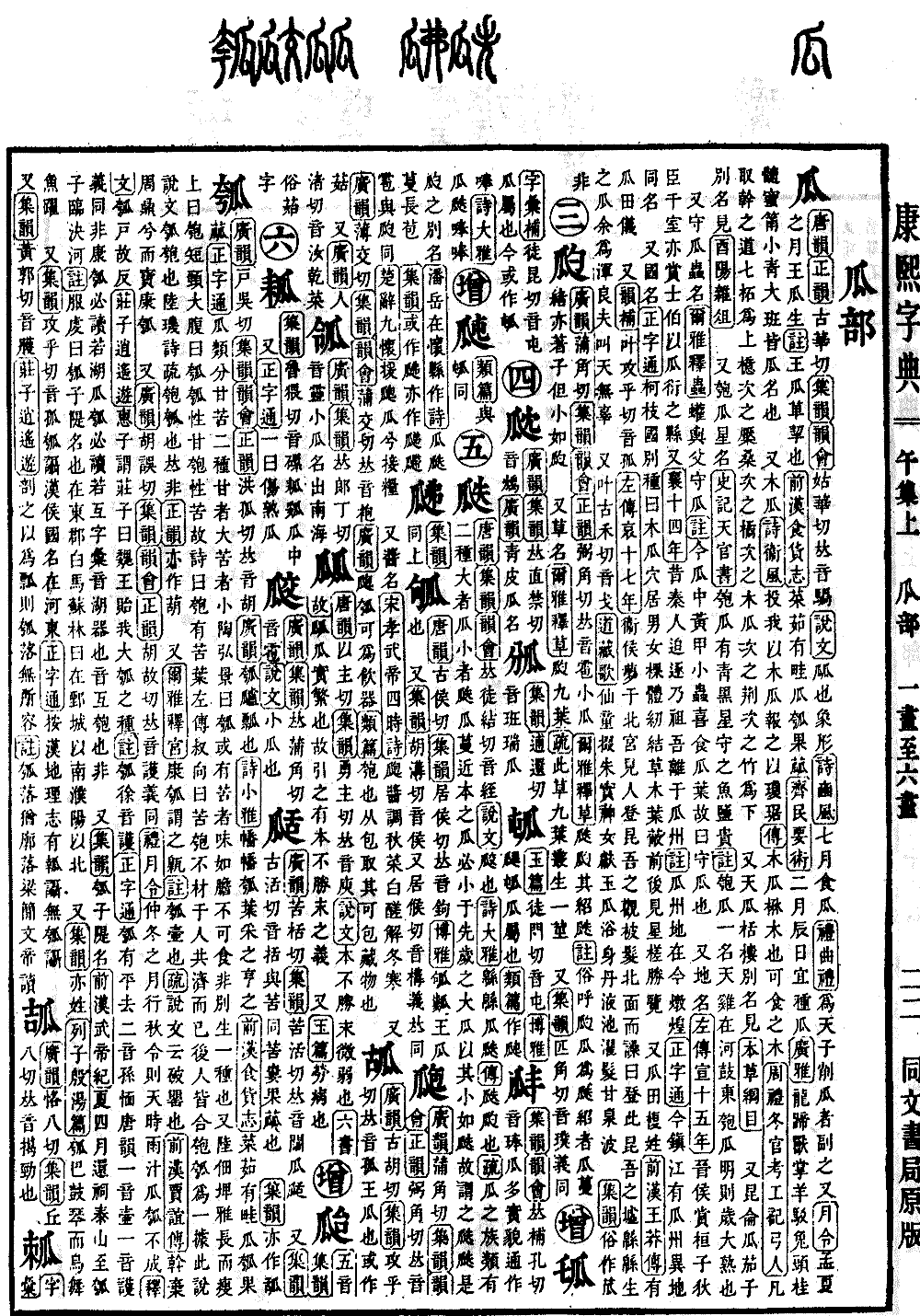
Wu Collection, Upper Volume
Radical: Melon (guā)
Kangxi strokes: 5
Page 746, Entry 01
Pronounced gua.
Shuowen Jiezi (Explanation of Writing and Analysis of Characters): A pictogram.
Book of Odes (Shijing), Odes of Bin: In the seventh month, we eat melons.
Book of Rites (Liji), Qu Li: He who peels a melon for the Son of Heaven shall cut it into slices.
Yueling (Monthly Ordinances): In the first month of summer, the snake gourd (wáng guā) sprouts.
Commentary: The snake gourd is the creeping plant known as bī qiè.
Book of Han (Hanshu), Treatise on Food and Money: Regarding vegetables, there are bedded melons, gourds, fruits, and vine-grown plants.
Essential Techniques for the Welfare of the People (Qimin Yaoshu): On the Chen day of the second month, it is suitable to plant melons.
Guangya (Expanded Dictionary): Dragon-hoof, beast-palm, sheep-shank, rabbit-head, cassia-branch, honey-tube, and striped-leopard-head are all types of melons.
Also, the flowering quince (mù guā).
Book of Odes (Shijing), Odes of Wei: They threw me a flowering quince, I returned to them a jade pendant.
Commentary: The flowering quince is the mào tree; it is an edible fruit tree.
Rites of Zhou (Zhouli), Winter Offices, Artificers' Record, Bow Makers: There are seven ways to obtain dried wood, with the cudrania tree being the best, followed by the blackwood, the mountain mulberry, the mandarin orange tree, the flowering quince, the chaste tree, and finally bamboo.
Also, heaven-melon, another name for the snake gourd (guā lóu). See Compendium of Materia Medica (Bencao Gangmu).
Also, Kunlun melon, another name for eggplant. See Miscellaneous Morsels from Youyang (Youyang Zazu).
Also, gourd-melon (páo guā), the name of a star.
Records of the Grand Historian (Shiji), Treatise on the Celestial Offices: If there is a blue-black star guarding the gourd-melon star, then fish and salt will be expensive.
Commentary: The gourd-melon is also known as the celestial chicken; it is located to the east of the He Gu star. When the gourd-melon shines brightly, the harvest of the year will be great.
Also, melon-guard, the name of an insect.
Erya (Approaching Elegance), Explanations of Insects: The quányúfù is the melon-guard.
Commentary: This refers to the small yellow-backed insect inside melons that loves to eat melon leaves; hence it is called melon-guard.
Also, a place name.
Zuo Tradition (Zuo Zhuan), 15th Year of Duke Xuan: The Duke of Jin rewarded Lord Huan with a thousand households of the Di tribe and also rewarded Shi Bo with the district of Guayan.
Also, 14th Year of Duke Xiang: In the past, the Qin people pressed and pursued your ancestor Wuli to Guazhou.
Commentary: Guazhou is a place located in present-day Dunhuang.
Zhengzitong (Correction of Characters): Today, there is a Guazhou in Zhenjiang; it is a different place with the same name.
Also, a country name.
Zhengzitong (Correction of Characters): A branch of the Kezhi country is called Flowering Quince; the people live in caves, and both men and women are naked, using leaves of plants and trees to cover themselves in front and back. See Xingcha Shenglan (Triumphant Visions from a Star Raft).
Also, Guatian, a compound surname.
Book of Han (Hanshu), Annals of Wang Mang: There was a person named Guatian Yi.
Also, rhyme-supplemented pronunciation: read as gu, matching the rime.
Zuo Tradition (Zuo Zhuan), 17th Year of Duke Ai: The Marquis of Wei dreamed in the North Palace that he saw a person ascending the Kunwu watchtower, disheveled, facing north and shouting, saying: Ascending this ruins of Kunwu, the endlessly growing melon. I am Hun Liangfu, crying to heaven that I am innocent.
Also, read as ge, matching the rime.
Daozang Ge (Songs of the Daoist Canon): The fairy child gathers the vermilion fruit, the goddess presents a jade melon; bathing the body in the pool of cinnabar fluid, washing the hair in the waves of the sweet spring.
Jiyun (Collection of Rhymes): The common form is written as gu (the character for melon-like plant), which is incorrect.