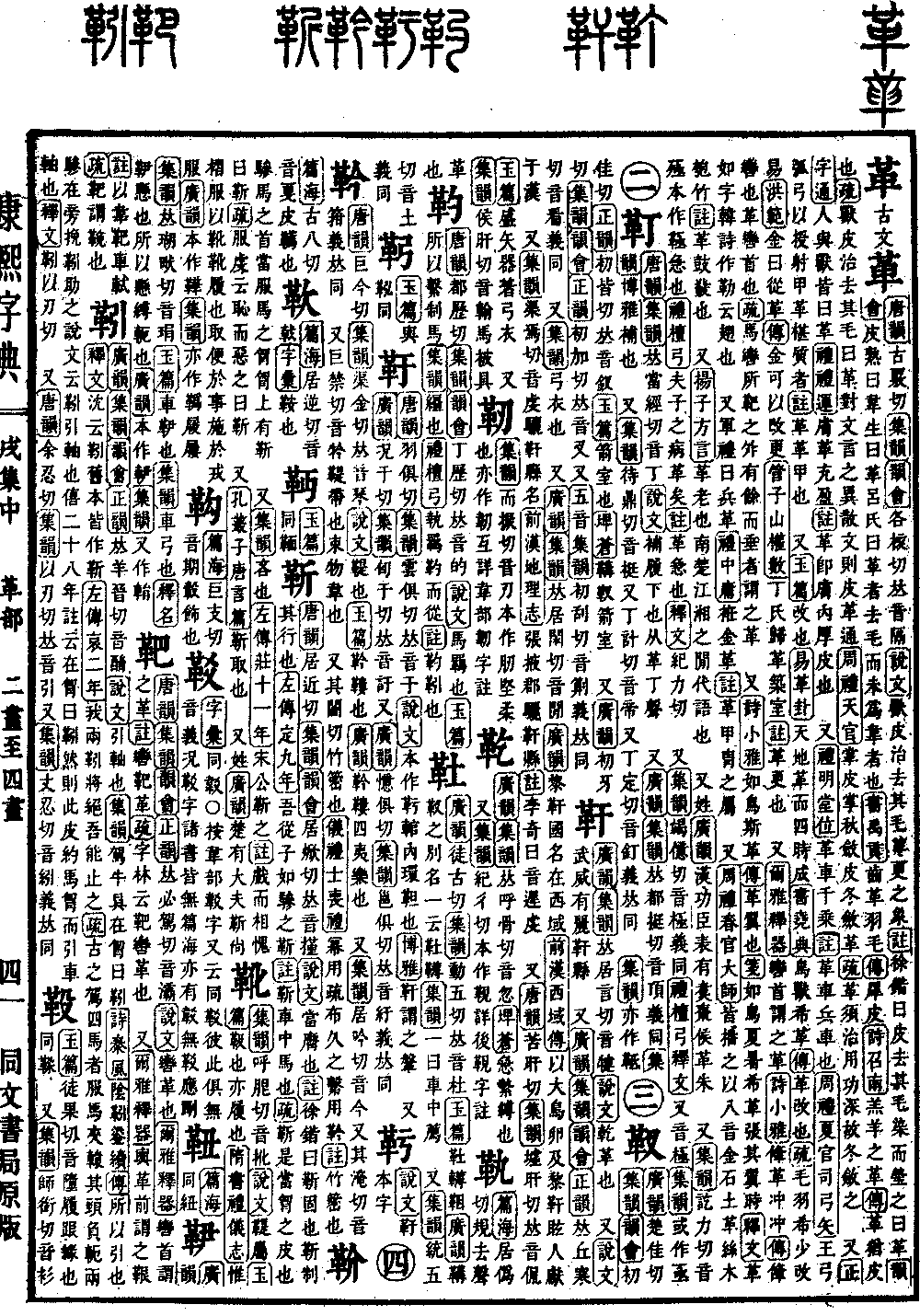
Xu Collection, Middle Volume
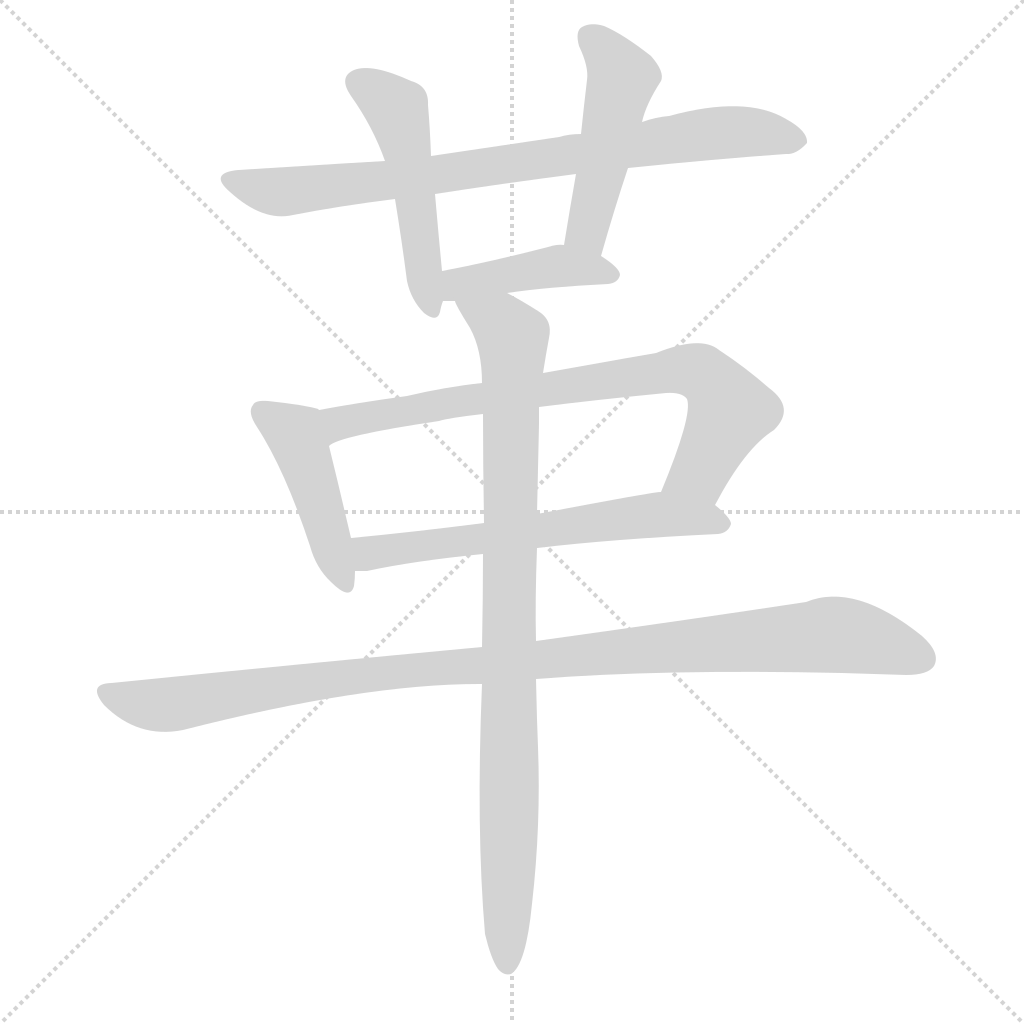
Radical: Leather (gé)
Page 1385, Entry 01
Archaic script form.
According to the Tang Rhyme (Tangyun), pronounced ge. According to the Collected Rhymes (Jiyun) and the Rhyme Compendium (Yunhui), pronounced ge.
According to the Explanation of Characters (Shuowen), it refers to animal hide processed by removing the hair. It implies a change or modification.
Note: Xu Kai stated that hide with the hair removed and then dyed and polished is called ge.
The Rhyme Compendium (Yunhui) notes that processed hide is called wei, while raw hide is called ge.
Lu stated that ge is hide that has had the hair removed but has not yet become wei.
Book of Documents (Shujing), Tribute of Yu: Teeth, leather, feathers, and hair. Commentary: Refers to rhinoceros hide.
Book of Odes (Shijing), Shao South: The hide of a lamb. Commentary: Ge is equivalent to skin. Sub-commentary: Animal skin processed to remove the hair is called ge. When contrasted, the terms differ; in general discourse, leather and skin are used interchangeably.
Rites of Zhou (Zhouli), Officers of Heaven: The leather officer manages the collection of skin in the autumn and ge in the winter. Sub-commentary: Ge requires deep processing, hence it is collected in the winter.
Also, according to Correct Character Investigation (Zhengzitong), it applies to both humans and animals.
Book of Rites (Liji), Evolution of Rites: Skin and leather are filled out. Note: Ge refers to the thick skin beneath the surface of the flesh.
Also, Book of Rites (Liji), Hall of Distinction: Leather chariots number one thousand. Note: Leather chariots are war chariots.
Rites of Zhou (Zhouli), Summer Officers, Master of Bows and Arrows: The king grants bows and arcuate bows to those who practice shooting at armor, leather, and targets. Note: Ge refers to leather armor.
Also, according to the Jade Chapters (Yupian), it means to change.
Book of Changes (Yijing), Revolution Hexagram: Heaven and earth change, and the four seasons are formed.
Book of Documents (Shujing), Canon of Yao: Birds and beasts are sparse and changing. Commentary: Ge means to change. Sub-commentary: Feathers and fur are sparse and undergoing transformation.
Great Plan (Hongfan): Metal is said to follow change. Commentary: Metal can be altered or modified.
Guanzi, Mountain Power and Numbers: The Ding clan returned, changed, and built a residence. Note: Ge means to change.
Also, according to the Er Ya, Explanation of Vessels: The head of the reins is called ge.
Book of Odes (Shijing), Lesser Odes: The leather reins flutter. Commentary: Tia means the reins. Ge is the head of the reins. Sub-commentary: The part of the horse reins that extends and hangs down beyond the grip is called ge.
Also, Book of Odes (Shijing), Lesser Odes: Like a bird’s wings. Commentary: Ge means wings. Note: Like a bird in summer heat, changing and spreading its wings. Explanation of Text: Ge is pronounced as written. Han Poetry writes it as le, meaning wings.
Also, military ritual is called weapons and armor.
Book of Rites (Liji), Doctrine of the Mean: Sleeping on metal and leather. Note: Leather refers to armor, helmets, and the like.
Also, Rites of Zhou (Zhouli), Spring Officers, Grand Master: All are broadcast using the eight musical sounds: metal, stone, earth, leather, silk, wood, gourd, and bamboo. Note: Leather refers to drums and rattles.
Also, Yangzi’s Regional Dialects (Fangyan): Ge means old. This is a local expression in the Southern Chu and Jiang-Xiang regions.
Also a surname. According to the Broad Rhyme (Guangyun), the Han Dynasty Table of Meritorious Officials includes the Marquis of Zhuzhao, Ge Zhu.
Also, according to the Collected Rhymes (Jiyun), pronounced ji. Originally written as a different character. It means urgent.
Book of Rites (Liji), Tan Gong: The Master’s illness is critical. Note: Ge means urgent. Explanation of Text: Pronounced ji.
Also, according to the Collected Rhymes (Jiyun), pronounced ji. The meaning is the same.
Book of Rites (Liji), Tan Gong, Explanation of Text: Also pronounced ji. According to the Collected Rhymes (Jiyun), sometimes written as ji.