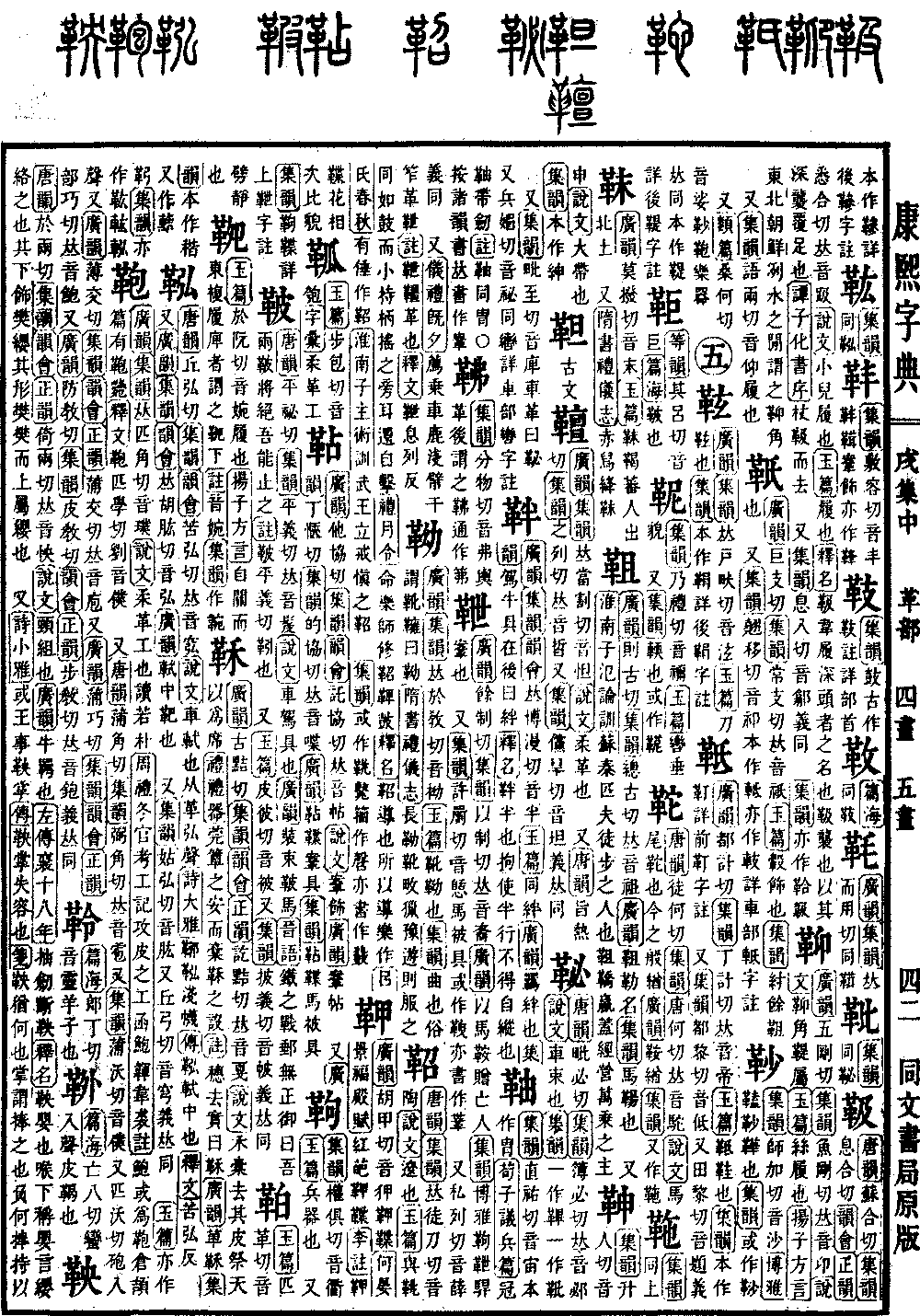
Xu Collection, Middle Volume
Radical: Leather (gé)
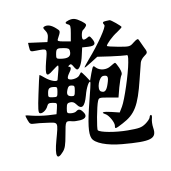
鞄
Kangxi Strokes: 14
Page 1386, Entry 38
Broad Rhymes (Guangyun) and Collected Rhymes (Jiyun): Pronounced pu.
Etymology (Shuowen): A worker who softens leather. Pronounced like pu.
Rites of Zhou (Zhouli), Winter Official, Record of Examination of Craftsmen, Crafts of Skinworking, Armour, Pou, Yun, Wei, and Fur commentary: Pou may also be written as bao. The Cangjie Chapter contains bao.
Explanation of Texts (Shiwen): Bao, pronounced xue. Liu says pronounced pu.
Also Tang Rhymes (Tangyun): Pronounced bao.
Collected Rhymes (Jiyun): Pronounced bo.
Also Collected Rhymes (Jiyun): Pronounced pu.
Also: Pronounced pu (entering tone).
Also Broad Rhymes (Guangyun): Pronounced pao.
Collected Rhymes (Jiyun), Rhyme Meetings (Yunhui), and Correct Rhymes (Zhengyun): Pronounced pao.
Also Broad Rhymes (Guangyun): Pronounced bao.
Collected Rhymes (Jiyun), Rhyme Meetings (Yunhui), and Correct Rhymes (Zhengyun): Pronounced bao.
Also Broad Rhymes (Guangyun): Pronounced bao.
Collected Rhymes (Jiyun), Rhyme Meetings (Yunhui), and Correct Rhymes (Zhengyun): Pronounced bao.
The meaning is the same. The original character was written with north below wan. Bao is also written as bao.