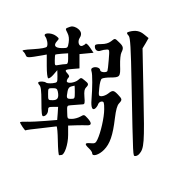
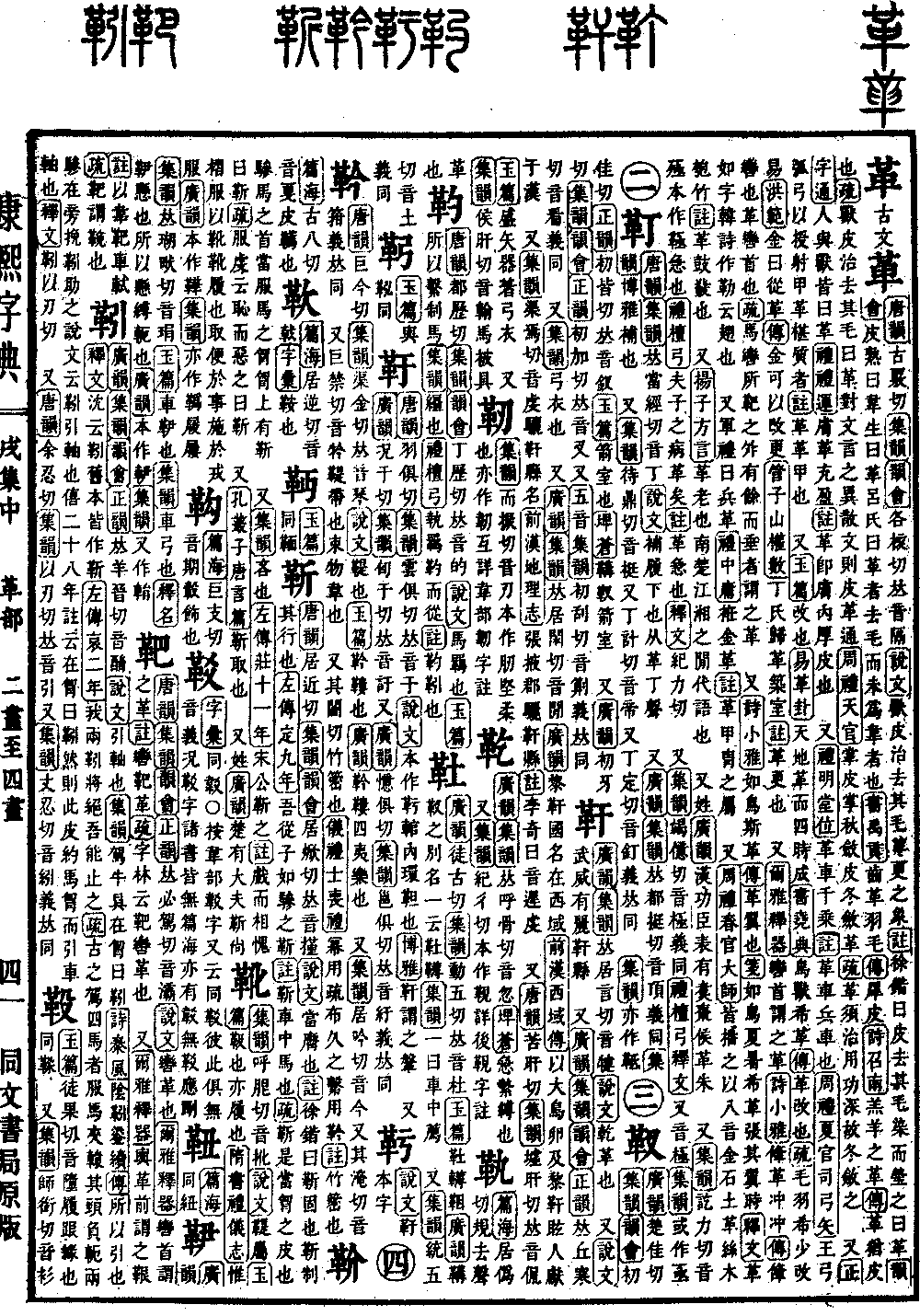
Xu Collection, Middle Volume
Radical: Leather (gé)
Yin
Kangxi stroke count: 13
Page 1385, Entry 25
Broad Rhymes (Guangyun), Collected Rhymes (Jiyun), Rhyme Compendium (Yunhui), and Correct Rhymes (Zhengyun) state the pronunciation is yin (falling tone).
According to the Explaining Graphs and Analyzing Characters (Shuowen): A strap for pulling the axle. According to the Collected Rhymes (Jiyun): Equipment for harnessing oxen. The strap across the chest is called yin.
Book of Odes (Shijing), Odes of Qin (Qin feng): With the yin strap reinforced by white metal rings. The Commentary states: It is that which is used for pulling. The Explanatory Text (Shiwen) says: Shen remarks that in old editions, this was written as jin.
Zuo Tradition (Zuo zhuan), Second Year of Duke Ai: My two yin straps are about to snap, how can I stop them? The Sub-commentary says: In ancient times, those who harnessed four horses had the two inner horses between the shafts, their necks bearing the yoke, with the two outer horses on the sides, assisted by the pulling yin straps. The Explaining Graphs and Analyzing Characters (Shuowen) says yin is that which pulls the axle. The Commentary for the twenty-eighth year of Duke Xi states that the strap on the chest is called yin. Thus, this is a leather band binding the horse's chest to pull the carriage axle.
The Explanatory Text (Shiwen) says: Yin is pronounced ren (falling tone). Also, according to the Tang Rhymes (Tangyun), it is pronounced yin (rising tone), and according to the Collected Rhymes (Jiyun), it is pronounced yin (falling tone). Also, according to the Collected Rhymes (Jiyun), it is pronounced zhen (rising tone). The meaning is the same.