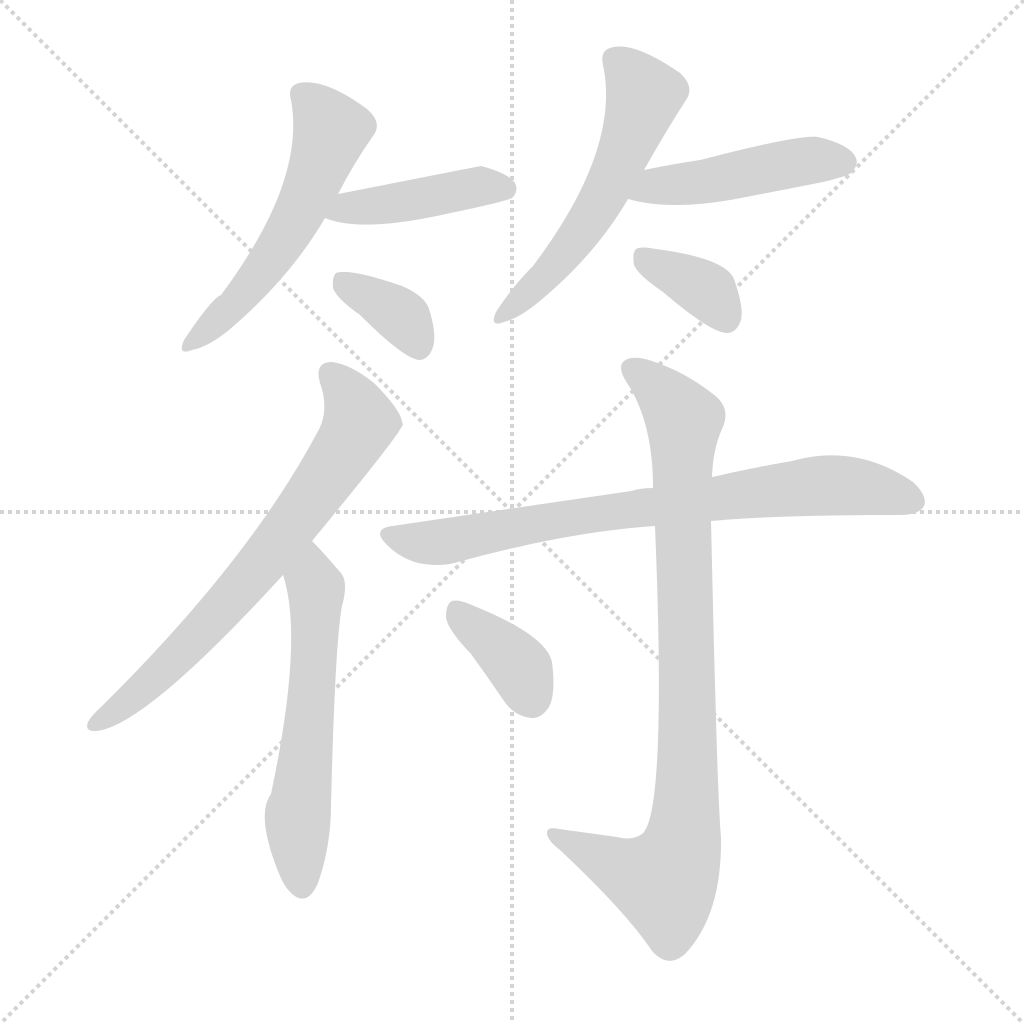
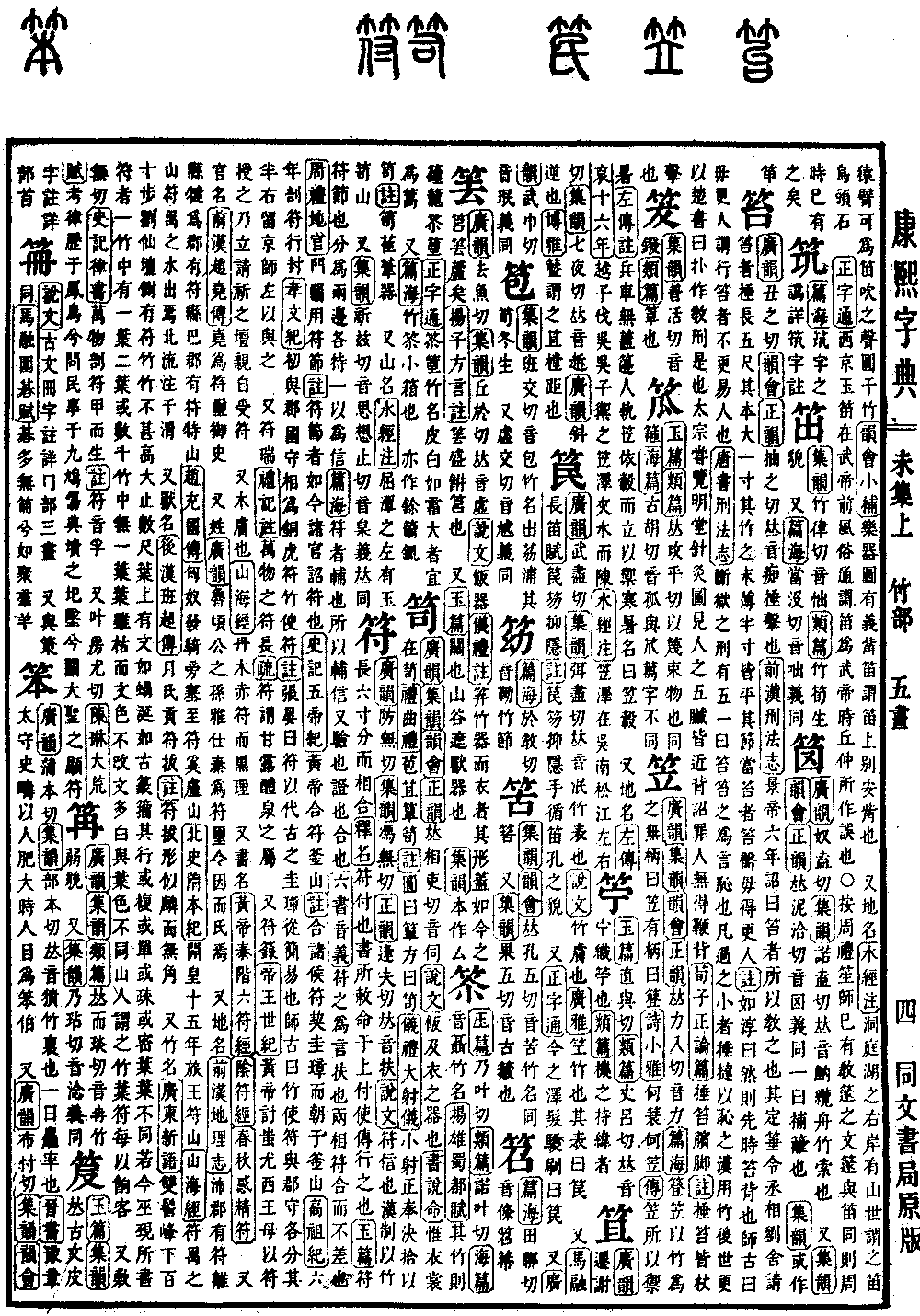
Wei Collection, Upper Volume
Radical: Bamboo (zhú)
Kangxi Strokes: 11
Page 880, Entry 18
Pronounced fu.
Shuowen Jiezi (Explanation of Characters): A fu is an object used as proof of identity. According to Han dynasty regulations, it was made of bamboo, six inches long, and split into two halves that could be fitted together to confirm authenticity.
Shiming (Explanation of Names): Fu means to deliver. Commands were written upon it and delivered by an envoy to be carried out.
Yupian (Jade Chapters): A fu is a tally. It is split into two, with each party holding one half as a credential.
Pianhai (Ocean of Chapters): Fu means to assist; it is used to assist in gaining trust. It also carries meanings of verification, credential, and correspondence.
Liushu Yinyi (Meaning of Sounds in the Six Categories of Characters): The reason it is called a fu is that it implies support, referring to the two halves fitting together without error.
Rites of Zhou (Zhouli), Office of Earth: City gates and checkpoints use tally seals. Commentary: Tally seals are like the official orders and credentials used by government offices today.
Records of the Grand Historian (Shiji), Annals of the Five Emperors: The Yellow Emperor met the feudal lords at Mount Fu to verify credentials. Commentary: Meeting the lords to verify tallies, gui (jade tablets), and zhang (jade insignia) while holding court at Mount Fu.
Annals of Emperor Gaozu: In the sixth year, credentials were split to confer fiefs and rewards.
Annals of Emperor Xiaowen: Began the creation of bronze tiger tallies and bamboo envoy tallies for commandery and state officials. Commentary: Zhang Yan states that the tally replaced the ancient jade tablets for the sake of simplicity. Yan Shigu states that for the bamboo envoy tally, the emperor and the commandery governor each held one half; the right half was kept in the capital, and the left half was given to the governor.
Also refers to signs of auspiciousness.
Book of Rites (Liji), Commentary: The manifestation of auspicious signs among all things. Sub-commentary: Fu refers to auspicious omens such as sweet dew and sweet springs.
Also refers to talismans (Daoist liturgical documents).
Diwang Shiji (Century of Emperors and Kings): When the Yellow Emperor campaigned against Chiyou, the Queen Mother of the West bestowed a talisman upon him, so he established a sacrificial altar and received the talisman in person.
Also refers to tree bark.
Classic of Mountains and Seas (Shanhaijing): The dan tree has red bark and black patterns.
Also refers to book titles: Huangdi Taijie Liufu Jing (Yellow Emperor’s Scripture of the Six Talismans of the Grand Terrace), Yinfu Jing (Scripture of the Hidden Talisman), and Spring and Autumn Annals (Chunqiu) Gan Jing Fu.
Also refers to official titles.
History of the Former Han Dynasty (Qian Hanshu), Biography of Zhao Yao: Zhao Yao served as the Palace Secretary for Tallies and Seals.
Also refers to surnames.
Guangyun (Broad Rhymes): Ya, the grandson of Duke Qing of Lu, served as the Prefect of Tallies and Seals in the State of Qin, and thus took the official title as a surname.
Also refers to place names.
History of the Former Han Dynasty, Treatise on Geography: Pei Commandery had Fuli County; Jianwei Commandery had Fu County; Ba Commandery had Fute Mountain.
Biography of Zhao Chongguo: The Xiongnu sent cavalry along the border to reach Fuxilu Mountain.
History of the Northern Dynasties (Beishi), Annals of the Sui: In the fifteenth year of the Kaihuang era, sacrifices were offered at Fu Mountain.
Classic of Mountains and Seas: Fuyu Mountain is where the Fuyu River originates, flowing north into the Wei River.
Also refers to the name of a beast.
History of the Later Han Dynasty (Hou Hanshu), Biography of Ban Chao: The Yuezhi kingdom presented a fuba beast as tribute. Commentary: The fuba is shaped like a qilin but has no horns.
Also refers to a type of bamboo.
Guangdong Xinyu (New Records of Guangdong): One hundred and ten paces below Shuangji Peak, near the altar of Liu the Immortal, there is a type of bamboo called fu bamboo. The bamboo is not very tall, only a few feet. The leaves have patterns like the tracks of a snail, or like ancient seal script. The flow of these lines is sometimes repetitive, sometimes singular, sometimes sparse, sometimes dense; every leaf is different, looking just like the incantations drawn by shamans today. A single stalk might have one or two such leaves, or even dozens of stalks may have none. Even when the leaves wither, the color of the patterns does not change. The patterns are mostly white, contrasting with the color of the leaves. The mountain people call them bamboo-leaf talismans and often give them to guests as gifts.
Also pronounced fu.
Records of the Grand Historian, Treatise on the Pitch Pipes: All things break through their shells (fu-jia) to be born. Commentary: Fu is pronounced like the word for trust.
Also rhyming as fang.
Chen Lin, Dahuang Fu (Rhapsody on the Great Wilderness): Examining the pitch pipes and calendar from the phoenix, and inquiring about civil affairs from the Nine Doves. Lamenting the destruction and loss of the classics, as it relates to the illustrious talismans of the great sages.