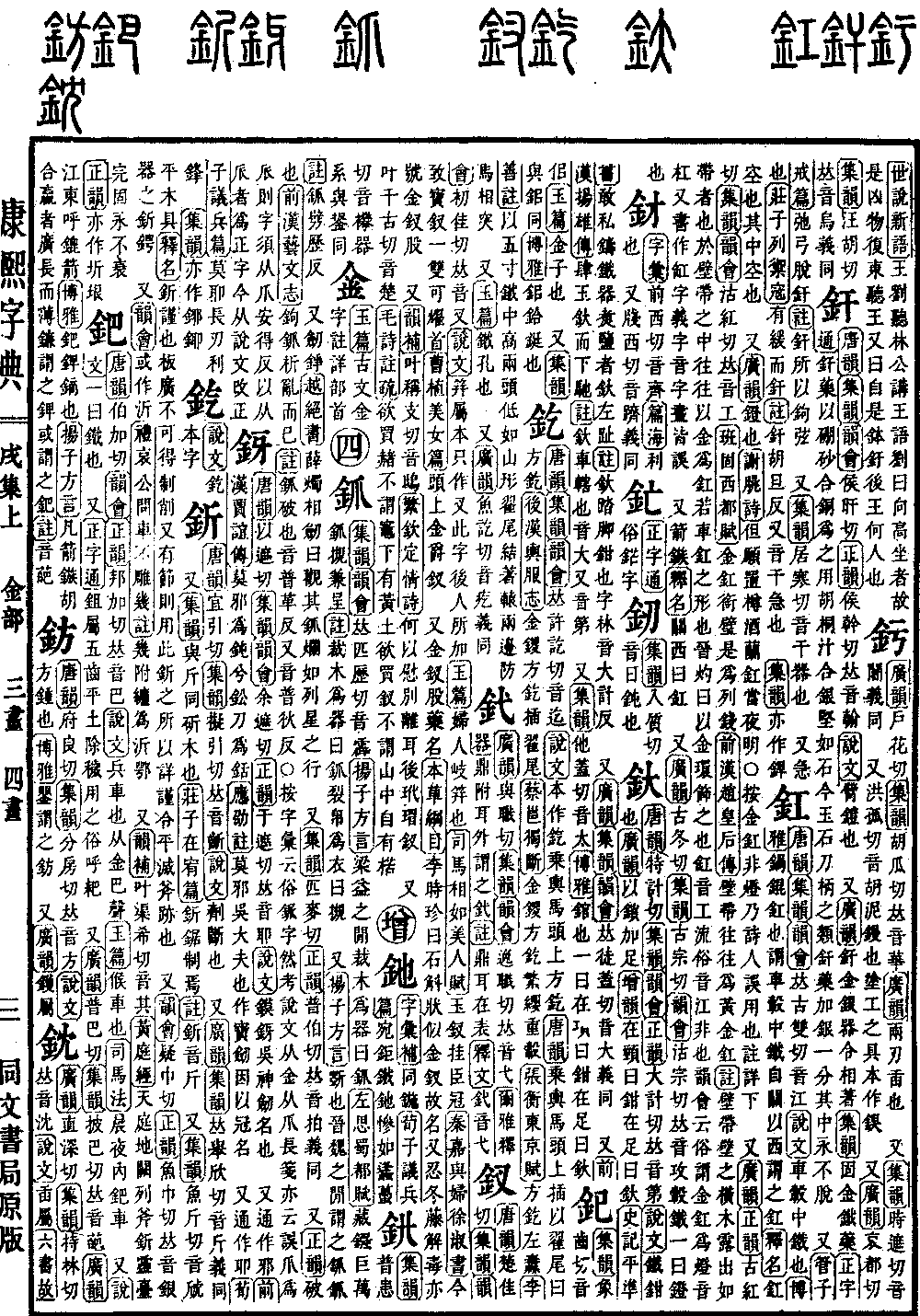
Xu Collection, Upper Volume
Radical: Metal (jīn)
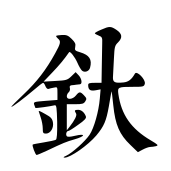
Character: di
Kangxi strokes: 11
Page 1297, Entry 07
Pronounced di (falling tone)
According to the Explaining Graphs and Analyzing Characters (Shuowen Jiezi), it is an iron shackle. According to the Broad Rhymes (Guangyun), it is a lock applied to the feet. According to the Augmented Rhymes (Zengyun), when placed on the neck it is called a cangue, and when placed on the feet it is called di. In the Records of the Grand Historian (Shiji), specifically the Treatise on the Balance of Standards and Weights (Pingzhun shu), it is written: Those who dare to privately cast iron implements or boil salt shall have their left foot shackled. The commentary notes that di refers to foot shackles. The Dictionary of Characters (Zilin) gives the pronunciation as di (falling tone).
Also pronounced da (falling tone). The meaning is the same.
Also, in the History of the Former Han (Qianhan shu), in the Biography of Yang Xiong, it is written: Arranging the jade linchpins and driving downwards. The commentary notes that di refers to the linchpin of a carriage. Pronounced da (falling tone). Also pronounced di (falling tone).
Also pronounced tai (falling tone). According to the Erudite Refinements (Boya), it refers to a lynchpin. Another source states that when placed on the neck it is called a cangue, and when placed on the feet it is called di.