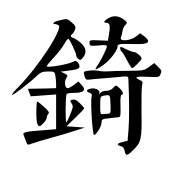
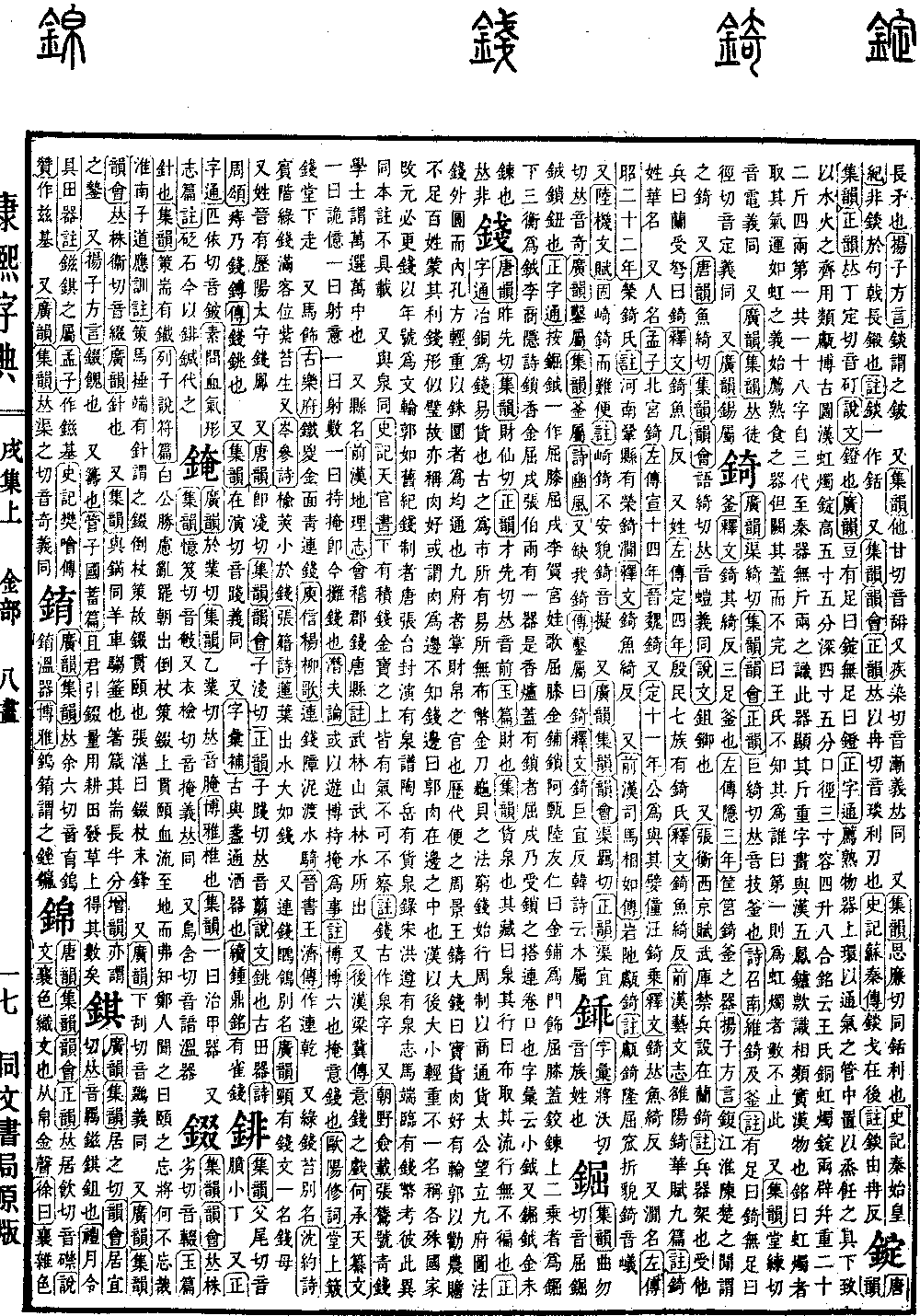
Xu Collection, Upper Volume
Radical: Metal (jīn)
Kangxi Strokes: 16
Page 1311, Entry 02
Pronounced jì. Refers to a type of cooking vessel. Book of Odes (Shijing), in the section Odes of Shao and the South (Zhaonan), mentions: "Only the tripod and the cauldron." The commentary explains: those with feet are called qi, and those without feet are called fu. The explanatory text states: qi refers to a three-legged cauldron. Zuo Tradition (Zuozhuan), third year of Duke Yin, records: "Utensils such as baskets, trays, tripods, and cauldrons." Master Yang's Dialects (Fangyan) states: A cauldron (fu) is called qi in the regions of the Yangtze, Huai, and Chu.
Also, pronounced yǐ. The meaning is the same. The Explaining Graphs and Analysis of Characters (Shuowen) defines it as a hoe.
Also, in Zhang Heng's Western Capital Rhapsody (Xijing Fu), it is written: "The military arsenal and forbidden weapons are stored in the lanqi." The commentary explains: This is a rack for storing weapons. A rack for general weapons is called lan, and a rack for crossbows is called qi.
Also a surname. Zuo Tradition (Zuozhuan), fourth year of Duke Ding, records the seven clans of the Yin people, among which is the Qi clan.
History of the Former Han (Qianhan), Treatise on Literature, records: "Nine chapters of the Luo Yang Qi Hua Rhapsody." The commentary explains: Qi is the surname, and Hua is the given name.
Also a given name. Mentioned in Mencius as Beigong Qi. Zuo Tradition (Zuozhuan), fourteenth year of Duke Xuan, mentions Wei Qi of the State of Jin. Also recorded in the eleventh year of Duke Ding: "The Duke rode with his favored attendant, Wang Qi."
Also the name of a mountain stream. Zuo Tradition (Zuozhuan), twenty-second year of Duke Zhao, mentions the Rongqi clan. The commentary explains: There is a Rongqi stream in Gong County, Henan.
Also found in Sima Xiangru's Biography in the History of the Former Han (Qianhan), describing "rocky and uneven cliffs." The commentary explains: yǎnqí describes the jagged and uneven appearance of mountain cliffs. Pronounced yí.
Also found in Lu Ji's Rhapsody on Literature (Wenfu): "Solid, uneven, and difficult to adapt." The commentary explains: qíqí refers to an unstable or insecure state. Pronounced nǐ.
Also, pronounced qí.
Guangyun defines it as a type of chisel. Jiyun defines it as a type of cooking vessel. Book of Odes (Shijing), in the section Odes of Binfeng, states: "Again you chip my chisel." The commentary explains: a tool of the chisel type is called qi. The Han version of the Odes states: It is a wooden tool.