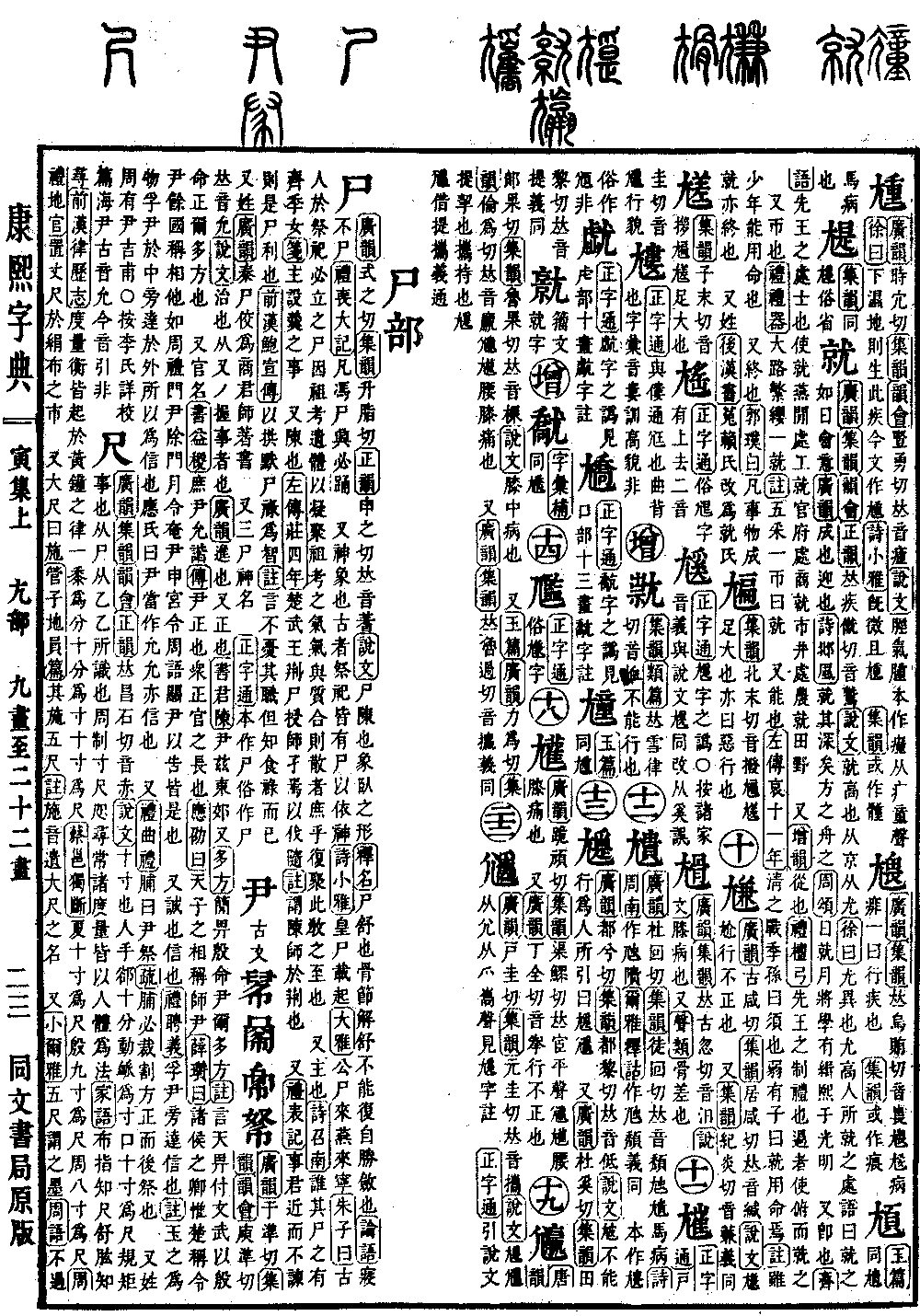
Yin Collection, Upper Volume
Radical: Corpse (shī)
Page 299, Entry 32
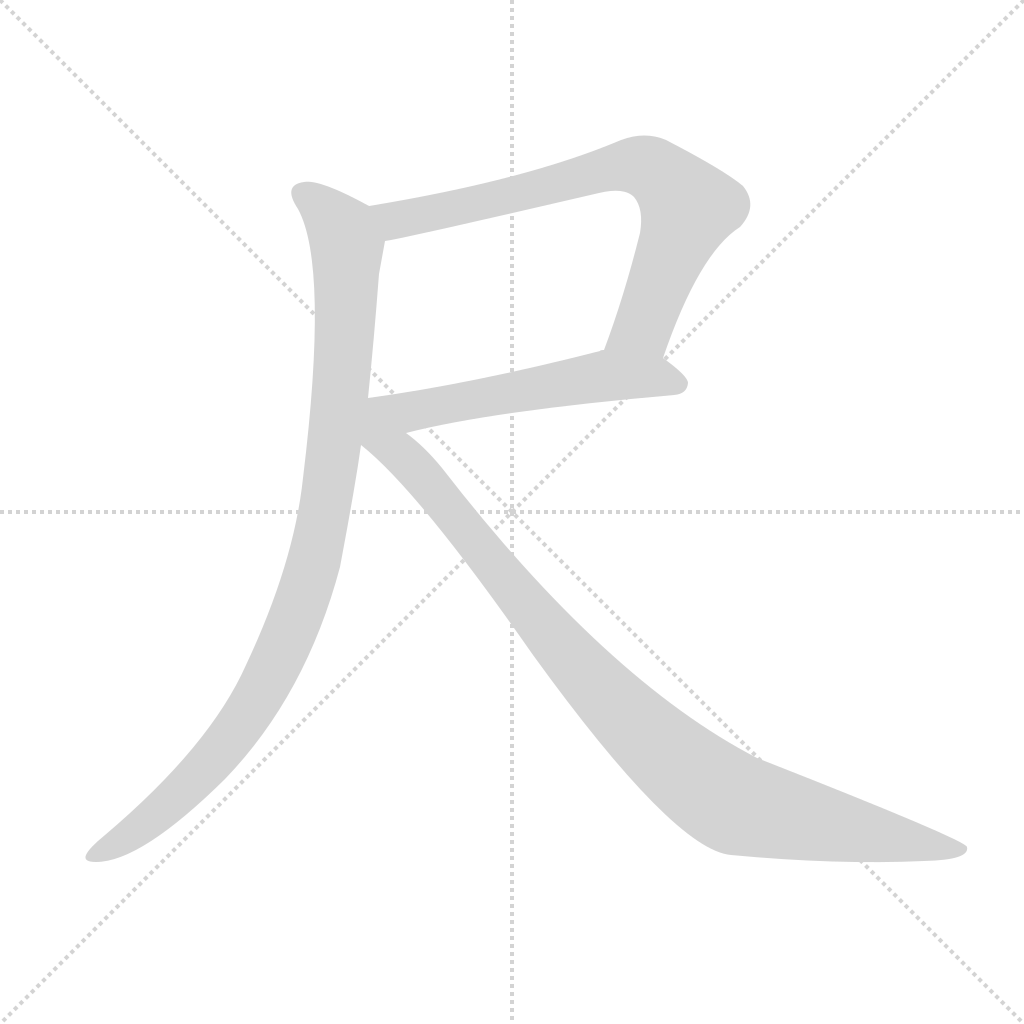
Broad Rhymes (Guangyun), Collected Rhymes (Jiyun), Rhyme Meetings (Yunhui), and Orthodox Rhymes (Zhengyun): Pronounced chi.
Explication of Written Characters (Shuowen Jiezi): Ten cun make one chi. For a person, the length from the wrist to the point where the pulse can be felt is ten fen, which is one cun, and ten cun make one chi; this is the standard used to establish rules and handle affairs. The character form is composed of corpse and yi. Yi is a symbol used for marking. The system of the Zhou dynasty: units of length such as cun, chi, zhi, xun, chang, and ren are all measurement standards based on the human body.
Family Sayings of Confucius (Kongzi Jiayu): By spreading the fingers one knows the length of a chi; by extending the arms one knows the length of a xun.
History of the Former Han (Qian Hanshu), Treatise on Harmonics and Calendrical Astronomy: Weights and measures all originate from the pitch pipe of the Yellow Bell; the width of a millet grain is one fen, ten fen are one cun, and ten cun are one chi.
Cai Yong, Discursive Monograph (Duduan): The Xia dynasty used ten cun for one chi, the Shang dynasty used nine cun for one chi, and the Zhou dynasty used eight cun for one chi.
Rites of Zhou (Zhouli), Commentary on the Administrator of Markets: In shops selling silk and cloth, place a zhang and a chi as standard implements.
Furthermore, a large chi is called a shi.
Guanzi, Chapter on Earth Resources (Diyuan Pian): Its shi is five chi. Note: Shi is pronounced yi; it is the name for a large chi.
Also, Little Erya: Five chi are called a mo.
Discourses of the States (Guoyu), Discourses of Zhou: Do not exceed the limits of mo, zhang, xun, and chang. Note: Five chi are one mo; two mo (ten chi) are one zhang. Nowadays, carpenters each use a five-chi long tool to build houses; this tool is called a mo, thus a mo is the five-chi tool used by master craftsmen.
Also, Record of Yearly Customs in the Tang Capital (Tang Nianxia Suishiji): The first day of the second lunar month is the Zhonghe Festival; the emperor bestows rulers upon ministers and relatives by marriage, calling it the regulation of the people.
There is also the expression law of three chi, which refers to the three-chi long bamboo slips used to record laws; therefore, the common expression for manipulating legal texts is to treat the three chi as a toy. Some now believe that three chi refers to a concrete object, which is incorrect.
Also, in the rhyme-harmonized reading, pronounced chuo.
Book of Odes (Shijing), Eulogies of Lu: To measure by xun and to measure by chi. Rhymes with the character ruo in the following line.
Rhyme Meetings (Yunhui): The character chi is also used interchangeably with chi.
Textual Research:
Explication of Written Characters (Shuowen Jiezi): The system of the Zhou dynasty: cun, chi, zhi, xun, chang, and various measures are all based on the human body. Following the original text, the character ren has been added after the character chang.
Rites of Zhou (Zhouli), Earth Official: In the silk and cloth markets, place a zhang and a chi. Following the original text, the reference to Earth Official has been changed to Commentary on the Administrator of Markets, and the character market has been changed to shop.