Zi Collection, Page Position: Upper
Radical: One (yī)
Bing
Kangxi Dictionary Stroke Count: 5
Page Number: Page 78, Line 2
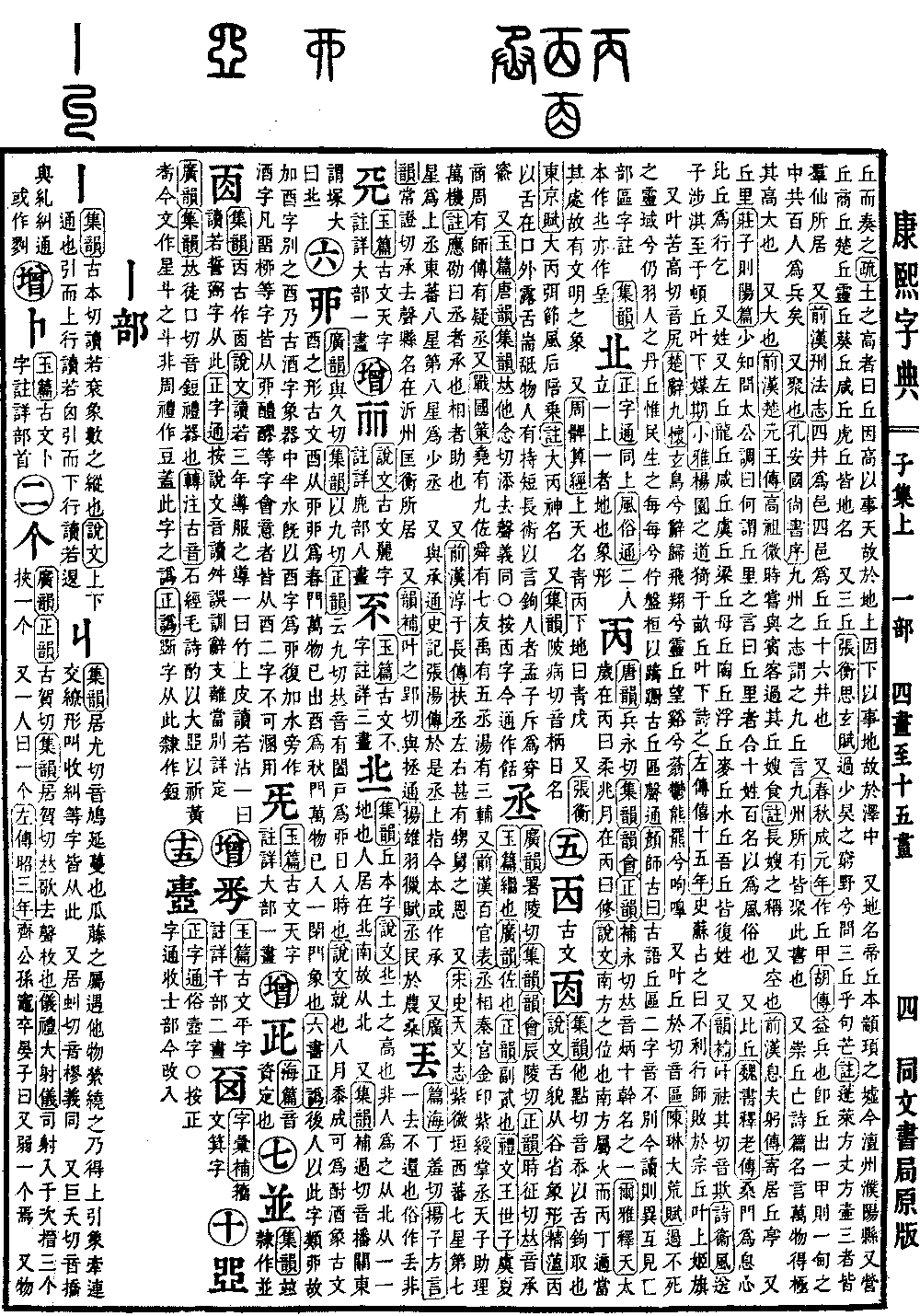
In the Tang Phonology (Tangyun), the pronunciation is a fanqie (syllabic fusion) of bīng and yǒng. In the Collected Rhymes (Jiyun), Rhyme Meeting (Yunhui), and Correct Rhymes (Zhengyun), the pronunciation is a fanqie of bǔ and yǒng. It sounds the same as the character bǐng. It is one of the Heavenly Stems. In the Erya (Erya), in the chapter Explaining the Heavens (Shitian), it is stated that when the Great Year resides in the position of bǐng, it is called róuzhào. When a month is in the position of bǐng, it is called xiū. The Explaining Graphs and Analyzing Characters (Shuowen Jiezi) states that it represents the southern direction. The south corresponds to fire, and since bǐng and dīng correspond to this direction, it symbolizes civilization. Furthermore, The Arithmetical Classic of the Gnomon and the Circular Paths of Heaven (Zhoubi Suanjing) states that the upper heaven is named qīngbǐng and the lower earth is named qīngwù. Also, in the Rhapsody on the Eastern Capital (Dongjing Fu) by Zhang Heng, it mentions the deity Dabing driving a chariot slowly with the deity Fenghou riding alongside. A commentary notes that Dabing is the name of a deity. Additionally, the Collected Rhymes (Jiyun) records the pronunciation derived from the fanqie bēi-bìng, sounding the same as the character bìng, which refers to a name for the sun.