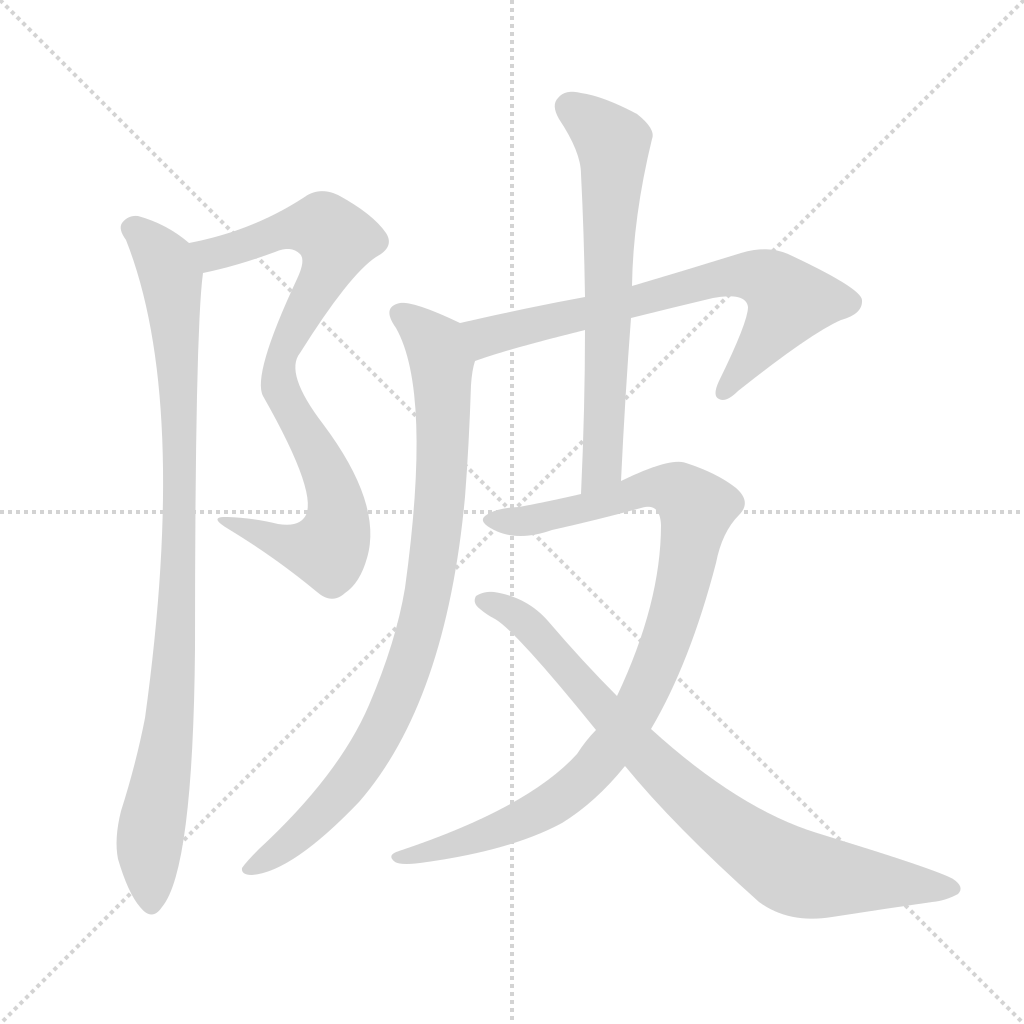
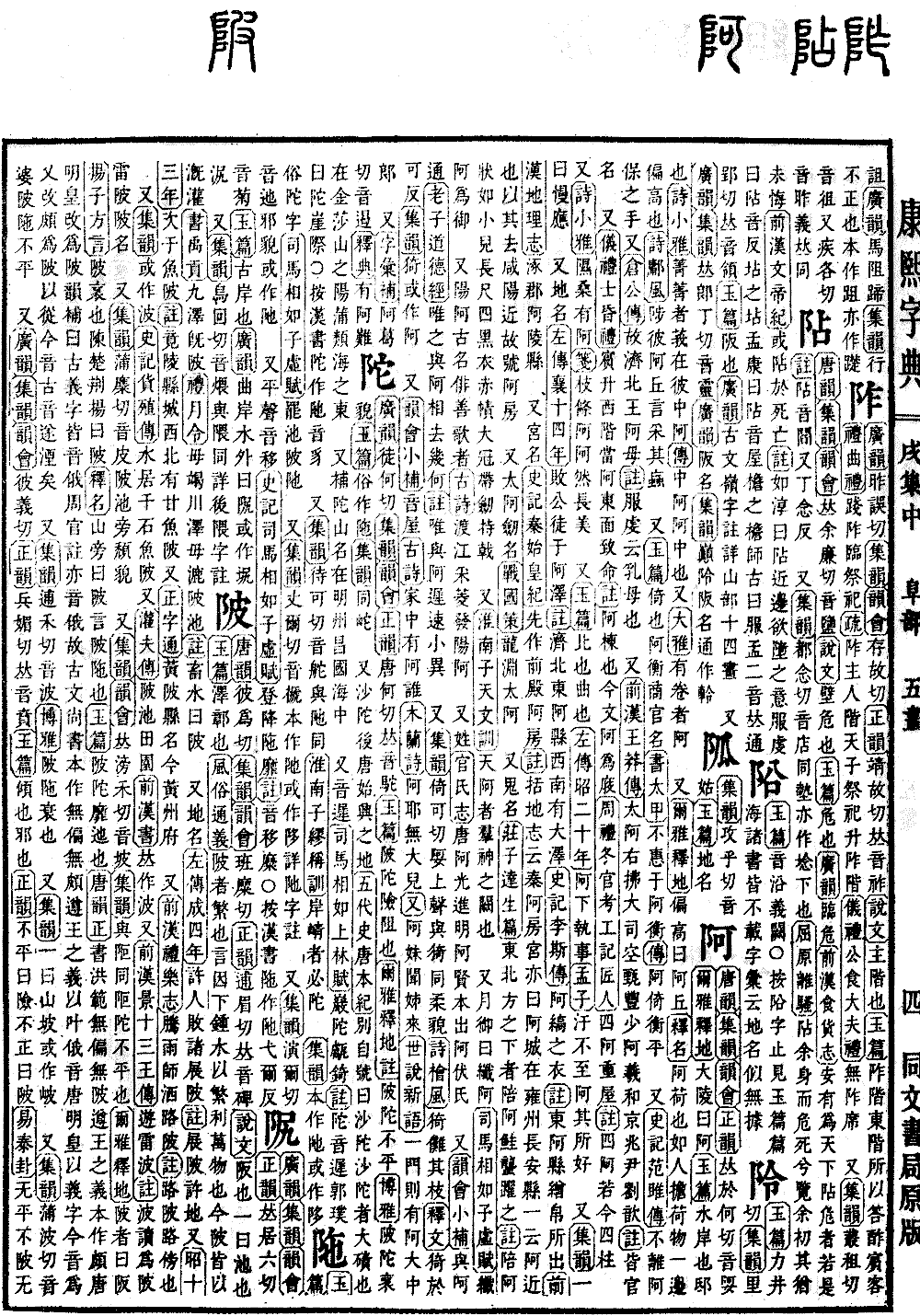
Xu Collection, Middle Volume, Radical: Mound (yì)
Po; Kangxi Stroke Count: 13; Page: Page 1348, Entry 10
Pronounced "bi wei qie" in Tang Yun, "ban mi qie" in Ji Yun and Yun Hui, and "bu mei qie" in Zheng Yun, similar to "bei".
Shuowen Jiezi explains it as "shan po" (mountain slope). Another explanation is "chi" (pond).
Yupian explains it as "ze zhang" (embankment of a water body).
Fēngsú Tōngyì states: Po means "fan" (to multiply). It means to use low-lying areas to store water, to nurture all things, and to benefit all things. The po of today are all used for irrigation.
Shu Jing, "Yu Gong" records: "Jiu ze ji po" (The nine great marshes were all embanked).
Li Ji, "Yue Ling" records: "Wu jie chuan ze, wu lu po chi." (Do not exhaust rivers and marshes, do not drain po and chi.) Annotation: A place where water is stored is called po.
Also used as a place name.
Zuo Zhuan, Duke Cheng, Year 4 records: "Xu ren bai zhu Zhan Po." (The people of Xu defeated them at Zhan Po.) Annotation: Zhan Po is a place in the state of Xu.
Also, "Zhao Gong, Year 13" records: "Ci yu Yu Po." (The army encamped at Yu Po.) Annotation: Northwest of Jingling county town is Gan Yu Po.
Also, Zheng Zitong records: Huang Po is the name of a county, belonging to the present-day Huangzhou Prefecture.
Also, Qian Han Shu, "Yue Shu Zhi" records: "Teng yu shi, sa lu po." (Summon the rain master to ascend, and sprinkle water by the roadside.) Annotation: Lu Po means by the roadside.
Also, Ji Yun sometimes writes it as "bo".
Shi Ji, "Huo Zhi Lie Zhuan" records: "Shui ju qian shi yu po." (Those living by the water had thousand-shi fish ponds.)
Also, "Guan Fu Zhuan" records: "Po chi tian yuan." Qian Han Shu writes it as "bo".
Also, Qian Han Shu, "Jing Shi San Wang Zhuan" records: "You lei bo." Annotation: "Bo" is pronounced "po". Lei Po is the name of a pond.
Also, Ji Yun is pronounced "pu mi qie", and read as "pi". "Po chi" describes a collapsed appearance.
Also, Ji Yun is pronounced "pang he qie", and read as "po".
Ji Yun is the same as "po". "Po tuo" means uneven.
Er Ya, "Shi Di" states: A sloping place is called "shan po".
Yangzi, Fang Yan states: Po means "xie" (sloping). It is called "po" in the regions of Chu, Jingzhou, and Yangzhou.
Shi Ming states: The side of a mountain is called "po", meaning "po tuo" (sloping and uneven).
Yupian explains: "Po tuo" means a continuous sloping appearance.
Tang Yun Zheng records: In the "Shu Jing, Hong Fan", the character "po" in "Wu pian wu po, zun wang zhi yi" was originally written as "po". Emperor Xuanzong of Tang changed it to "po". Yun Bu says: In ancient times, the character "yi" was always read as "e". The annotation of Zhou Guan also reads as "e". Therefore, the ancient text of "Shu Jing" was originally written as "Wu pian wu po, zun wang zhi yi" to rhyme with the sound "e". Emperor Xuanzong of Tang, because the character "yi" was then read as "ai", changed "po" to "po" to conform to the pronunciation of the time, and the ancient sound was thus lost.
Also, Ji Yun is pronounced "bu he qie", and read as "bo".
Bo Ya explains: "Po tuo" means decline and slope.
Also, Ji Yun has another explanation: mountain slope, sometimes written as "que".
Also, Ji Yun is pronounced "pu bo qie", and read as "po". "Po tuo" means uneven.
Also, Guang Yun, Ji Yun, Yun Hui are pronounced "bi yi qie", and Zheng Yun is pronounced "bing mei qie", read as "ben".
Yupian explains: Sloping, not upright.
Zheng Yun explains: Unevenness is called "xian", and lack of uprightness is called "po".
Yi Jing, "Tai Gua" states: "Wu ping bu po, wu wang bu fu." (There is no permanent flatness without slope, and no going without returning.)
Zhou Li, "Chun Guan, Dian Tong" records: "Po sheng san." (A distorted sound scatters.)
Shi Ji, "Wu Zong Shi Jia" records: The envoys and travelers in Handan city, because Peng Zu (King of Zhao) was treacherous and not upright (xian po), were unwilling to stay in Handan.