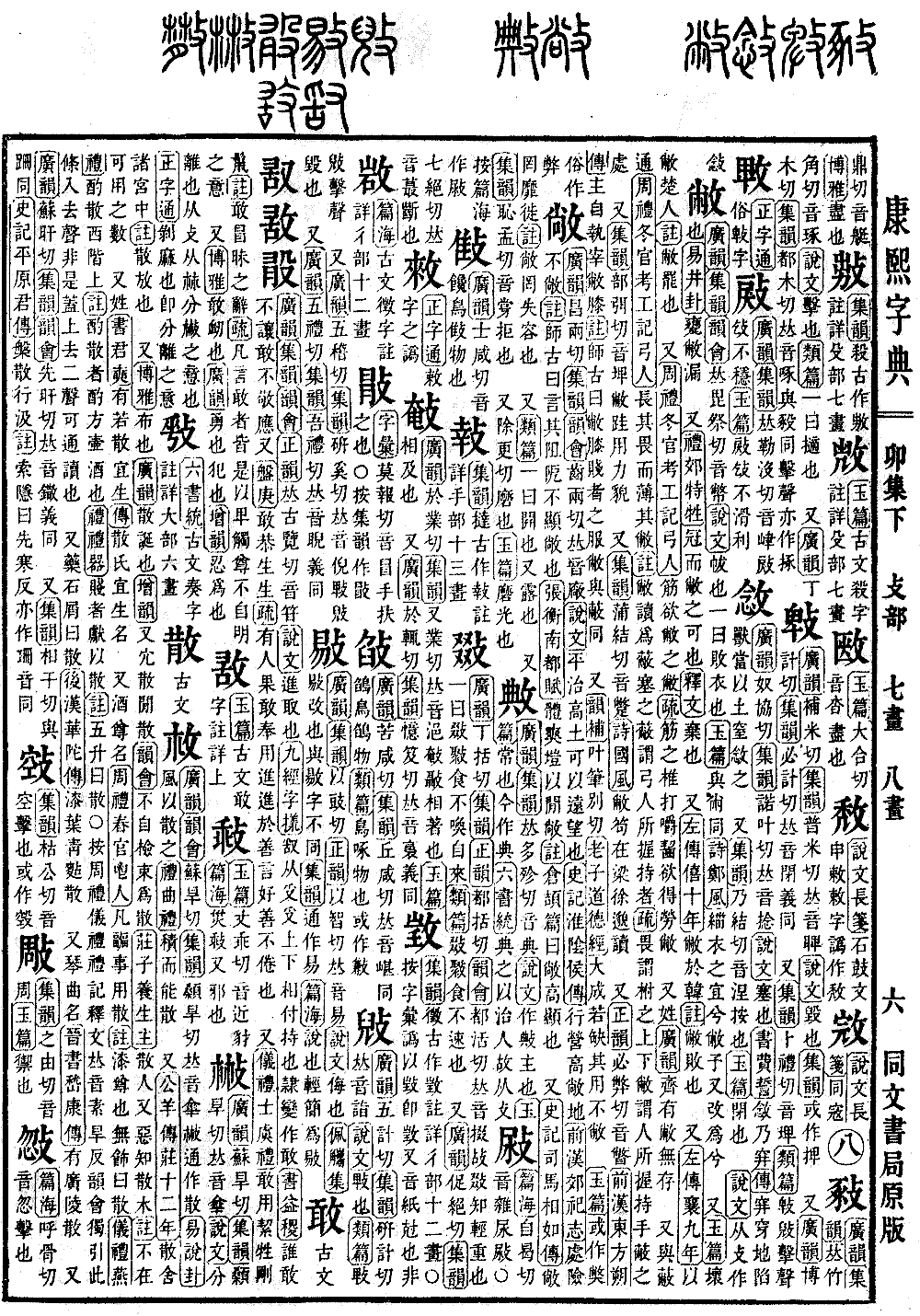
Mao Collection, Lower Volume
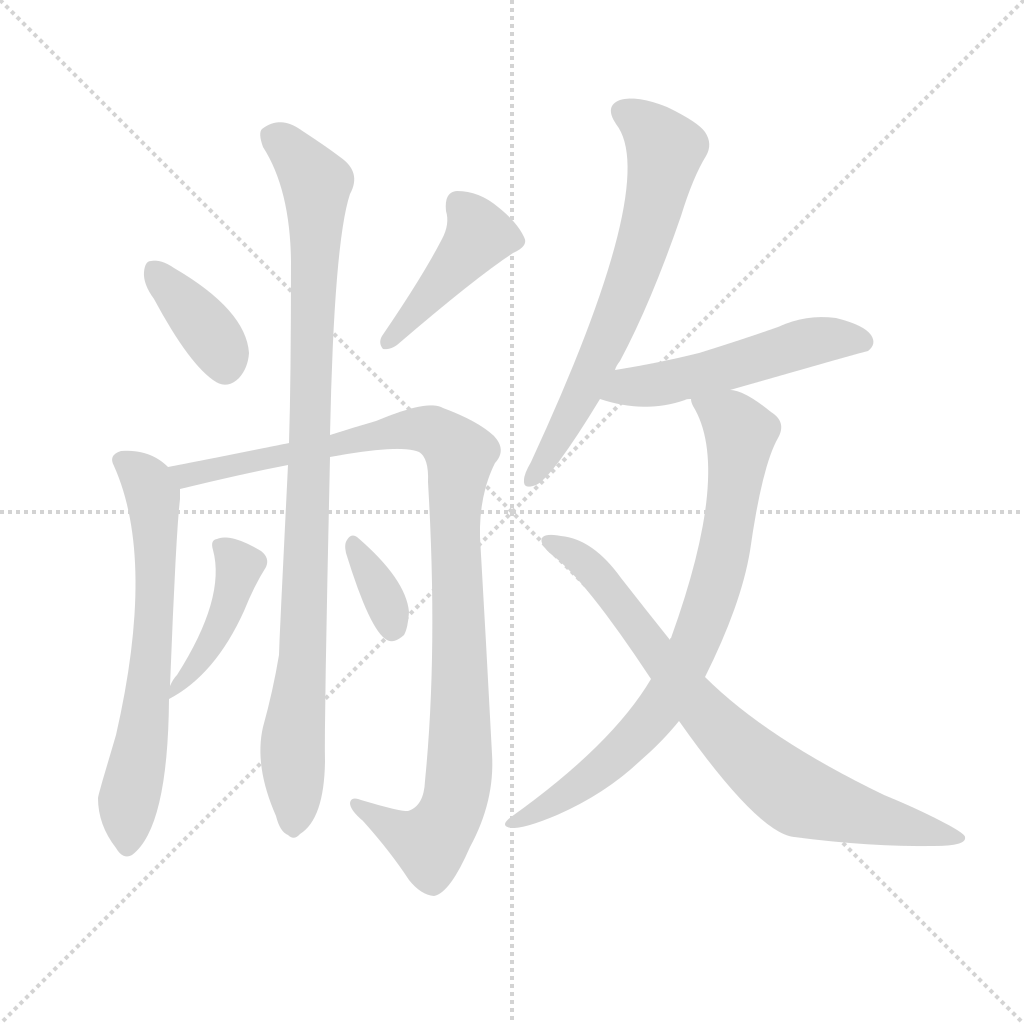
Radical: Tapping (pū)
Kangxi Strokes: 12
Page 472, Entry 11
Pronounced bi.
According to the Explaining Graphs and Analyzing Characters (Shuowen Jiezi), it refers to a banner. Another definition states it is worn-out clothing. According to the Jade Chapters (Yupian), it is the same as the character for worn out. In the Book of Odes (Shijing), in the Zheng Winds section: The black robes are suitable, when they are worn out I will have them remade.
Also, according to the Jade Chapters, it means ruined or broken. In the Book of Changes (Yijing), in the Well Hexagram: The jar is broken and leaking.
Also, in the Book of Rites (Liji), in the Suburban Sacrifice section: At the capping ceremony, one may cast it off. The Explication of Text (Shiwen) says this means to discard.
Also, in the Zuo Commentary (Zuo Zhuan), in the tenth year of Duke Xi: Defeated at Han. The commentary notes: Bi means to be defeated.
Also, in the Zuo Commentary (Zuo Zhuan), in the ninth year of Duke Xiang: To defeat the people of Chu. The commentary notes: Bi means to be exhausted.
Also, in the Rites of Zhou (Zhouli), Winter Officers, Artificers Record, Bow-makers section: Tendons should be thoroughly beaten. The sub-commentary states: The pounding and chewing of the tendons is to make them supple and worn down.
Also a surname. According to the Extensive Rhymes (Guangyun), there was a person named Bi Wucun in the state of Qi.
Also interchangeable with the character for cover. In the Rites of Zhou, Winter Officers, Artificers Record, Bow-makers section: Lengthening its grip and thinning its covering. The commentary notes: Bi is read as the bi in covering or blocking, referring to the place where the bow-maker holds the bow. The sub-commentary states: The grip refers to the top and bottom of the handle; bi refers to the place where the hand covers the hold.
Also, according to the Collection of Rhymes (Jiyun), pronounced pi. Bi-kui describes the appearance of exerting force.
Also, according to the Collection of Rhymes (Jiyun), pronounced bie. In the Book of Odes (Shijing), National Airs: The worn-out fish trap is on the dam. Xu Miao reads it thus.
Also, according to the Correct Rhymes (Zhengyun), pronounced pie. In the History of the Former Han (Qianhan Shu), Biography of Dongfang Shuo: The master himself held the official's knee-cover. The commentary by Yan Shigu says: A knee-cover is the clothing of a person of low status. Bi is synonymous with the character for cover.
Also, according to the Rhyme Supplement (Yunbu), rhyming with bie. In the Classic of the Way and Virtue (Dao De Jing): Great completion seems lacking, but its use is not exhausted.
The Jade Chapters notes that it is sometimes written with an alternate form. The common form is written as the character for corruption.