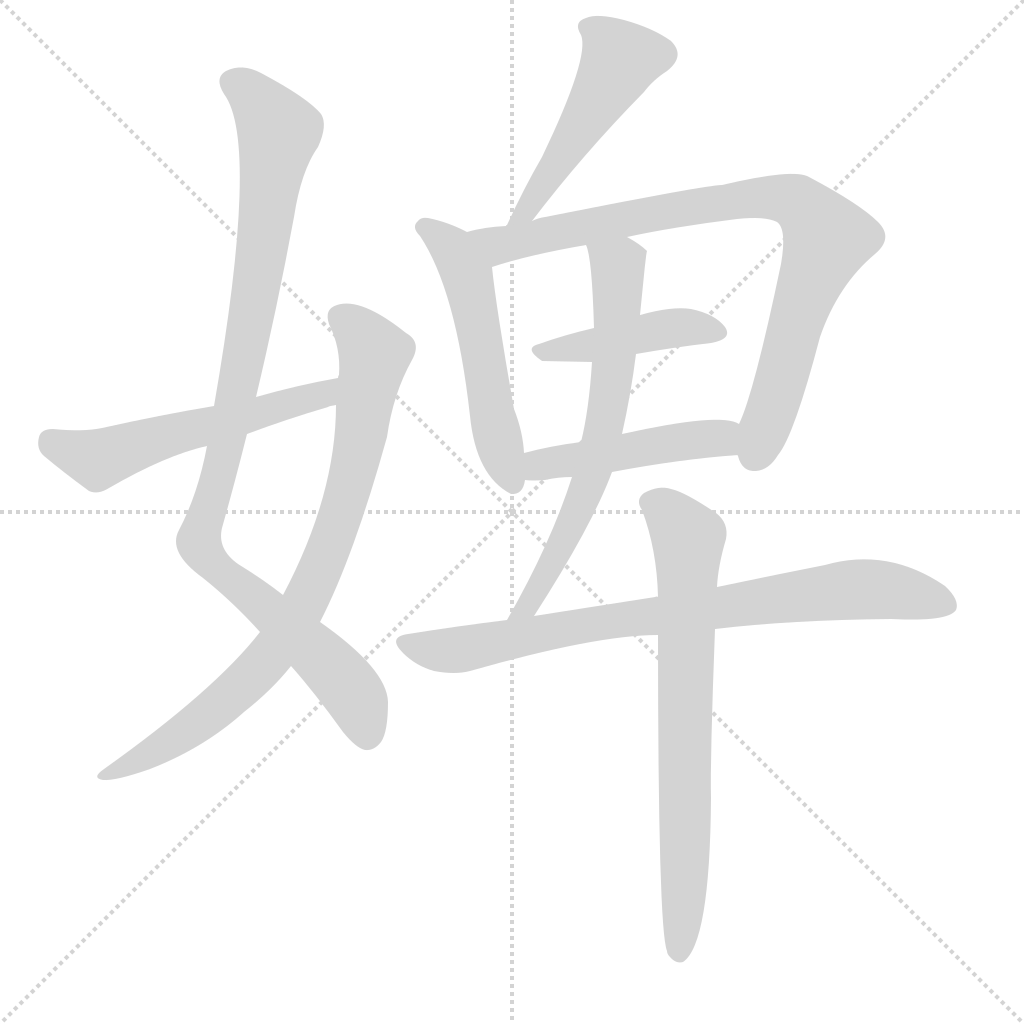
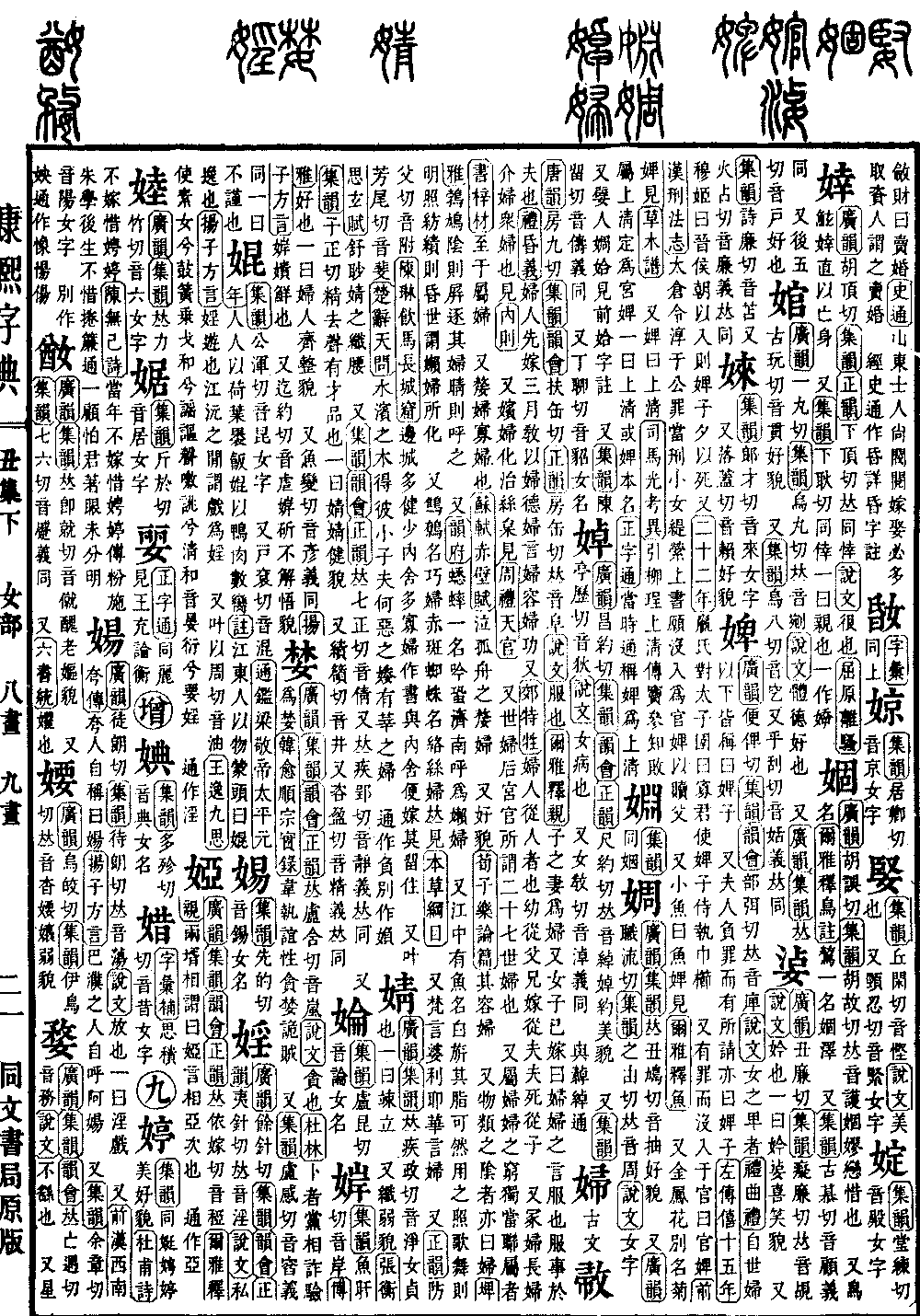
Chou Collection, Lower Volume
Radical: Woman (nǚ)
Bi
Kangxi strokes: 11
Page 265, Entry 10
Broad Rhymes (Guangyun): Pronounced bi (falling tone). Collected Rhymes (Jiyun) and Rhymes Collection (Yunhui): Pronounced bi (rising tone).
Explaining Graphs and Analyzing Characters (Shuowen): A woman of low status.
Book of Rites (Liji), Section on Miscellaneous Customs (Quli): From the rank of court lady downwards, all refer to themselves as servant. Also, when a noble lady has committed an offense and makes a request, she also refers to herself as servant.
Zuo Commentary (Zuo Zhuan), 15th Year of Duke Xi: The concubine said: If the Lord of Jin enters in the morning, then this servant will die in the evening.
15th Year of Duke Xi: Lady Ying replied to Crown Prince Yu: My humble ruler sent this servant to wait upon you with towels and combs.
Also, those who are confiscated into government service due to crimes are called official servants.
History of the Former Han Dynasty (Qian Han Shu), Treatise on Law: The Prefect of the Grand Granary, Chunyu Gong, was sentenced to punishment. His young daughter, Tiying, submitted a petition requesting to be confiscated as an official servant to redeem her father.
Also, small fish are called fish servants; see the Erya, Explaining Fishes.
Also, the touch-me-not flower, also known as chrysanthemum servant; see the Manual of Plants and Trees (Caomu Pu).
Also, a servant is called Shangqing.
Sima Guang, Examination of Differences (Kaoyi): Citing the Biography of Shangqing by Liu Cheng, when Dou Can knew of his impending defeat, he entrusted Shangqing, who was determined to be a palace servant. Another source says Shangqing might be the original name of the servant.
Correct Meaning Integrated (Zhengzitong): At the time, it was common to refer to a servant as Shangqing.
Editorial note: In the Zuo Commentary, 15th Year of Duke Xi, the text says the Lord of Jin. Following the original text, the reference to the Marquis of Jin has been corrected to the Lord of Jin.