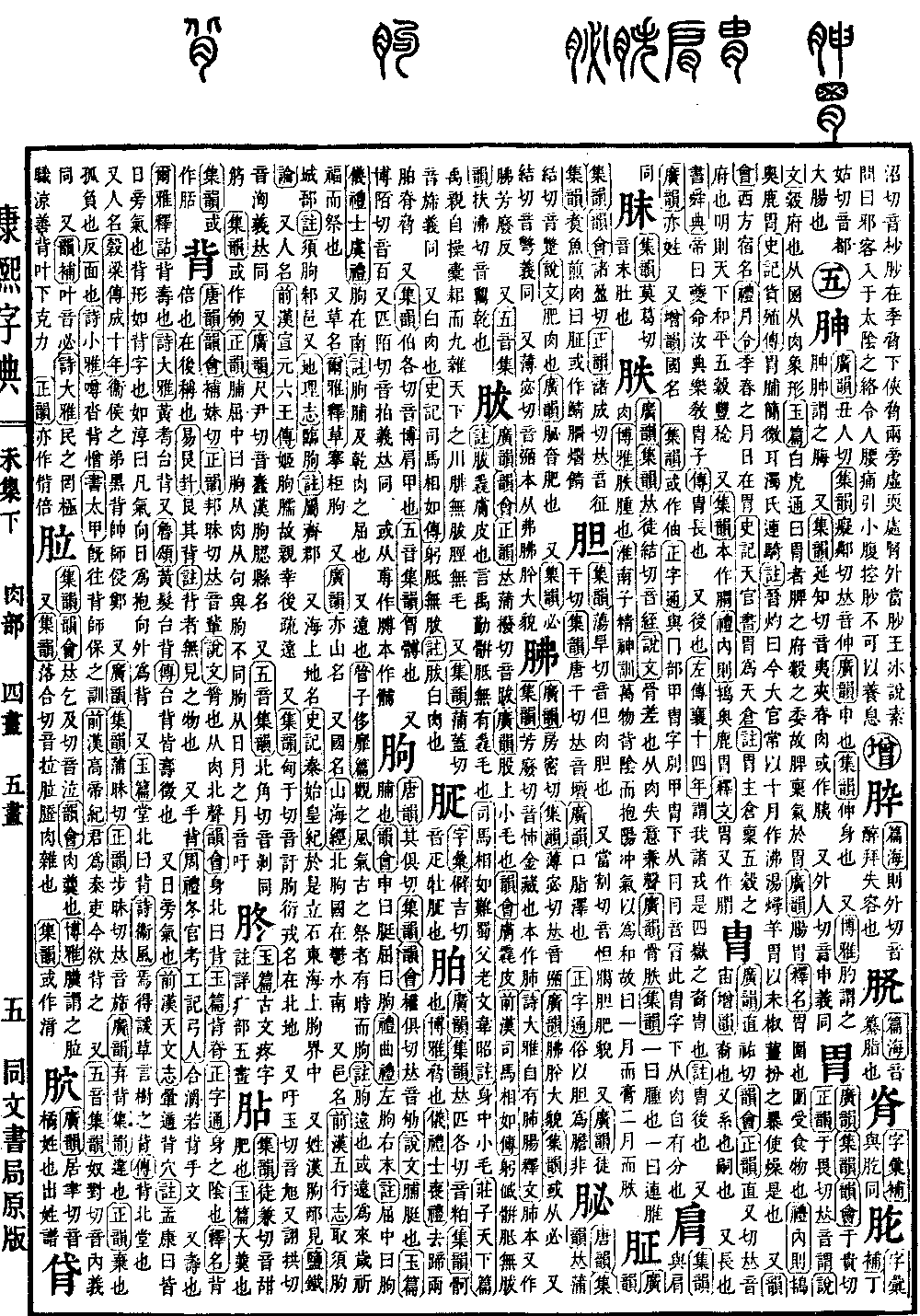
Wei Collection, Lower Volume
Radical: Meat (ròu)
Kangxi strokes: 11
Page 977, Entry 21
Pronounced bèi (falling tone).
According to the Tang Rhymes (Tangyun) and the Rhyme Collection (Yunhui), the pronunciation is bu-mei; according to the Correct Rhymes (Zhengyun), the pronunciation is bang-mei.
In the Discussion of Script (Shuowen), it is defined as the spine or back. The character is formed from the radical for meat with the phonetic component bei.
The Rhyme Collection (Yunhui) states that the back of the body is called bei.
The Jade Chapters (Yupian) defines it as the spine.
The Correct Meaning (Zhengzitong) refers to it as the shaded side of the body.
The Explanation of Names (Shiming) notes that bei, or back, implies the meaning of double, referring to it being located at the rear of the body.
In the Book of Changes (Yijing), the Gen hexagram symbolizes the back. The commentary states that the back is an unseen part of the body.
It also refers to the back of the hand.
In the Rites of Zhou (Zhouli), section on the Artificers Record (Kaogongji), it describes the grain of lacquer as resembling the patterns on the back of a hand.
It also refers to longevity.
In the Literary Expositor (Erya), the definition of bei is long life.
In the Book of Odes (Shijing), it mentions old people with yellow hair and hunched backs. The tradition states that a hunched back is a symbol of long life.
It also refers to cloud formations near the sun.
In the History of the Former Han (Qianhanshu), section on Astronomical Records, it mentions solar halos with auxiliary phenomena. The commentary by Meng Kang states that these are cloud formations near the sun shaped like the character for back. Ru Chun states that when clouds face the sun, it is called bao (embracing), and when they face away, it is called bei (turning the back).
The Jade Chapters (Yupian) notes that the north side of a hall is called bei.
In the Book of Odes (Shijing), it asks where one might find a plant to dispel sorrow, suggesting it be planted by the northern hall. The tradition states that bei here refers to the northern hall.
It is also used as a personal name.
In the Guliang Commentary (Guliangzhuan), it mentions Heibei, the younger brother of the Marquis of Wei, leading an army to invade the state of Zheng.
Pronounced pèi (falling tone).
According to the Wide Rhymes (Guangyun) and the Collected Rhymes (Jiyun), the pronunciation is pu-mei; according to the Correct Rhymes (Zhengyun), the pronunciation is bu-mei.
The Wide Rhymes (Guangyun) defines it as to abandon or to deviate from.
The Collected Rhymes (Jiyun) defines it as to disobey or go against.
The Correct Rhymes (Zhengyun) defines it as to abandon, to fail, or to be on the reverse side.
In the Book of Odes (Shijing), it describes people laughing face-to-face while harboring resentment behind one's back.
In the Classic of History (Shujing), it refers to past actions that violated the teachings of one's mentors and guardians.
In the History of the Former Han (Qianhanshu), it recounts that one who was originally a Qin official now turns to betray the state.
Pronounced nèi (falling tone).
The meaning is the same.
It is also used to rhyme with bi.
In the Book of Odes (Shijing), it describes the conduct of the common people as having no standard, due to the harsh and fickle nature of their rulers. This rhymes with the following line regarding the strength of the administration.
The Correct Rhymes (Zhengyun) notes it is also written in variant forms (bèi) and (bèi).