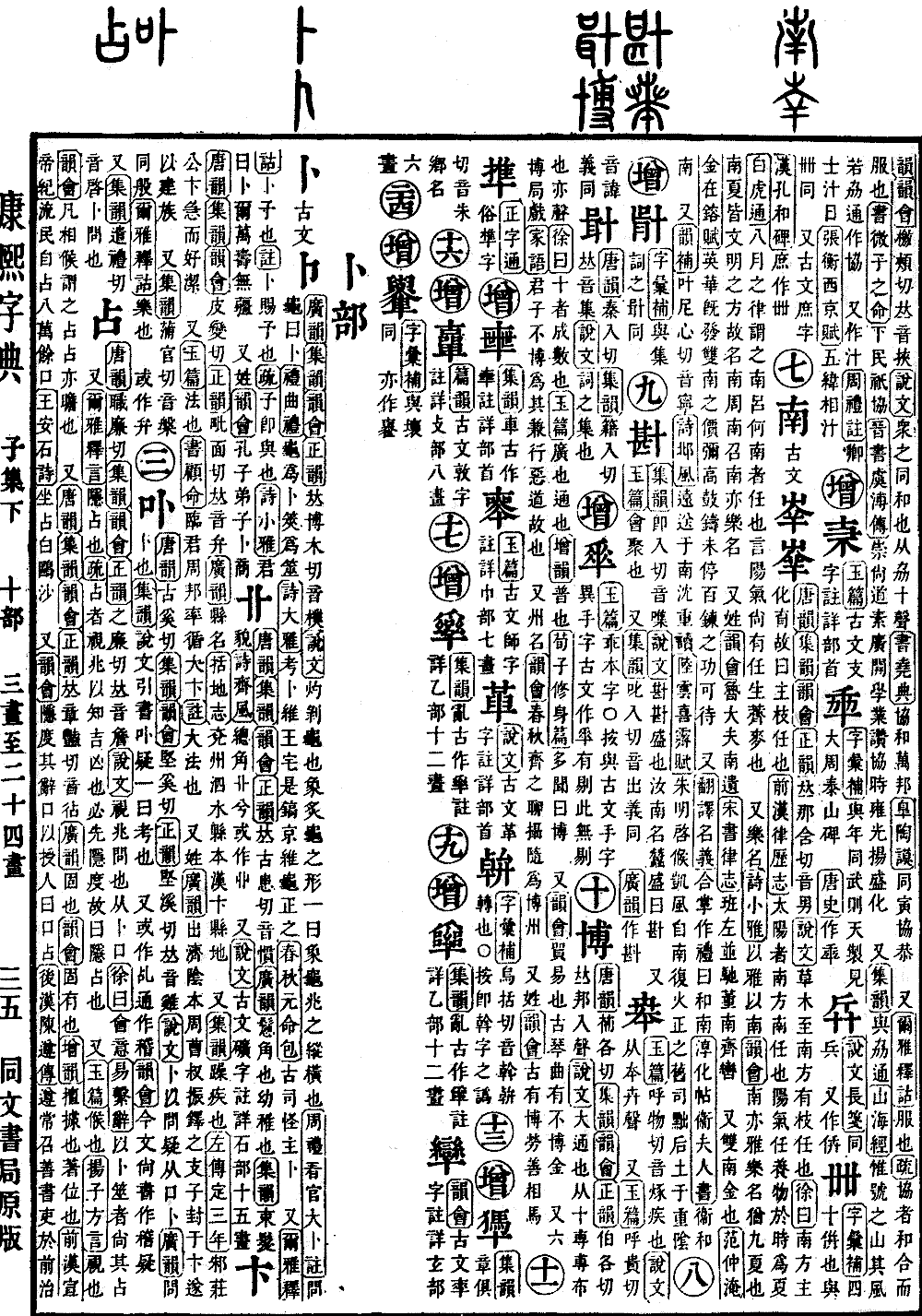
Zi Collection, Page Position: Lower
Radical: Divination (bǔ)
Kangxi Dictionary Strokes: 17
Page 157, Entry 25
Ancient texts record in "Guangyun", "Jiyun", "Yunhui", "Zhengyun", pronounced "Bo mu qie", same sound as "pu".
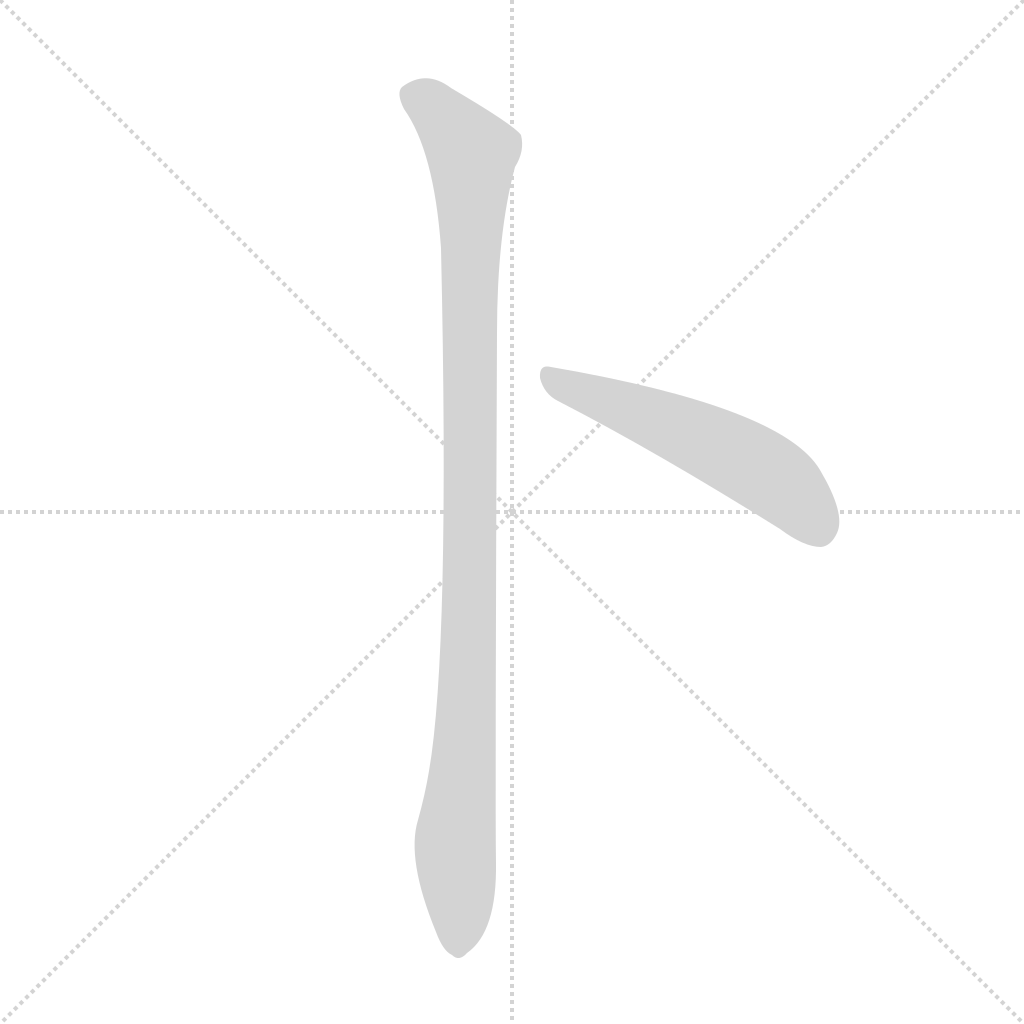
"Shuowen Jiezi" explains: To divine by scorching tortoise shells with fire. The character shape simulates the appearance of scorching tortoise shells. Another theory is that it simulates the crisscrossing cracks of tortoise shells.
"Zhou Li - Chun Guan - Da Bu Zhu" states: To inquire of tortoise shells is called "bu".
"Liji - Qu Li" records: To divine with tortoise shells is called "bu", to divine with yarrow stalks is called "shi".
"Book of Odes - Da Ya" writes: The King of Zhou divined to ask for guidance, and decided to establish the capital at Haojing; the tortoise shells showed auspicious signs.
"Chun Qiu - Yuan Ming Bao" records: In ancient times, there was an official position called "Si guai" who was in charge of divination.
Furthermore, "Erya - Shigu" explains: "Bu" has the meaning of "to give".
Note: Bu means to bestow.
Commentary: Yu means to give.
"Book of Odes - Xiao Ya" states: The king said he would bestow upon you, and that your longevity would be boundless.
There is also the surname "Bu".
"Yunhui" records: Confucius' disciple Bu Shang (also known as Zi Xia).