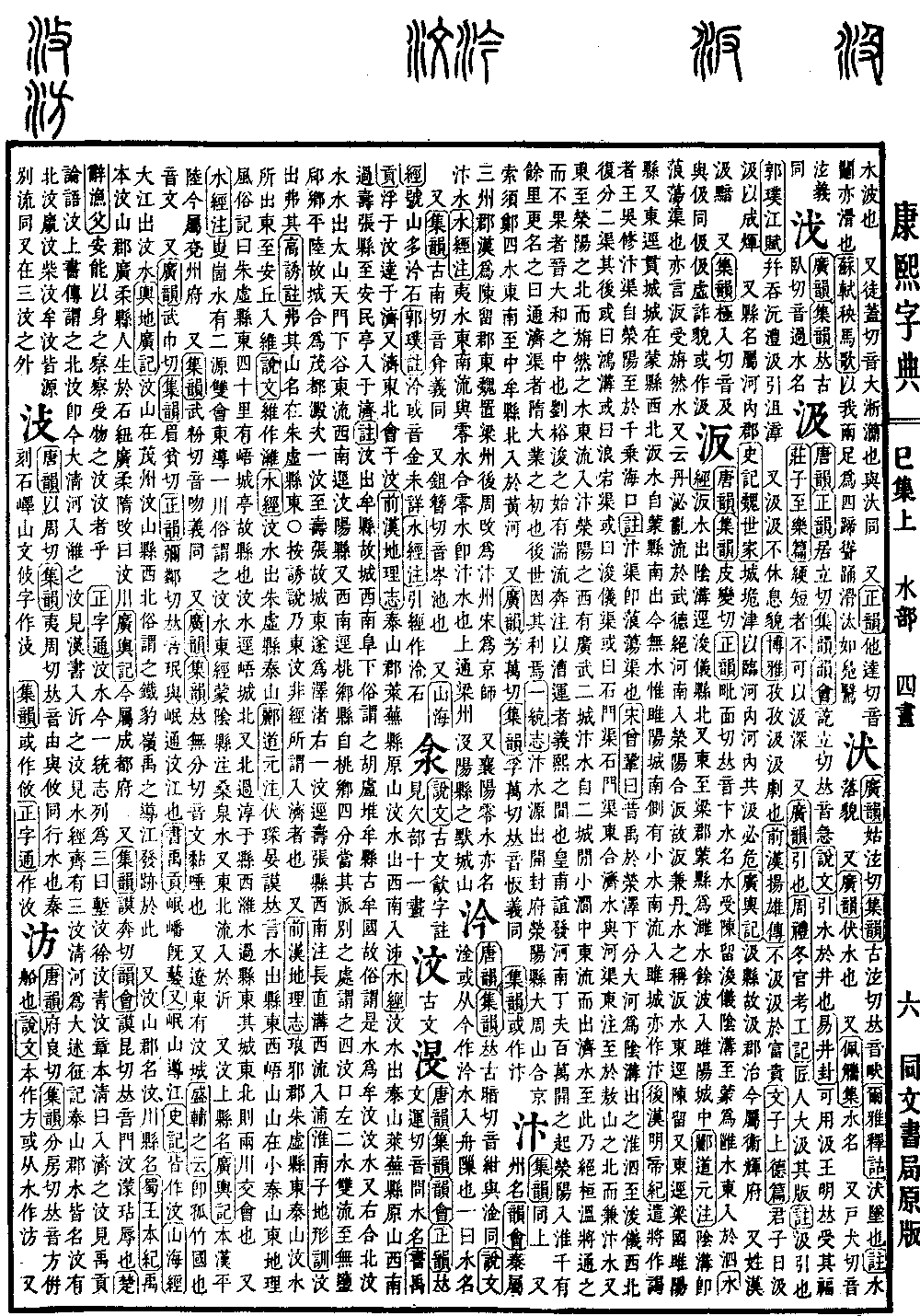
Si Collection, Upper Volume
Radical: Water (shuǐ)
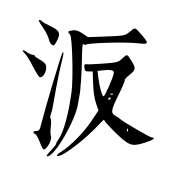
Bian
Kangxi stroke count: 8
Page 608, Entry 04
Pronounced biàn. Name of a river. The water flows from Yinyi Valley in Chenliu, and upon reaching Meng County is called Yong Water, flowing eastward into the Si River.
Classic of Waterways (Shuijing): The Bian River originates at Yinyi Valley and flows past the north of Junyi County. It continues eastward to Meng County in Liang Commandery, where it is called Sui Water. The remainder of the water flows into Suiyang City.
Annotation by Li Daoyuan: Yinyi Valley is the same as the Langdang Canal, also known as the Bian, which receives the Zhanran Water. It is also said that the Dan River and the Mi River flow together; during the Wude era, they were cut off from the Yellow River, flowing south to merge with the Bian River at Xingyang, hence the Bian River also carries the name of the Dan River. The Bian River flows east through Chenliu, passes through Suiyang County in the Liang state, and continues east past Guancheng. The city is northwest of Meng County. The Bian River flows out from the south of Meng County; currently, there is no water there. Only a small stream remains south of Suiyang City, flowing south into Jucheng. It is also written in a variant form (biàn).
Book of the Later Han (Hou Hanshu), Annals of Emperor Ming: Sent the court architect Wang Wu to repair the Bian Canal, stretching from Xingyang to the mouth of the sea at Qiansheng.
Annotation: The Bian Canal is the same as the Langdang Canal.
Zeng Gong of the Song Dynasty states: In the past, Great Yu diverted the Yellow River below Xingze to create the Yinyi Valley, which flowed out toward the Huai and Si Rivers. Northwest of Junyi, it split into two canals. Later, these were variously called the Hong Canal, the Langdang Canal, the Junyi Canal, or the Shimen Canal. The Shimen Canal flowed east to merge with the Ji River, continuing east with the river canals to the north of Ao Mountain, where it took on the name of the Bian River. It continued east to the north of Xingyang, where the Zhanran River flowed east into the Bian River. West of Xingyang stand the two Guangwu cities; the Bian River flows east through a small gap between the two, where the Ji River ceases. Huan Wen intended to dredge it but was unsuccessful during the Taihe era of the Jin Dynasty. Liu Yu dredged it, which allowed for the first time for rapid currents to flow through. It was used for grain transport during the Yixi era. Huangfu Yi conscripted one million laborers from Henan to excavate it, extending from Xingyang to the Huai River, a distance of over one thousand li. It was renamed the Tongji Canal in the early Daye era of the Sui Dynasty, and later generations relied upon its convenience.
Unified Geography (Yitongzhi): The source of the Bian River is Dazhou Mountain in Xingyang County, Kaifeng Prefecture. It collects the waters of the Jing, Suo, Xu, and Zheng rivers, flowing southeast to Zhongmu County and north into the Yellow River.
Pronounced fàn. The meaning is the same.
Compiled Rhymes (Jiyun): Sometimes written in a variant form (biàn).