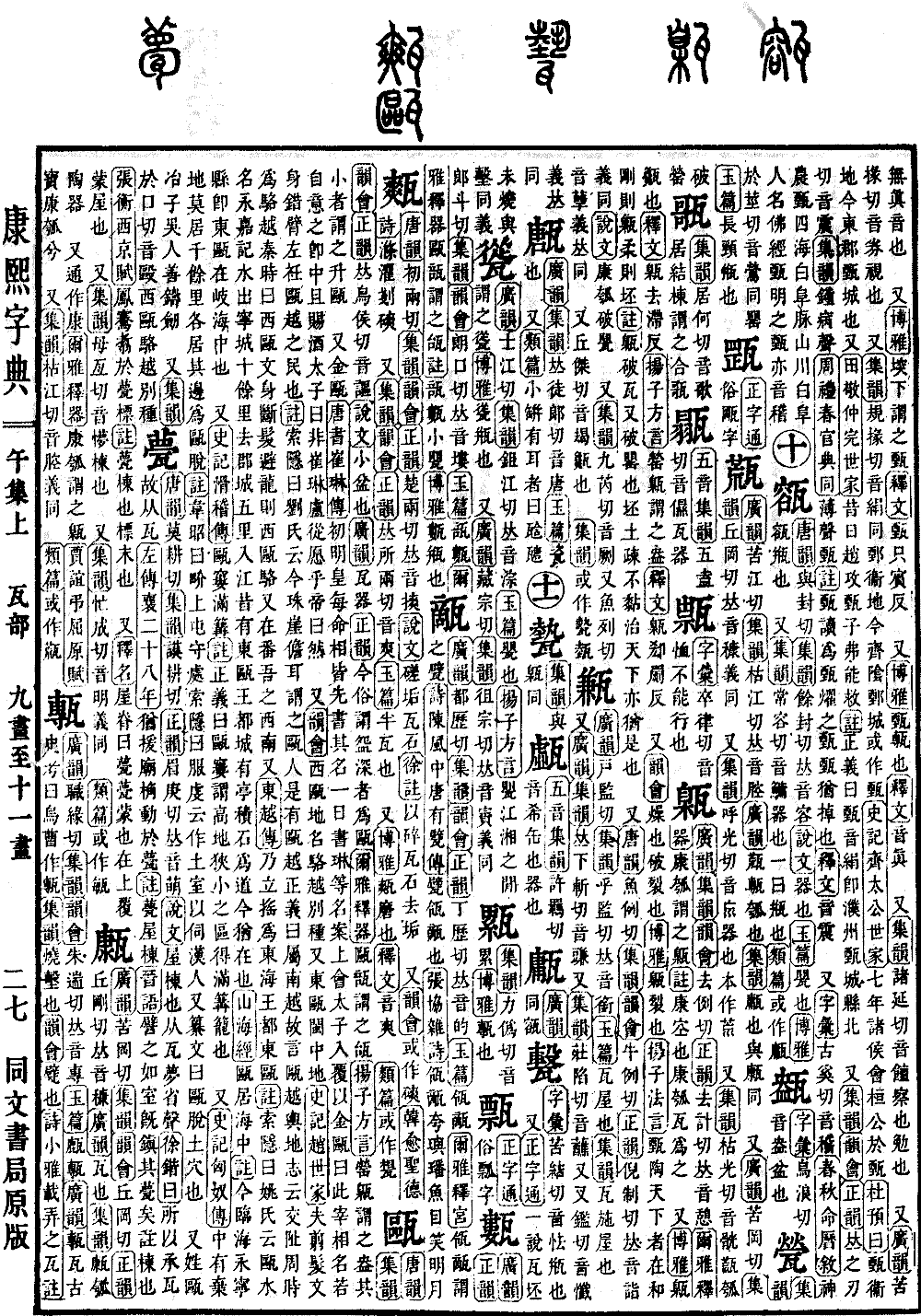
Wu Collection, Upper Volume
Radical: Tile (wǎ)
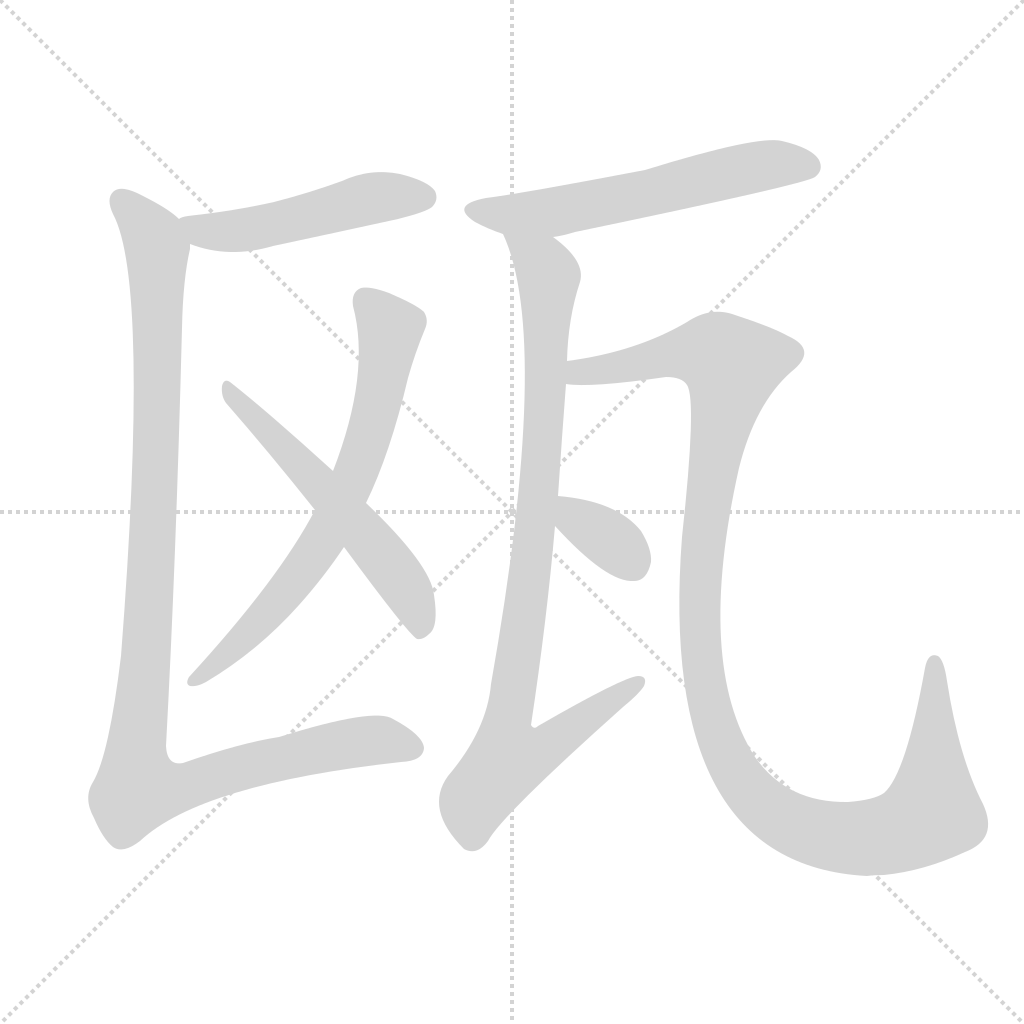
Ou
Kangxi Stroke Count: 16
Page 751, Entry 01
Pronounced ou.
According to the Explanation of Graphs and Analysis of Characters (Shuowen Jiezi): a small basin.
According to the Broad Rhymes (Guangyun): a ceramic vessel.
According to the Correct Rhymes (Zhengyun): today, in common parlance, a deep bowl is called an ou.
According to the Approaching Elegance (Erya), in the section on utensils: a vessel called an ou bu is known as a yi.
According to the Dialects (Fangyan) by Yang Xiong: a ying-yi is called an ang, and its smaller version is called a sheng-ou.
Also, a golden ou. According to the History of Tang (Tangshu), Biography of Cui Lin: Originally, whenever the Emperor (Xuanzong) appointed a prime minister, he would first write the name down. One day, he wrote the names of Lin and others on a desk. Just then, the Crown Prince entered, and the Emperor covered the names with a golden ou, saying, "These are the names of the prime ministers. If you can guess them, you will be rewarded with wine." The Prince said, "Are they not Cui Lin and Lu Congyuan?" The Emperor replied, "Correct."
Also, according to the Rhyme Compendium (Yunhui): Xi'ou, a place name; a separate group of the Luoyue people.
Also, Dong'ou, a place in the Min region. According to the Records of the Grand Historian (Shiji), Hereditary House of Zhao: "Cutting hair and tattooing bodies, crossing arms and wearing robes wrapped to the left; these are the people of Ou-Yue." The commentary (Suoyin) says: The Liu family says that today Zhuya and Dan'er are called the Ou people; thus, there is an Ou-Yue. The Correct Meaning (Zhengyi) says: It belongs to Nanyue, hence it is called Ou-Yue. The Record of Geography (Yudizhi) says: Jiaozhi was called Luoyue during the Zhou dynasty, and was called Xi'ou during the Qin dynasty. Tattooing bodies and cutting hair to avoid dragons; the Xi'ou-Luo were to the southwest of Fanwu.
Also, according to the Biography of Eastern Yue (Dongyue Zhuan): "Then Yao was established as the King of Donghai, with his capital in Dong'ou." The commentary (Suoyin) says: The Yao family says that Ou is the name of a river. The Record of Yongjia states: The river emerges ten or more li from Ningcheng and enters the river five li from the commandery seat. Previously, there was the capital city of the King of Dong'ou, which had a pavilion and a path made of piled stones, which still exist today. The Classic of Mountains and Seas (Shanhaijing) states: "The Ou dwell in the middle of the sea." The commentary says: Today, Yongning County in Linhai is Dong'ou; it is in the middle of the Qihai sea.
Also, according to the Records of the Grand Historian (Shiji), Biographies of Masters of Wit (Huaji): "Ou-ju filled the basket." The commentary (Zhengyi) says: Ou-ju refers to a high, narrow, and small plot of land, where one gathers enough to fill a basket.
Also, according to the Records of the Grand Historian (Shiji), Biography of the Xiongnu: There was abandoned land where no one lived for over a thousand li; each side established an outuo along its border. The commentary by Wei Zhao says: A place for garrison troops on the border. The commentary (Suoyin) says: Fu Qian says it is building earthen chambers to watch for the Han people. The Zuanwen says: Outuo is an earthen pit.
Also a surname. Ouyezi, a man of Wu, was skilled in casting swords.
Also, according to the Collected Rhymes (Jiyun): Pronounced ou. Xi'ou, a separate group of the Luoyue people.