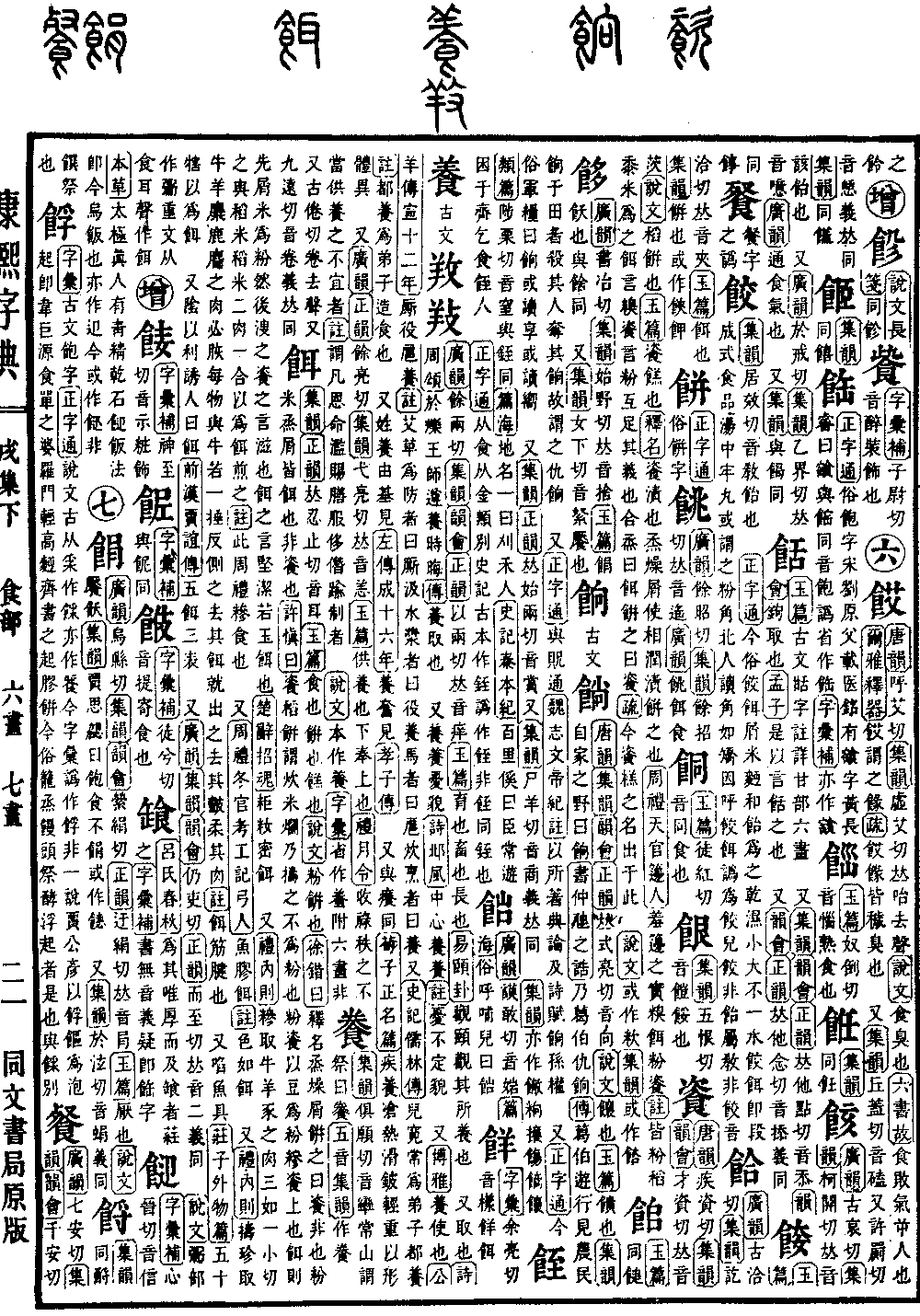
Xu Collection, Lower Volume
Radical: Food (shí)
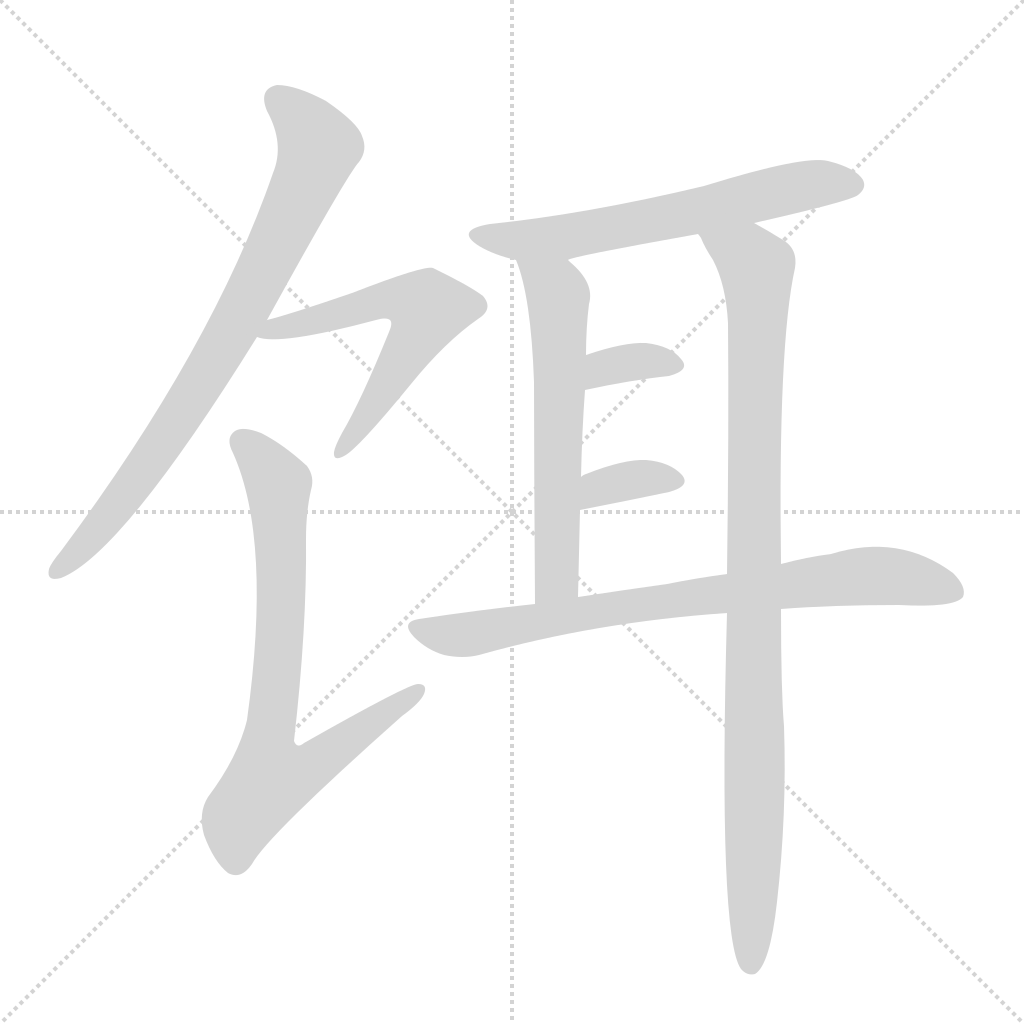
Character: 餌
Kangxi Stroke Count: 15
Page 1419, Entry 01
Pronounced er (rising tone).
Jade Chapters (Yupian): This is food, referring to types of cakes and pastries.
Explaining Graphs and Analyzing Characters (Shuowen Jiezi): Refers to flour cakes.
Xu Kai states: The Explanation of Names (Shiming) claims that steamed crushed cakes are called zi, but this is incorrect. Anything made from steamed rice flour is called er, not zi.
Xu Shen states: Zi is a rice cake made by boiling rice until soft and then pounding it, without grinding it into flour. Flour zi is made by sprinkling bean flour over the top, whereas er is made by grinding the rice into flour first, then kneading it with water. The meaning of zi is moist; the meaning of er is hard and white like a jade ornament.
Songs of Chu (Chucheng): Mentions juyu and honey cakes (er).
Book of Rites (Liji): Take beef, mutton, and pork; cut the meat into pieces one-third the size of the original, mix with rice in a ratio of two parts rice to one part meat, and combine to make fried cakes (er). Note: This is what the Rites of Zhou (Zhouli) calls san food.
Rites of Zhou (Zhouli): The color of fish glue is like er. Note: The color is like er.
Book of Rites (Liji): In preparing pounded delicacies, take beef, mutton, elk, and roe deer meat, ensuring it is tenderloin; use equal amounts of each meat as the beef, pound repeatedly, remove the tendons, cook until done, and remove the membranes to make it tender. Note: Er refers to the tendons.
Also refers to bait for fishing.
Zhuangzi: Used fifty oxen as bait for fish.
Also refers to secretly luring someone with profit.
History of the Former Han (Qianhanshu): Five baits and three standards.
Pronounced er (falling tone). The meaning is the same.
Shuowen Jiezi: In the radical section, it is written as a variant form. The variant form is composed of the food radical and the phonetic component er, written as 餌.
Textual Research: In the Book of Rites (Liji), the original text reads "remove its tendons, then take it out." According to the original text, "then take out" has been corrected to "cook until done."