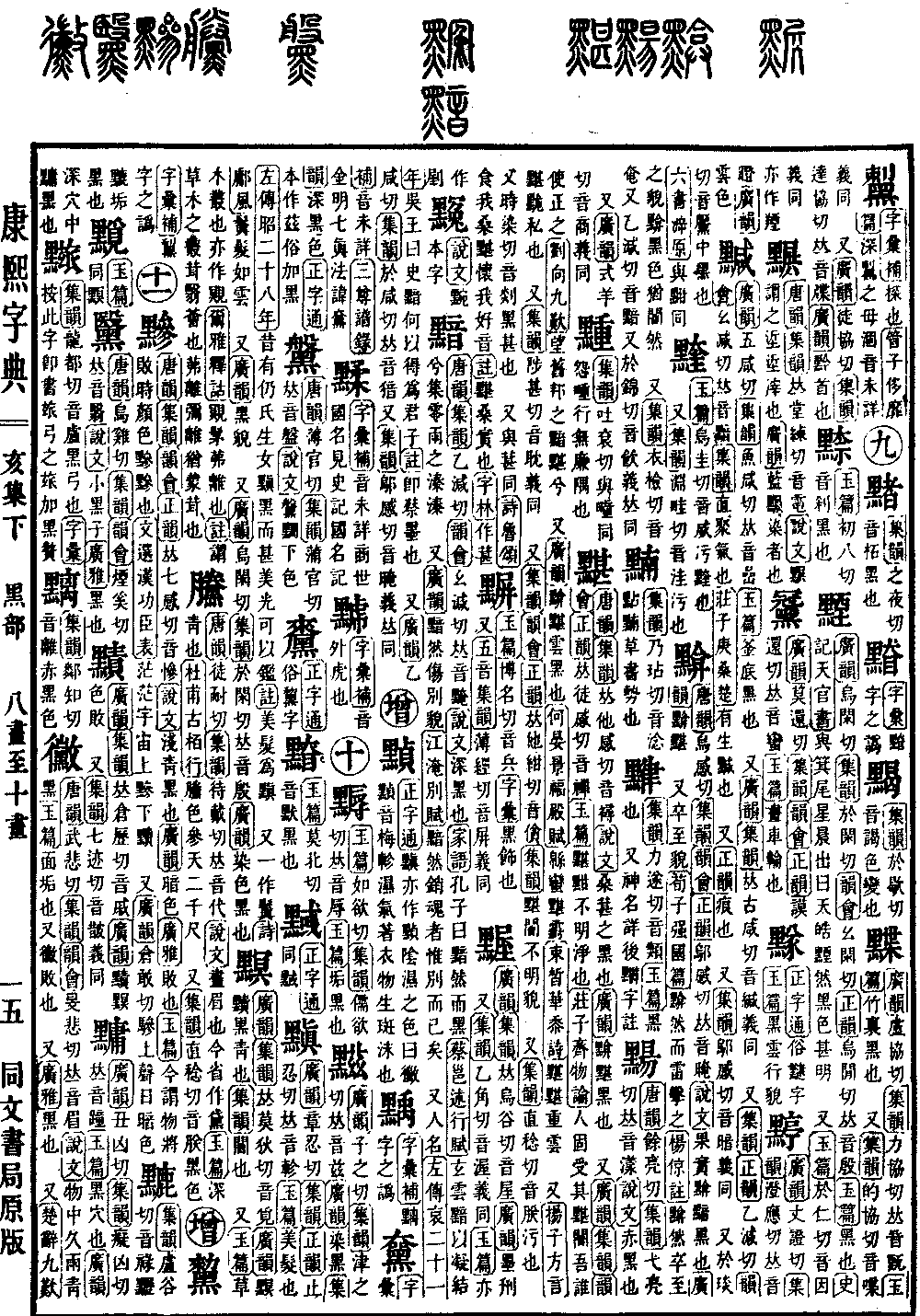
Hai Collection, Lower Volume
Radical: Black (hēi)
Kangxi Strokes: 21
Page 1521, Entry 23
According to Tang Rhymes (Tangyun) and Collected Rhymes (Jiyun), pronounced an (falling tone); according to Rhyme Collection (Yunhui), pronounced an (falling tone). The pronunciation is the same as the character pronounced an (third tone). Explanation in Explaining Simple and Analyzing Compound Characters (Shuowen Jiezi) defines it as deep black. School Sayings of Confucius (Kongzi Jiayu) records Confucius saying: An signifies deep black. In Cai Yong's Narration of the Journey (Shuxing Fu), it describes dark clouds as deep black and dense, gathering continuous rain. Furthermore, Broad Rhymes (Guangyun) mentions the state of being an-ran, describing the appearance of sorrowful separation. In Jiang Yan's Rhapsody on Parting (Bie Fu), it states: That which makes one feel sorrowful and soul-broken, losing one's spirit, is only parting. It is also used as a personal name. Zuo Tradition (Zuo Zhuan), twenty-first year of Duke Ai, records the King of Wu saying: How can Shi An be called a gentleman? Note: Shi An is Cai Mo. Additionally, according to Broad Rhymes (Guangyun), pronounced an (rising tone); according to Collected Rhymes (Jiyun), pronounced an (rising tone), with the same pronunciation as the character pronounced an (rising tone). Also, according to Collected Rhymes (Jiyun), pronounced an (third tone), with the same pronunciation as the character pronounced an (third tone). The meaning is the same.