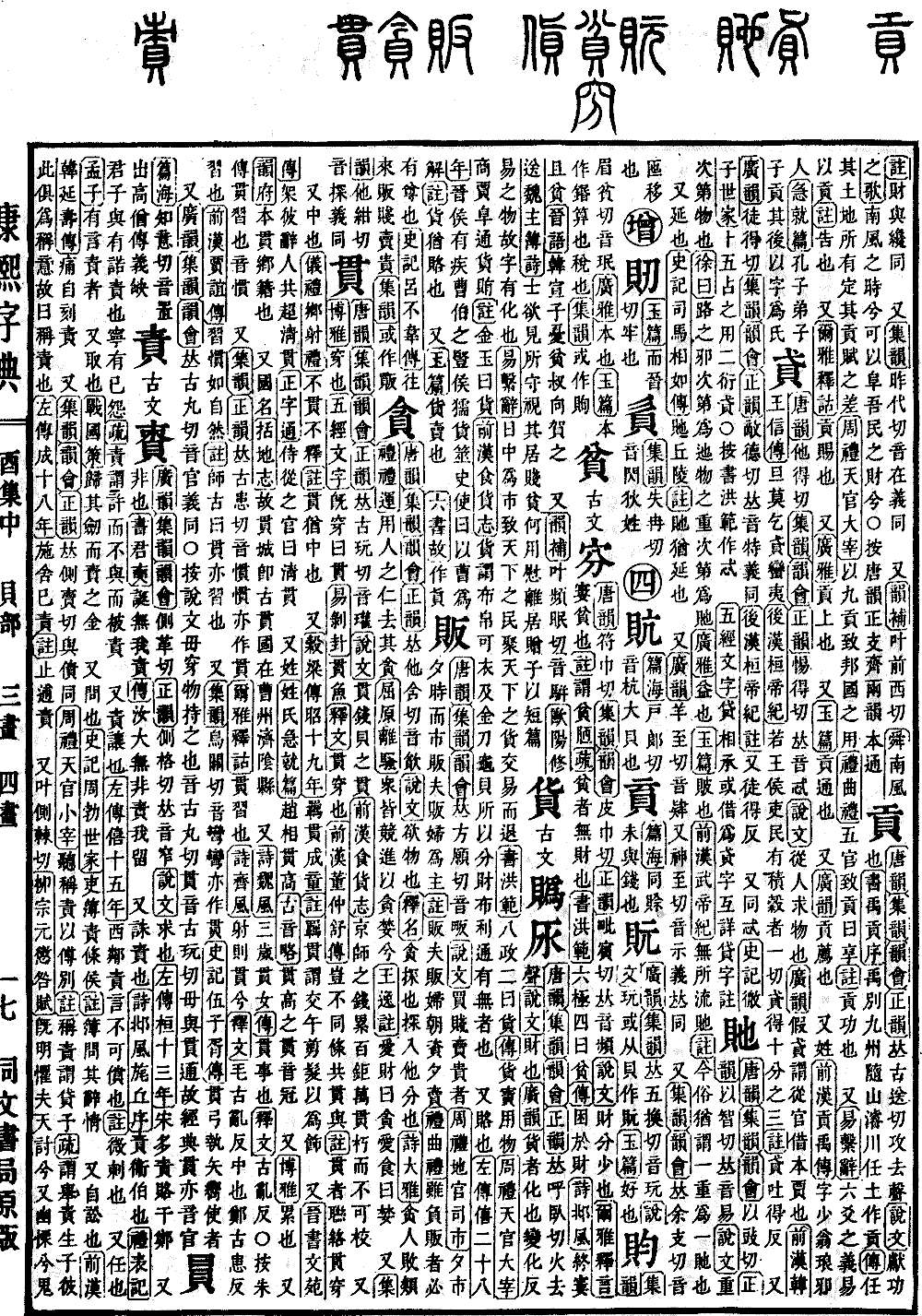
You Collection, Middle Volume
Radical: Shell (bèi)
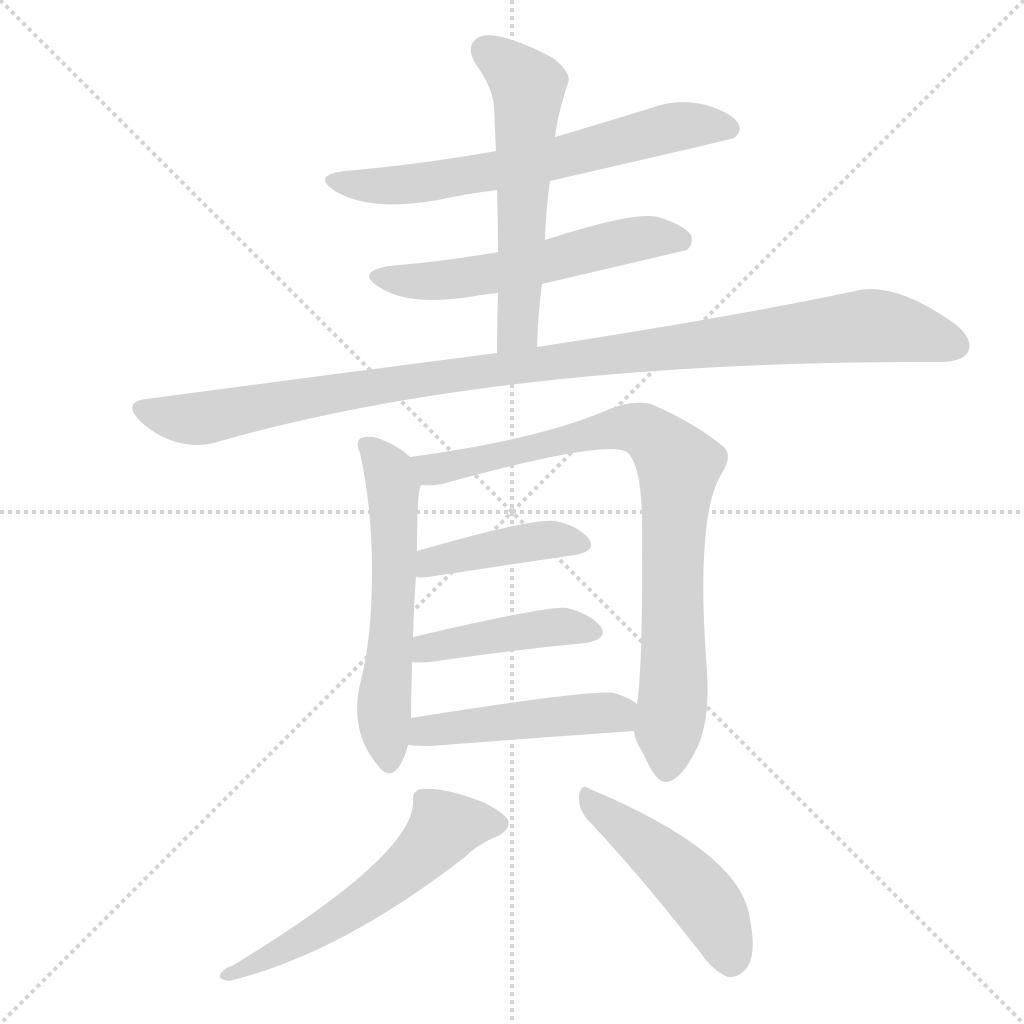
Character: Ze
Kangxi stroke count: 11
Page 1205, Entry 19
Ancient forms according to the Wide Rhymes (Guangyun), Compendium of Rhymes (Jiyun), and Collection of Rhymes (Yunhui) are pronounced ze. According to the Correct Rhymes (Zhengyun), it is also pronounced ze.
In the Explanation of Writing (Shuowen), it is defined as to seek or demand.
In the Zuo Commentary (Zuozhuan), under the thirteenth year of Duke Huan, it states: The state of Song demanded many bribes from the state of Zheng.
It also means to blame or censure.
In the Book of Documents (Shujing), in the Announcement of Duke Shi (Junshi), it states: Do not blame me greatly. The commentary states: Do not find fault with me.
It also means to punish or reprimand.
In the Book of Odes (Shijing), in the preface to the Maoqiu poem of the Odes of Bei, it refers to reprimanding the Earl of Wei.
In the Book of Rites (Liji), in the Record of External Examples (Biaoji), it states: A gentleman would rather incur resentment against himself than make a promise he cannot fulfill. The sub-commentary explains that ze refers to making a promise and failing to deliver, thereby being blamed.
It also means to reproach.
In the Zuo Commentary (Zuozhuan), under the fifteenth year of Duke Xi, it states: A neighbor who reproaches one with words cannot be repaid. The commentary notes this refers to subtle mockery.
It also refers to responsibility or duty.
In the Mencius, it mentions those who have official responsibilities.
It also means to obtain or exact.
In the Stratagems of the Warring States (Zhanguoce), it describes returning a sword and exacting payment in gold.
It also means to interrogate.
In the Records of the Grand Historian (Shiji), in the Biography of Zhou Bo, it describes officials interrogating the Marquis of Tiao. The commentary explains this refers to examining his statements and intentions.
It also means to blame oneself.
In the History of the Former Han Dynasty (Qianhanshu), in the Biography of Han Yanshou, it describes him bitterly reproaching himself.
According to the Compendium of Rhymes (Jiyun), the Collection of Rhymes (Yunhui), and the Correct Rhymes (Zhengyun), it is also pronounced zhai, equivalent to the word for debt.
In the Rites of Zhou (Zhouli), in the Office of Heaven and the Minor Administrator, it mentions hearing cases of debts and written contracts. The commentary explains that debts refer to lending with interest. The sub-commentary explains that when one lends at interest and both parties are satisfied, it is called a debt.
In the Zuo Commentary (Zuozhuan), under the eighteenth year of Duke Cheng, it mentions remitting debts. The commentary refers to stopping the collection of outstanding debts.
It also rhymes with ze.
In Liu Zongyuan’s Punishment for Faults (Chengjiu Fu), it states: Already clearly fearing the punishments of Heaven, and again feeling anxious and trembling at the blame of ghosts. Agitated and fearful, waking at night and terrified by day, like a deer that cannot rest.
Textual Research: In the Book of Rites (Liji), in the Record of External Examples (Biaoji), the phrase a gentleman would rather incur resentment against himself should contain the character for his. It has been added here in accordance with the original text.