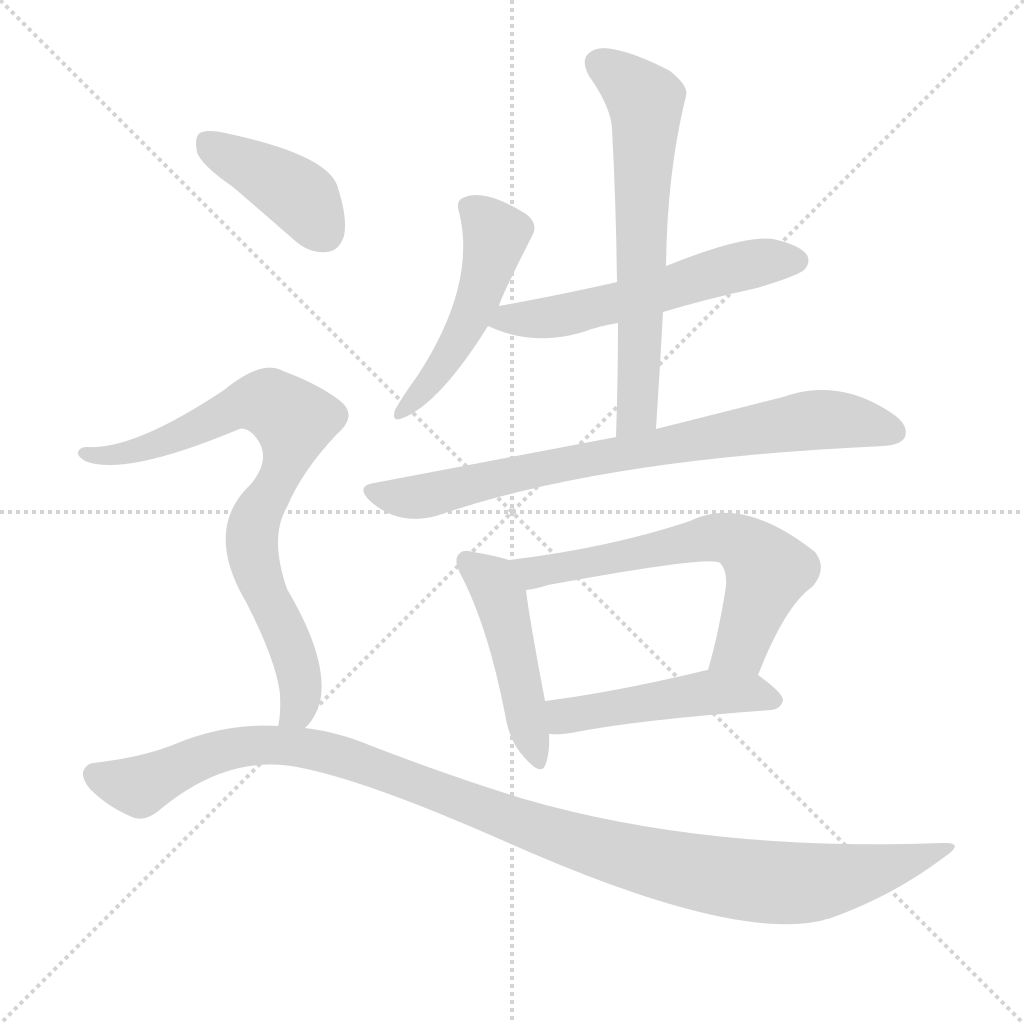
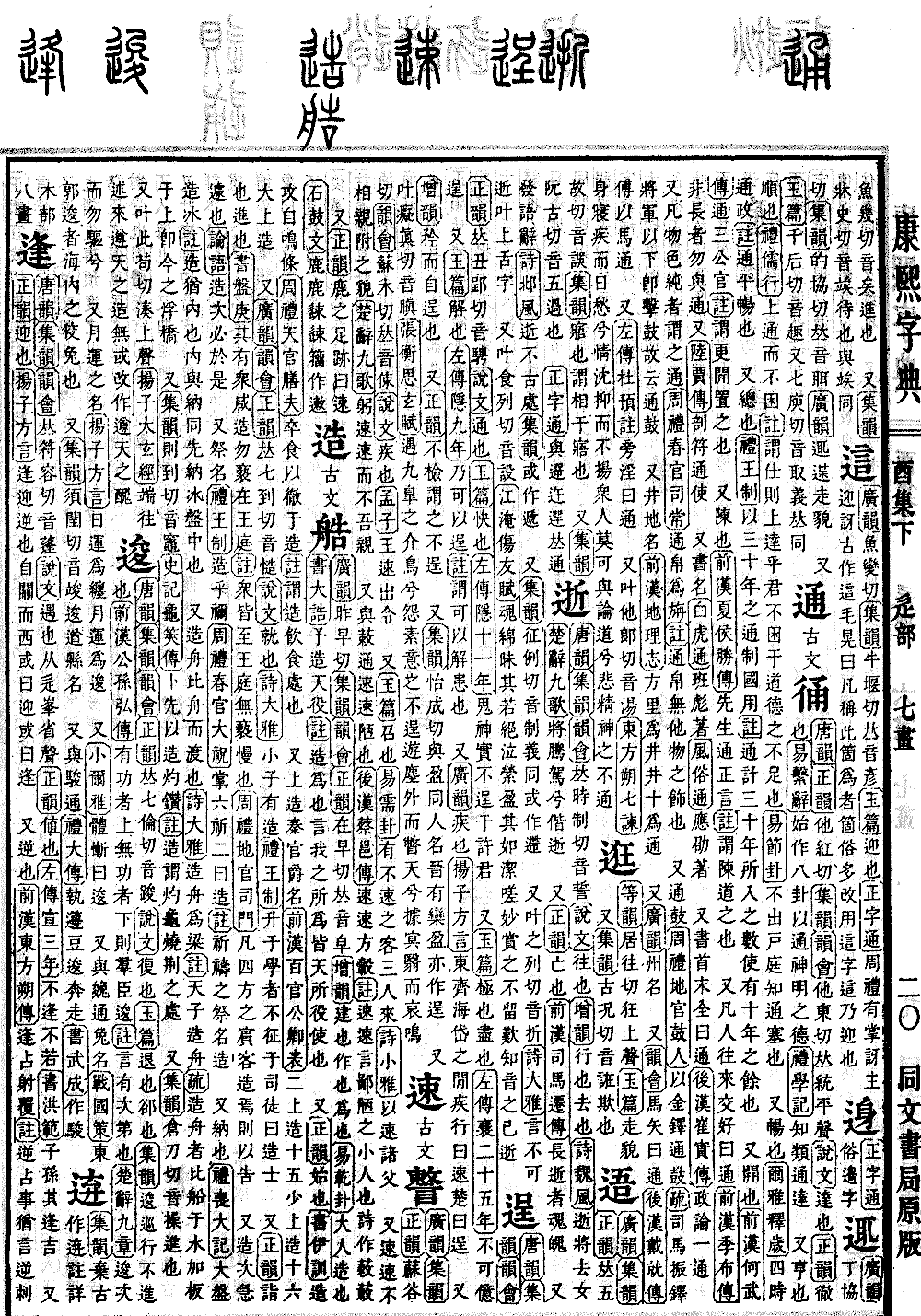
You Collection, Lower Volume
Radical: Walk (chuò)
14 strokes
Page 1258, Entry 12
Ancient form of the character is written as (fáo)
Pronounced zào
Extended Rhymes (Guangyun): Pronounced zào
Collected Rhymes (Jiyun), Dictionary of Rhymes (Yunhui), Correct Rhymes (Zhengyun): Pronounced zào
Augmented Rhymes (Zengyun): To establish, to make, to act.
Book of Changes (Yijing), Hexagram Qian: The great man creates.
Book of Documents (Shujing), Great Announcement (Dagao): I create the service of Heaven. Note: To create means to act. It means that all my actions are directed by Heaven.
Also, Correct Rhymes (Zhengyun): To begin.
Book of Documents (Shujing), Instructions of Yi (Yixun): Operations began from Mingtiao.
Rites of Zhou (Zhouli), Offices of Heaven (Tianguan), Chef (Shanfu): When the meal is finished, use music to clear the place of preparation. Note: This refers to the place where food and drink are prepared.
Also, Shangzao, the name of a title of nobility in the Qin dynasty.
History of the Former Han (Qianhan), Table of Officials and Ministers (Baiguan Gongqing Biao): Two are Shangzao, fifteen are Shaoshangzao, sixteen are Dashangzao.
Also, Extended Rhymes (Guangyun), Dictionary of Rhymes (Yunhui), Correct Rhymes (Zhengyun): Pronounced zào
Explication of Written Characters (Shuowen): To approach.
Book of Odes (Shijing), Greater Odes (Daya): The young man has an achievement.
Book of Rites (Liji), Royal Regulations (Wangzhi): Those promoted to the schools are not taxed by the Minister of Instruction; they are called scholar-candidates.
Also, Correct Rhymes (Zhengyun): To visit, to advance.
Book of Documents (Shujing), Pan Geng: When all the masses have arrived, do not be disrespectful in the royal court. Note: The masses all arrived at the royal court, and one must not be disrespectful or lazy.
Rites of Zhou (Zhouli), Offices of Earth (Diguan), Gatekeepers (Simen): Whenever guests from the four quarters arrive, report them.
Also, zaoci, meaning urgent or hurried.
Analects (Lunyu): Even in hurried moments, one must be in accordance with this.
Also, the name of a sacrifice.
Book of Rites (Liji), Royal Regulations (Wangzhi): Sacrifice to the temple of the father.
Rites of Zhou (Zhouli), Offices of Spring (Chunguan), Great Invoker (Dazhu): Managing the six prayers, the second is called zao. Note: A prayer sacrifice named zao.
Also, to insert.
Book of Rites (Liji), Record of Funeral Rites (Sangdaji): A large basin is used to hold ice. Note: Zao is like inserting. Inserting is the same as entering. First, place the ice into the basin.
Also, zaozhou, meaning to join boats together to cross.
Book of Odes (Shijing), Greater Odes (Daya): Joins boats to make a bridge. Note: The Son of Heaven joins boats. Commentary: Joining boats means arranging ships on the water and placing boards on top; it is the modern floating bridge.
Also, Collected Rhymes (Jiyun): Pronounced zào
Records of the Grand Historian (Shiji), Biography of Tortoise Divination (Guice Zhuan): In divination, first use the zao to scorch the drill holes. Note: Zao refers to the places where the tortoise shell is scorched and the brambles burned.
Also, Collected Rhymes (Jiyun): Pronounced cāo
To advance.
Also, rhymes with the character (gǒu), with a rising tone.
Yangzi, Canon of Supreme Mystery (Taixuanjing): If the end goes and the beginning follows, follow the creation of Heaven. There is no need to change or alter, follow the pattern of Heaven.
Textual verification: Rites of Zhou (Zhouli), Offices of Heaven (Tianguan), Chef (Shanfu): When the meal is finished, use music to clear the place of preparation. (The character for music has been added to the original text for accuracy).