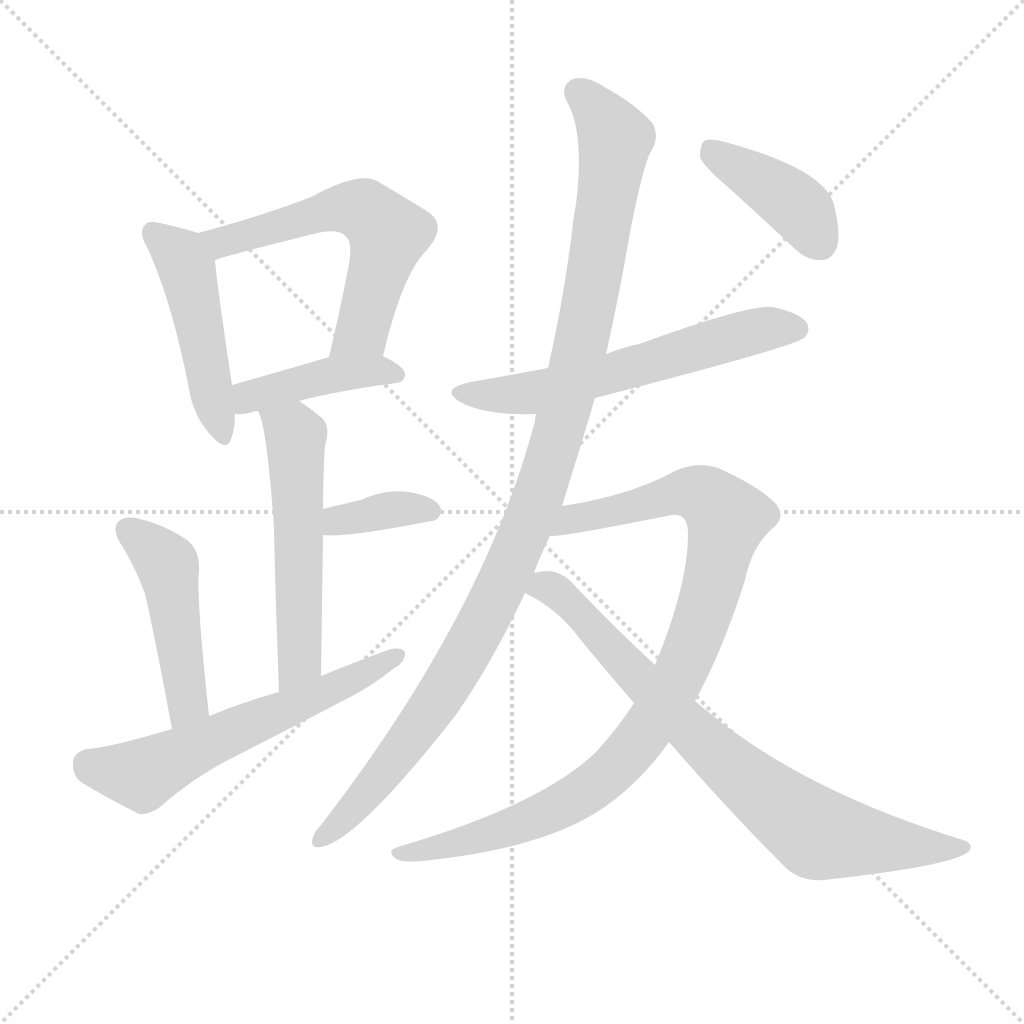
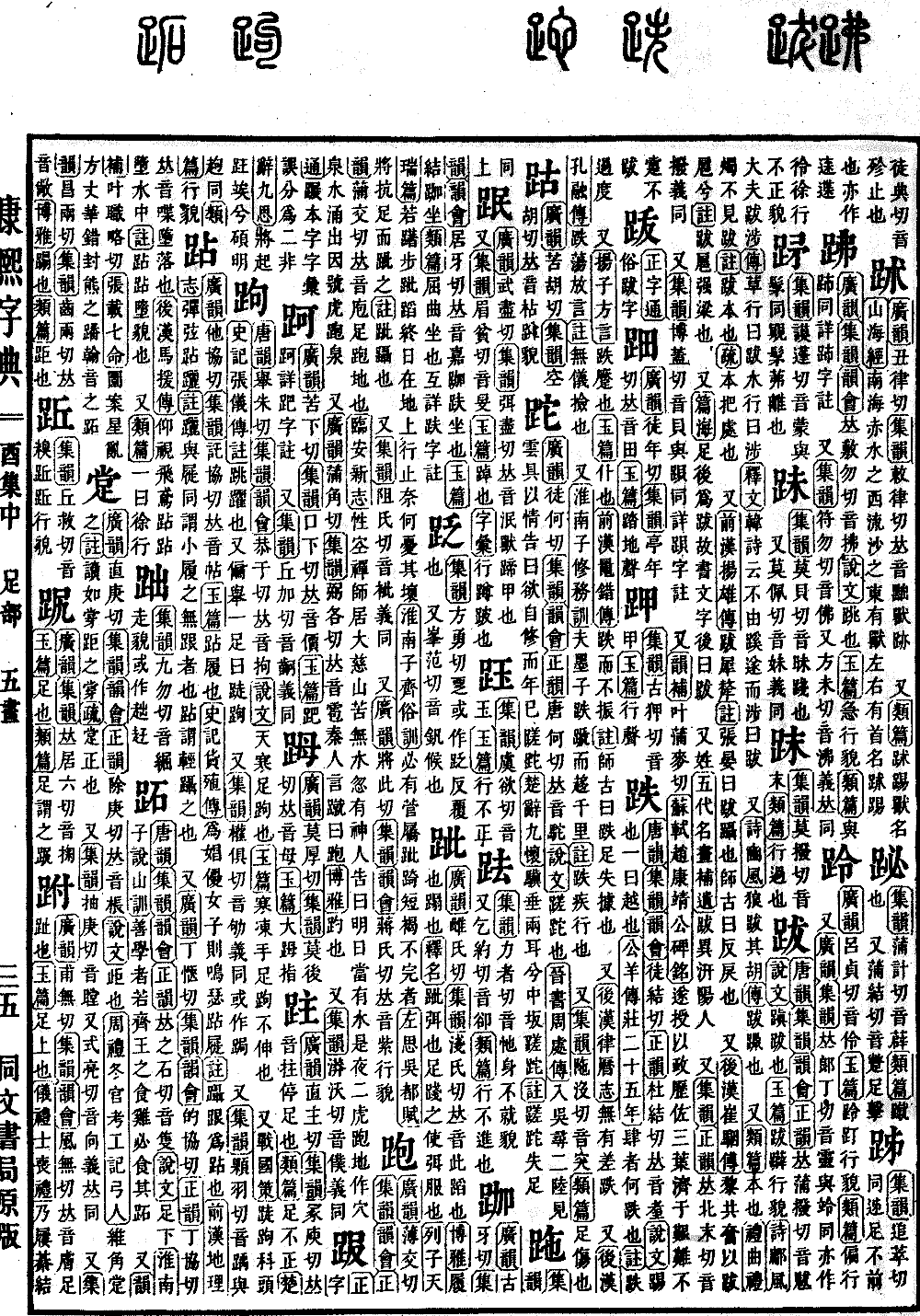
You Collection, Middle Volume
Radical: Foot (zú)
Kangxi Strokes: 12
Page 1223, Entry 09
Tang Rhymes (Tangyun), Collected Rhymes (Jiyun), Rhyme Compendium (Yunhui), Correct Rhymes (Zhengyun): Pronounced ba.
Shuowen (Shuowen Jiezi): To stumble or fall.
Jade Chapter (Yupian): The appearance of walking.
Book of Odes (Shijing), Odes of Yong: The great officers stumble and wade.
Commentary: Traveling through grass is called ba; traveling through water is called she.
Explanation of Text (Shiewen): Han Poetry says: To wade without following a path or track is called ba.
Also, Book of Odes (Shijing), Odes of Bin: The wolf stumbles on its dewlap.
Commentary: Ba means to tread upon.
Also, Classified Compilation (Leipian): Origin or base.
Book of Rites (Liji), Summary of the Rules of Propriety (Quli): The candle does not show the base.
Commentary: Ba means base.
Sub-commentary: Base refers to the part one holds.
Also, History of the Former Han (Qianhan Shu), Biography of Yang Xiong: Treading on rhinoceros and yak leather.
Commentary: Zhang Yan says: Ba means to step on. Shigu says: It means to turn back or resist.
Also, History of the Later Han (Houhan Shu), Biography of Cui Yin: Li altogether exerted strength to be arrogant and unruly.
Commentary: Ba-hu means headstrong and violent.
Also, Sea of Documents (Pianhai): The back of the foot is called ba. Therefore, the writing at the end of a book is called a postscript (ba).
Also a surname.
Supplement to Famous Paintings of the Five Dynasties (Wudai Minghua Buyi): Ba Yi, a man from Qianyang.
Also, Collected Rhymes (Jiyun), Correct Rhymes (Zhengyun): Pronounced bo. The meaning is the same.
Also, Collected Rhymes (Jiyun): Pronounced bei. Same as the character for a type of bed. See the note for that character.
Also, Rhyme Supplement (Yunbu): Rhymes with pu mai. Su Shi, Inscription for Duke Zhao Kangjing: Then he was entrusted with government, assisting through three generations. He helped in times of difficulty, not stumbling and not falling.