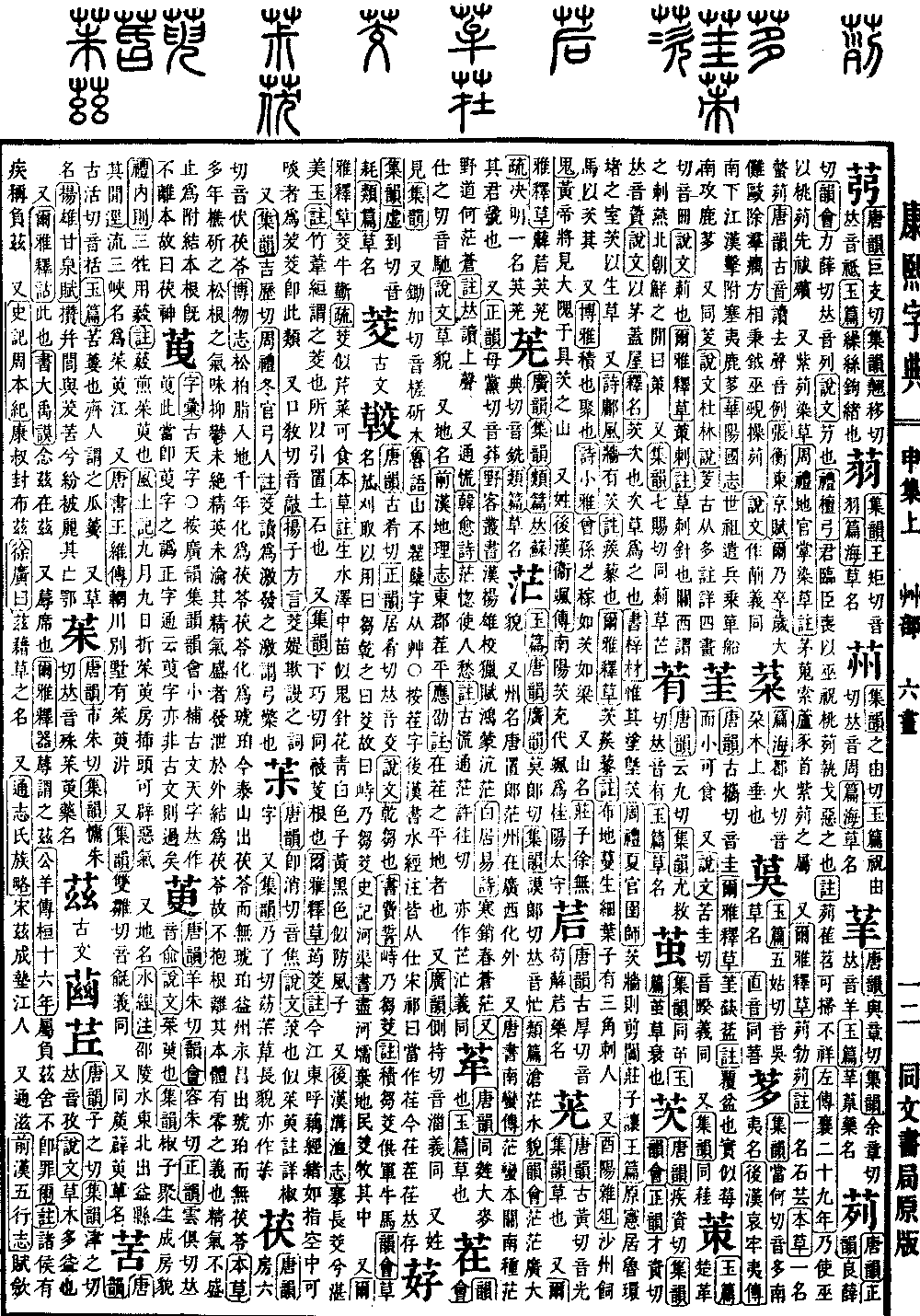
Shen Collection, Upper Volume
Radical: Grass (cǎo)
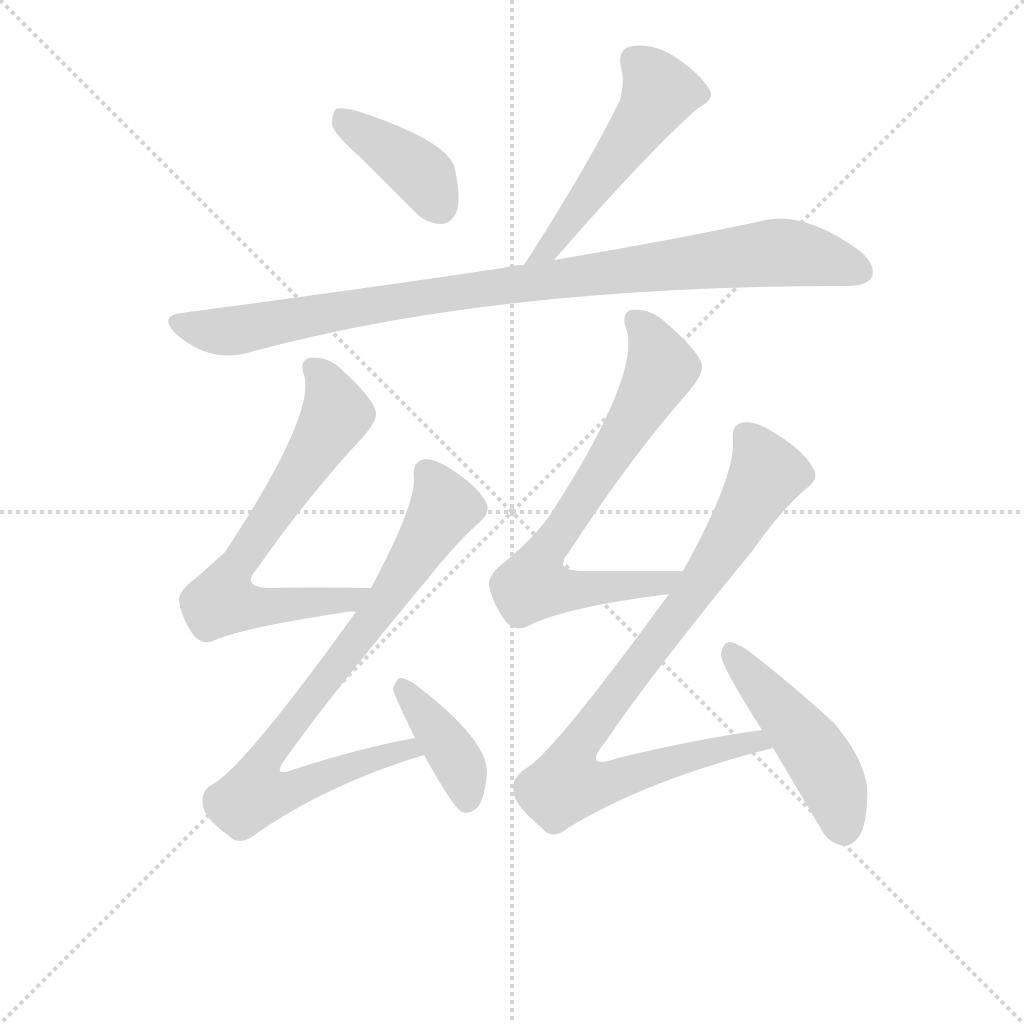
茲
Kangxi strokes: 12
Page 1028
Ancient form: 茊
According to Tang Rhyme (Tángyùn), pronounced zī (from zǐ zhī qiè). According to Jiyun (Jíyùn), pronounced zī (from jīn zhī qiè).
Shuowen Jiezi (Shuowen) states: "Grass and trees growing luxuriantly."
Erya (Er ya), Explanation of Terms (Shìgǔ) states: "This."
Book of Documents (Shujing), Counsels of Great Yu (Dàyǔmó): "To reflect on this and be here."
Also, a mat.
Erya (Er ya), Explanation of Implements (Shìqì): "A mat (rù) is called zī."
Gongyang Commentary on the Spring and Autumn Annals (Gongyang Zhuan), Duke Huan, Year 16: "Assign the mat bearer to a dwelling, not to immediately punish you." The commentary states: "When a feudal lord is ill, they are referred to as 'bearing the mat' (fù zī)."
Records of the Grand Historian (Shiji), Basic Annals of Zhou (Zhōuběnjì): "Kang Shu enfeoffed and spread mats (bù zī)." Xu Guang (Xú Guǎng) says: "Zī is the name of a grass mat."
Tongzhi (Tōngzhì), Treatise on Clans (Shìzúlüè): "Song Zicheng (Sòng Zīchéng) was a native of Dianjiang."
Also interchangeable with zī (滋).
Book of Han (Qian Han Shu), Treatise on the Five Elements (Wǔxíngzhì): "Taxes and levies became increasingly heavy."
Tai Xuan Jing (Tàixuánjīng) by Yang Xiong (Yángzi): "Heaven does not allow this to grow."
Xunzi (Xúnzǐ), On Rectifying Names (Zhènglùnpiān): "Lánggān and Lóngzī." The commentary states: "The same as zī (髭, mustache)."
Pianhai (Piānhǎi) states: "Pronounced cí. Kucha (Qiūcí), a country name."