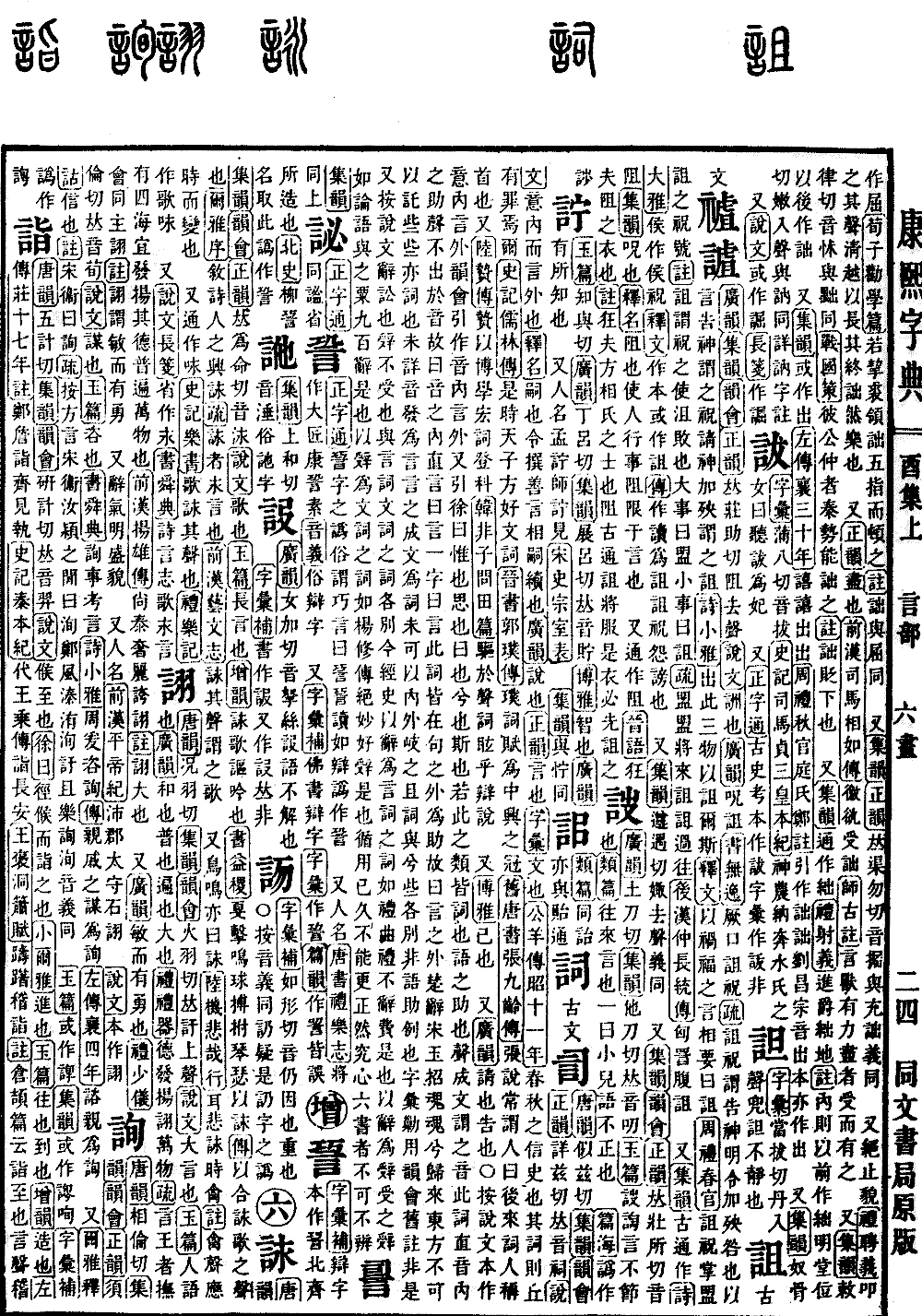
You Collection, Upper Volume
Radical: Speech (yán)
詞; Kangxi Stroke Count: 12; Page 1156
Ancient form. Pronounced ci (rising tone).
Shuowen Jiezi (Explanation of Graphs and Analysis of Characters): Meaning is internal, while speech is used to express it externally.
Shiming (Explanation of Names): This means to inherit. It is the act of having beautiful language recorded so that it may be inherited and continued by others.
Guangyun (Expanded Rhymes): It is the meaning of speaking.
Zhengyun (Orthodox Rhymes): It is the meaning of language.
Zihui (Collection of Characters): It is the meaning of literary composition.
Gongyang Zhuan (Commentary of Gongyang) on the 11th year of Duke Zhao: The Spring and Autumn Annals (Chunqiu) are credible historical records. If it is said that its literary composition is problematic, then I, Kong Qiu, would be guilty.
Records of the Grand Historian (Shiji), Biography of Confucian Scholars: At this time, the Emperor took pleasure in literary composition.
Book of Jin (Jinshu), Biography of Guo Pu: The poetic compositions (ci) of Guo Pu are the best since the restoration of the Jin Dynasty.
Old Book of Tang (Jiu Tangshu), Biography of Zhang Jiuling: Zhang Yue often said to others that Zhang Jiuling was the leader of the younger generation of literary men.
Also, Biography of Lu Zhi: Lu Zhi passed the imperial examination by relying on his profound scholarly ability in the broad literary composition category.
Han Feizi, Asking about the Fields Chapter: Driven by reputation and words, and confused by debates and lobbying.
Also, Guangya (Enlightening the Elegant): It is the meaning of stopping.
Also, Guangyun (Expanded Rhymes): It is the meaning of requesting or informing.
Note: In the Shuowen Jiezi, the original text was written as "meaning internal and speech external." The Yunhui (Collection of Rhymes) cites it as "sound internal and speech external." Furthermore, it cites the words of Xu Xuan, stating: The characters wei, si, yue, xi, and si are all empty words (xu ci), which are auxiliary to language. Sound forming patterns is called tone (yin), and these empty words only act as auxiliaries within the tone; the sound itself does not issue from within the tone, therefore it is said to be within the tone. That which is spoken directly is called speech (yan), and a single character is also called speech; these empty words all function as auxiliaries outside the sentence, therefore it is said to be outside of speech. The Songs of Chu (Chuci), Song Yu, Summoning the Soul, says: O soul, return; the East cannot be a place to lodge or dwell. The character xie is also an empty word. However, this does not explain in detail how sound is issued to become language, and how language forms patterns to become literary composition, and it cannot be mechanically divided into internal and external. Moreover, the word ci, xi, and xie each have their own distinctions and cannot all be treated as examples of auxiliary words. The Zihui copies and follows the old commentary of the Yunhui, which is incorrect.
Also note: In the Shuowen Jiezi, the character ci (辞) refers to a lawsuit. The character ci (辤) refers to not accepting something. These two characters are distinct from the word ci (詞) which refers to language and literary composition. Currently, in the classics and historical records, the character ci (辞) is used to represent the language and literary composition meaning of ci (詞); for example, in the Book of Rites (Liji), the phrase "do not excuse (ci) the expense." The character ci (辞) is used to represent the meaning of declining to accept, as in the Analects (Lunyu), where Yuan Si declined 900 dou of grain. The character ci (辤) is used to represent the literary composition meaning of ci (詞), such as in the Biography of Yang Xiu, where it is written "an absolutely wonderful composition (ci)." This usage has been followed for a long time and cannot be corrected; however, those who study philology with diligence cannot fail to distinguish between them.