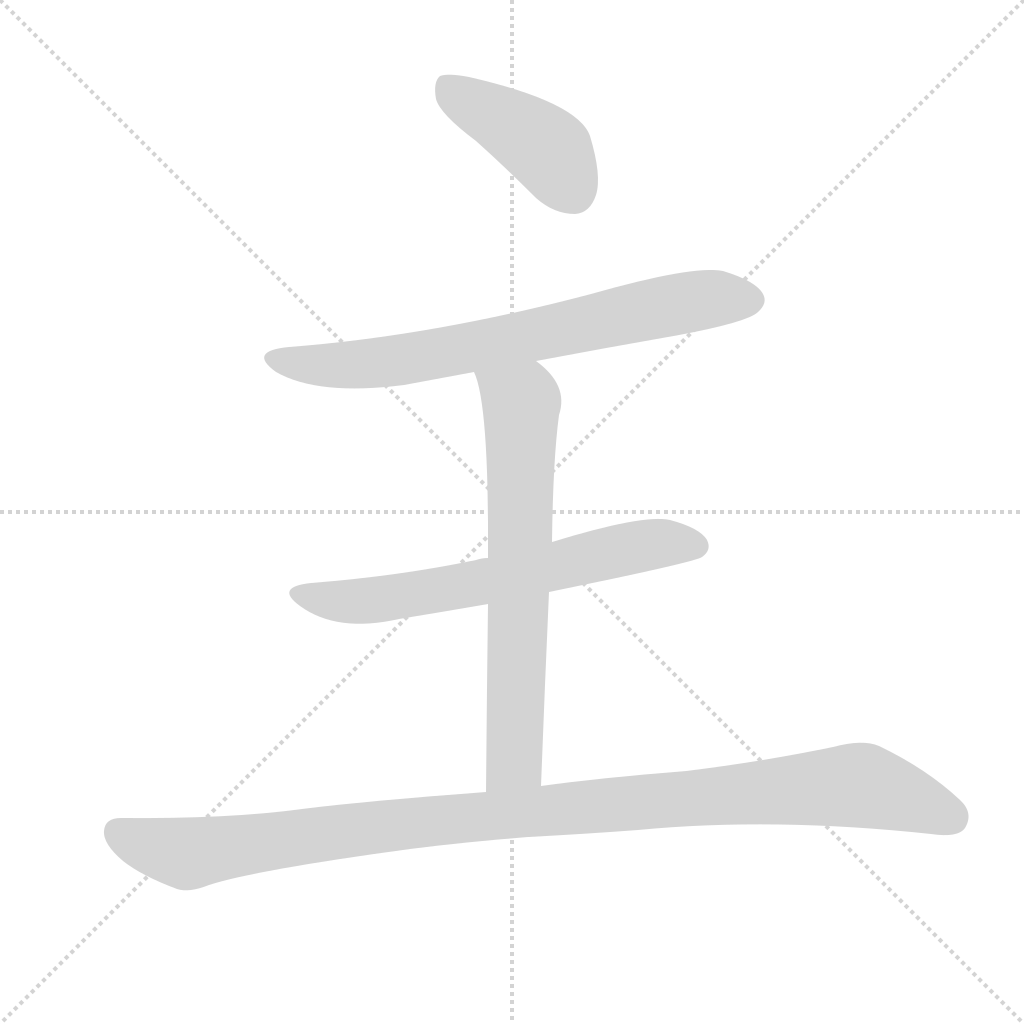
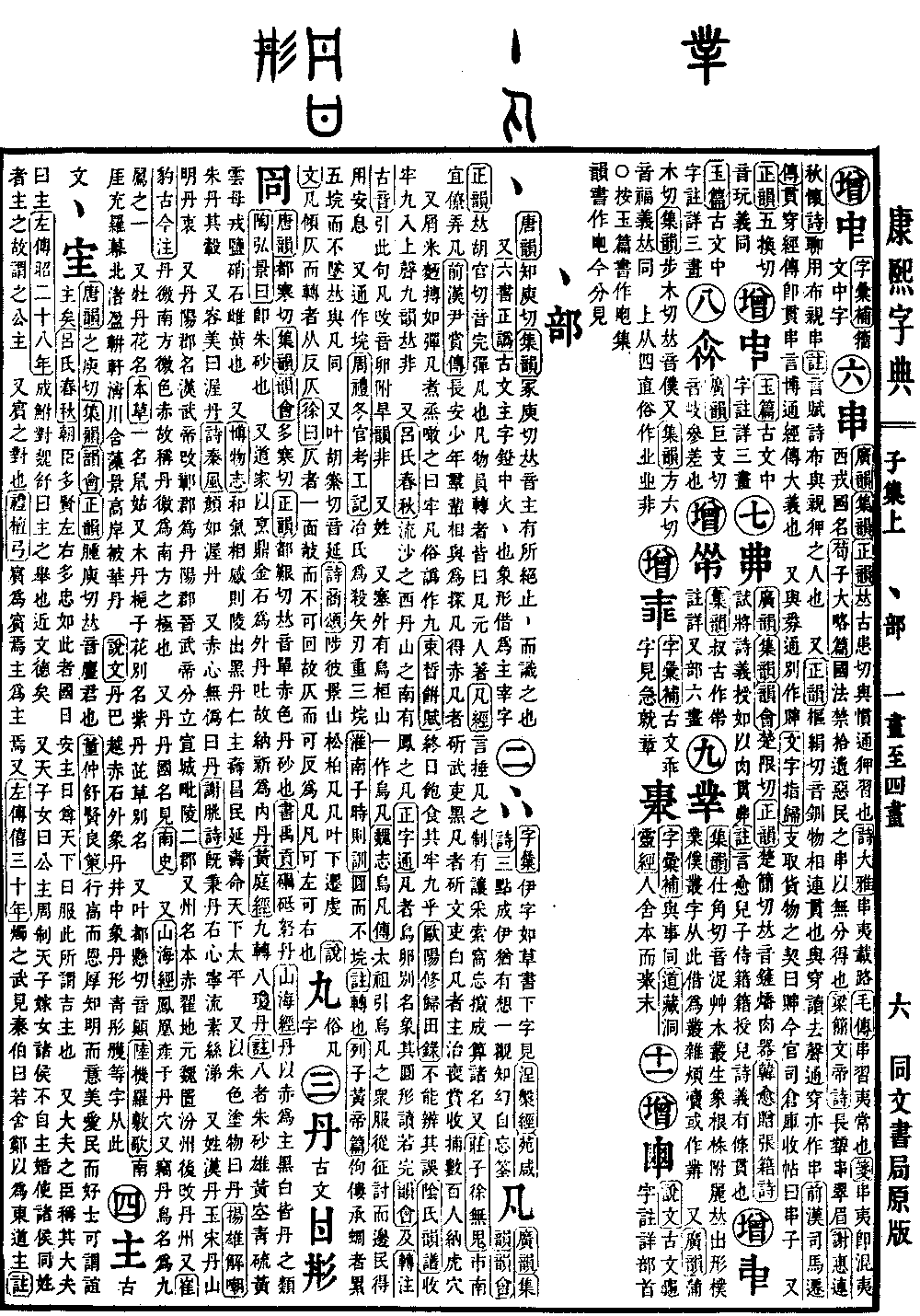
Zi Collection, Page Position: Upper. Radical: Dot (diǎn). Character: zhu. Kangxi Dictionary Stroke Count: 5. Page Number: Page 80, Line 20.
In ancient scripts, this was also written as dian or zhu. In the Tang Rhymes (Tangyun), the pronunciation is indicated by the fanqie characters zhi and yu. In the Collected Rhymes (Jiyun), the Rhyme Assembly (Yunhui), and the Correct Rhymes (Zhengyun), it is indicated by the fanqie characters zhong and yu. It is pronounced the same as the character zhu.
It means a monarch or ruler. According to the Strategies for the Worthy and Good (Xianliangce) by Dong Zhongshu: One whose conduct is noble and whose benevolence is profound, whose wisdom is clear and whose heart is kind, who loves the people and cherishes worthy men, can be called a ruler of the Way. According to the Master Lu's Spring and Autumn Annals (Lüshi Chunqiu): If the ministers in the court are mostly worthy and the close attendants are mostly loyal, then in such a state, the administration will become increasingly stable, the ruler increasingly honored, and the world increasingly submissive; this is what is called an auspicious ruler.
It also refers to the retainers of high officials calling their lords master. In the Commentary of Zuo (Zuo Zhuan), in the twenty-eighth year of Duke Zhao: Cheng Zhuan replied to Wei Shu, saying that the master's recommendation is close to the virtue of refinement.
Furthermore, the daughter of the Son of Heaven is called a princess (gongzhu). Under the system of the Zhou Dynasty, when the Son of Heaven married off his daughter, he could not preside over the wedding himself, so he had a duke of the same surname preside over it, hence the name princess.
It is also the counterpart to a guest. According to the Book of Rites (Liji), in the Tangong chapter: The guest fulfills the rites of a guest, and the host fulfills the rites of a host. Also, in the Commentary of Zuo, in the thirtieth year of Duke Xi: Zhu Zhiwu met with Duke Mu of Qin and said: If you spare the state of Zheng and let it be the host of the eastern road to provide for those passing through. Note: Zheng was to the east of the state of Qin.
It also means to master, to maintain, or the root. According to the Book of Changes (Yijing), in the Appended Phrases (Xici): The movement of the pivotal mechanism is the master of honor and disgrace.
It also refers to a spirit tablet, a wooden plaque set up in an ancestral temple for the spirit to rest upon, made of chestnut wood. According to the Spring and Autumn Commentary (Chunqiu Zhuan): The spirit tablet for the Yu sacrifice after burial is made of mulberry wood, and the spirit tablet for the Lian sacrifice after one year is made of chestnut wood. It also refers to the danzhu. According to the Rites of Zhou (Zhouli), in the Office of Spring (Chunguan): The Master of Shamans manages the orders for all shamans and provides the dan container for the spirit tablet during sacrifices. Note: This is the tablet upon which the spirit relies. The dan is the vessel that holds the spirit tablet.
Also, according to the Book of Rites, in the Summary of Ceremonies (Quli): One does not usually sit in the southwest corner of a room. Commentary: Here, the character has the meaning of sitting.
Also, according to the Discourses of the States (Guoyu), in the Discourses of Jin (Jinyu): Yangzi is firm and his talent is outstanding. Note: Here it means being superior or outstanding.
It is also a surname. In the Sui Dynasty, there was Zhu Zhou, and in the Ming Dynasty, there was Zhu Wenli. There is also Zhufu, which is a compound surname.
Also, in the Correct Rhymes, it is pronounced similarly to the fanqie characters zhi and lu. In this sense, it is the same as the character meaning to pour or focus (zhu). According to the Xunzi, in the Youzuo chapter: The master's measure must be level like a law. Note: Here the character is used as the character for pouring or focusing.
Correction: In the Commentary of Zuo, in the twenty-eighth year of Duke Zhao, the text Cheng Fu said to Wei Shu should be corrected based on the original text to Cheng Zhuan said to Wei Shu.