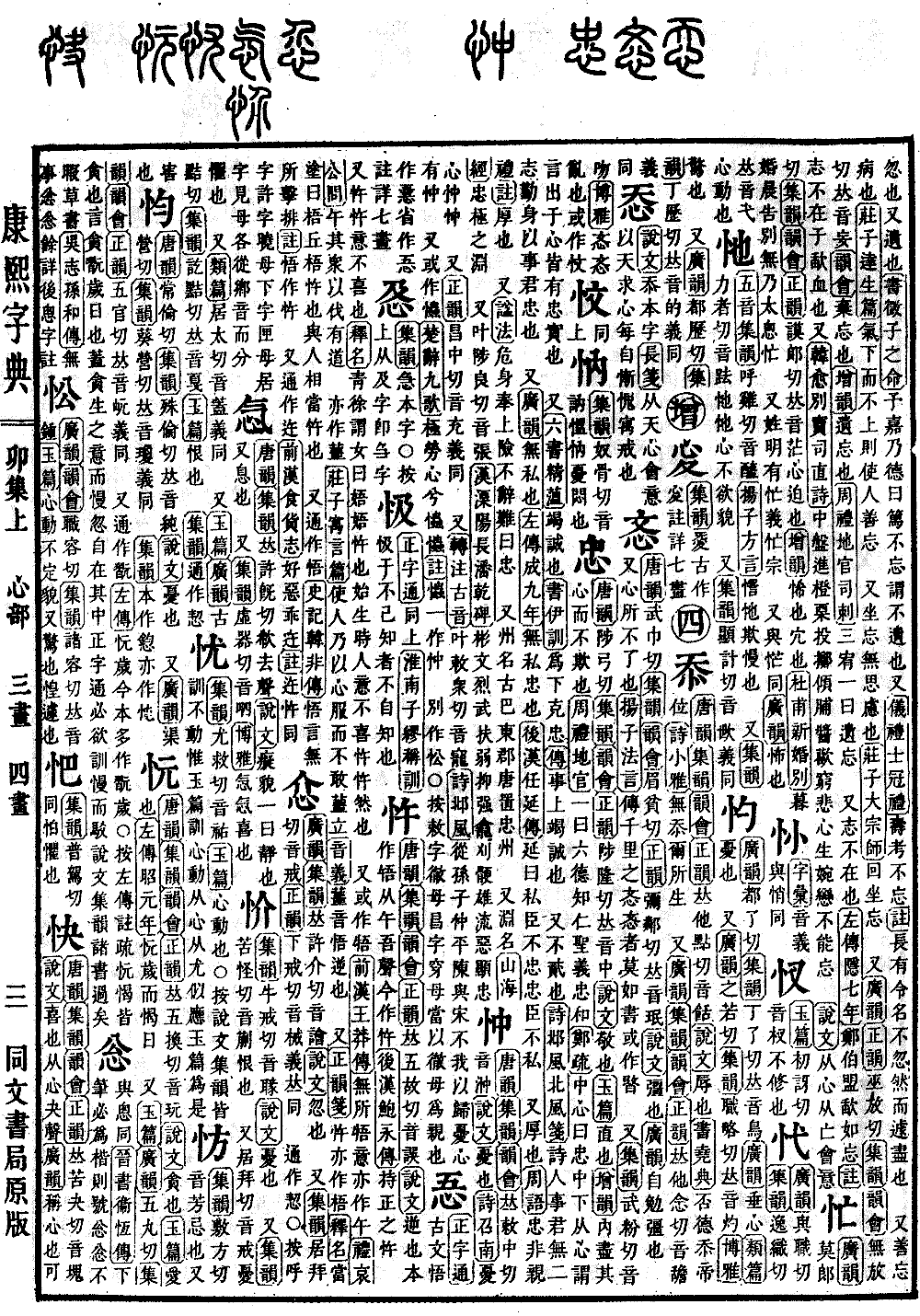
Mao Collection, Upper Volume
Radical: Heart (xīn)
忠
Kangxi stroke count: 8
Page 377, Entry 13
Pronounced zhōng.
Shuowen Jiezi (Explanation of Characters): Respect.
Yupian (Jade Chapters): Upright.
Zengyun (Augmented Rhymes): To exhaust one's heart internally, without deception.
Book of Rites (Zhouli), Office of the Grand Minister of Instruction (Da situ): The first is the six virtues: wisdom, benevolence, sagacity, righteousness, loyalty, and harmony.
Commentary: That which is centered in the heart is called loyalty (zhong). It is composed of middle (zhong) and heart (xin), meaning that words issuing from the heart are all loyal and true.
Liushu Jingyun (Essence of the Six Scripts): To exhaust sincerity.
Classic of History (Shujing), Instructions of Yi (Yi xun): To be loyal as a subordinate.
Commentary: To exhaust sincerity in serving a superior.
Also: To have no two minds.
Book of Odes (Shijing), Odes of Bei (Beifeng), Commentary note: The poet serves his lord without second intentions, diligently exerting his body to serve his lord; this is loyalty.
Guangyun (Expanded Rhymes): Being without selfishness.
Zuo Commentary (Zuo zhuan), Ninth Year of Duke Cheng: To be without selfishness is loyalty.
Book of the Later Han (Hou Hanshu), Biography of Ren Yan: Yan said, Selfish ministers are not loyal; loyal ministers are not selfish.
Also: To be thick or profound.
Discourses of the States (Zhou yu): Loyalty is not the ritual of relatives.
Commentary: It means profound.
Also: Posthumous title law: To endanger one's person to serve the superior, and in times of danger not to refuse hardships, is called loyalty.
Also: Name of a prefecture. Formerly Badong Commandery, established as Zhong Prefecture during the Tang Dynasty.
Also: Name of an abyss. Classic of Mountains and Seas (Shanhaijing), the Abyss of Zhongji.
Also: Rhyming as zhang.
Inscribed by Pan Qian, Magistrate of Liyang during the Han Dynasty: Refined in civil, ardent in martial, supporting the weak and suppressing the strong. Cutting down the obstinate and the mighty, flowing away the evil and manifesting loyalty.
Textual research: In the Book of Rites (Zhouli), Office of Earth (Di guan), the six virtues are wisdom, benevolence, sagacity, righteousness, loyalty, and harmony. The commentary by Zheng is not written by Zheng himself. I have carefully corrected this to the Office of the Grand Minister of Instruction (Da situ) according to the original text and removed the reference to Zheng.