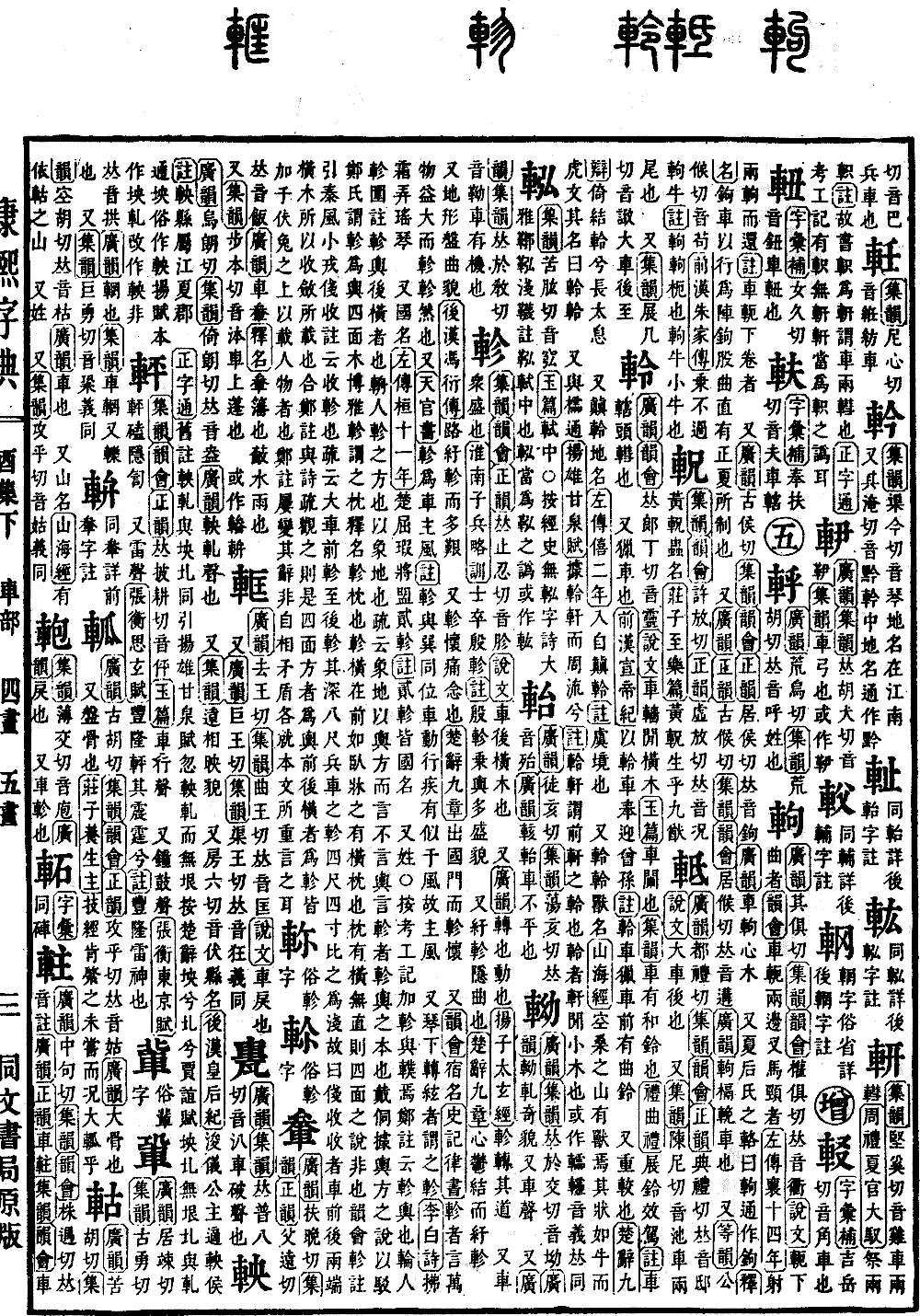
You Collection, Lower Volume
Radical: Carriage (chē)
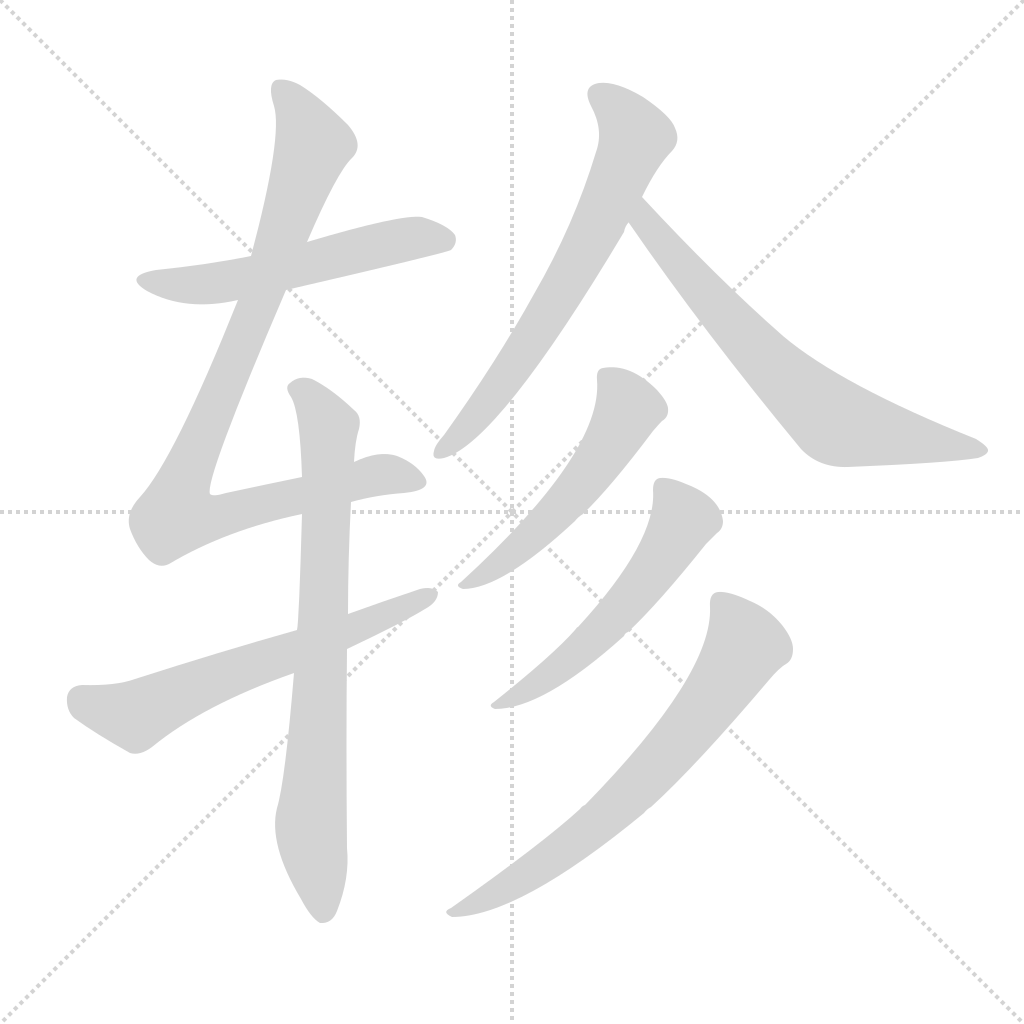
Zhen (third tone)
Page 1241, Entry 05
According to Collection of Rhymes (Jiyun), Rhyme Meetings (Yunhui), and Orthodox Rhymes (Zhengyun), pronounced zhen (rising tone).
According to Explaining Graphs and Analyzing Characters (Shuowen), the horizontal wood at the rear of a carriage.
Also, according to Broad Rhymes (Guangyun), to turn, to move.
According to Master Yang's Great Mystery (Yangzi Taijing), the carriage turns along its path.
Also, the abundance of carriages.
According to Huainanzi: Training in Military Strategy (Huainanzi Bingluexun), the soldiers were numerous and flourishing.
Commentary: Yin-zhen refers to the appearance of many carriages and vehicles.
Also, yu-zhen, meaning convoluted and winding.
According to Songs of Chu: Nine Declarations (Chuci Jiuzhang), my heart is depressed, knotted, and winding.
Also, the appearance of terrain that is winding and twisting.
According to History of the Later Han: Biography of Feng Yan (Houhan Shu Feng Yan Zhuan), the road was winding and full of difficulties.
Also, zhen-huai, meaning to feel deep grief or longing.
According to Songs of Chu: Nine Declarations (Chuci Jiuzhang), leaving the gates of the capital, I am filled with grief.
Also, according to Rhyme Meetings (Yunhui), the name of a lunar mansion.
According to Records of the Grand Historian: Treatise on the Pitch Pipes (Shiji Lushu), Zhen means that all things increase in size and are Zhen-Zhen (the appearance of growth).
Also, according to Treatise on the Celestial Offices (Tianguanshu), Zhen is associated with the carriage and governs the wind.
Commentary: Zhen and the Xun trigram occupy the same position; the carriage moves rapidly like the wind, therefore it governs the wind.
Also, the tuning pegs used to adjust the strings on a zither (qin).
According to a poem by Li Bai, brushing off the frost to play the jade zither.
Also, the name of a state.
According to Zuo Tradition: Eleventh Year of Duke Huan (Zuozhuan), the state of Chu, Qu Xia, was about to form an alliance with the states of Er and Zhen.
Commentary: Er and Zhen are both names of states.
Also, a surname.
Note: According to the Record of Trades (Kaogongji), one adds the Zhen and the Fu (a type of wooden fitting).
Zheng's commentary states: The Zhen is the carriage box.
In the record of wheel-makers, commentary on the circumference of the Zhen: The Zhen is the horizontal wood at the rear of the carriage box.
In the record of shaft-makers, the squareness of the Zhen symbolizes the earth.
The sub-commentary states: Symbolizing the earth refers to the squareness of the carriage box; one says Zhen instead of carriage box because the Zhen is the foundation of the carriage box.
Dai Tong used the theory of the squareness of the carriage box to refute Zheng, stating that the Zhen refers to the wooden pieces on all four sides of the carriage.
According to the Erya extension (Boya), the Zhen is called a pillow.
According to Explaining Names (Shiming), Zhen means pillow.
The Zhen is horizontal in the front, like the horizontal pillow on a sleeping bed.
A pillow has a horizontal part but no vertical part, so the theory of four sides is incorrect.
According to Rhyme Meetings (Yunhui), the commentary on Zhen cites the Odes of Qin: Little Chariot (Shijing Xiaorong), commenting on the shallow Shou (a part of the carriage): The Shou is the Zhen.
The sub-commentary states: The large carriage from the front Zhen to the back Zhen is eight feet deep, while the military carriage's Zhen is four feet and four inches; compared to that, it is shallow, so it is called a shallow Shou.
The Shou are the horizontal pieces of wood at the front and back of the carriage that serve to contain the load.
Observing both Zheng's commentary and the commentary on the Book of Odes (Shijing) together, the square structure on all four sides is the carriage box, and the horizontal pieces in the front and back are the Zhen; both are added above the rabbit-shaped supports (futu) to carry people and objects.
Zheng changed his terminology several times; this is not a contradiction, but rather he spoke according to what was emphasized in each specific text.