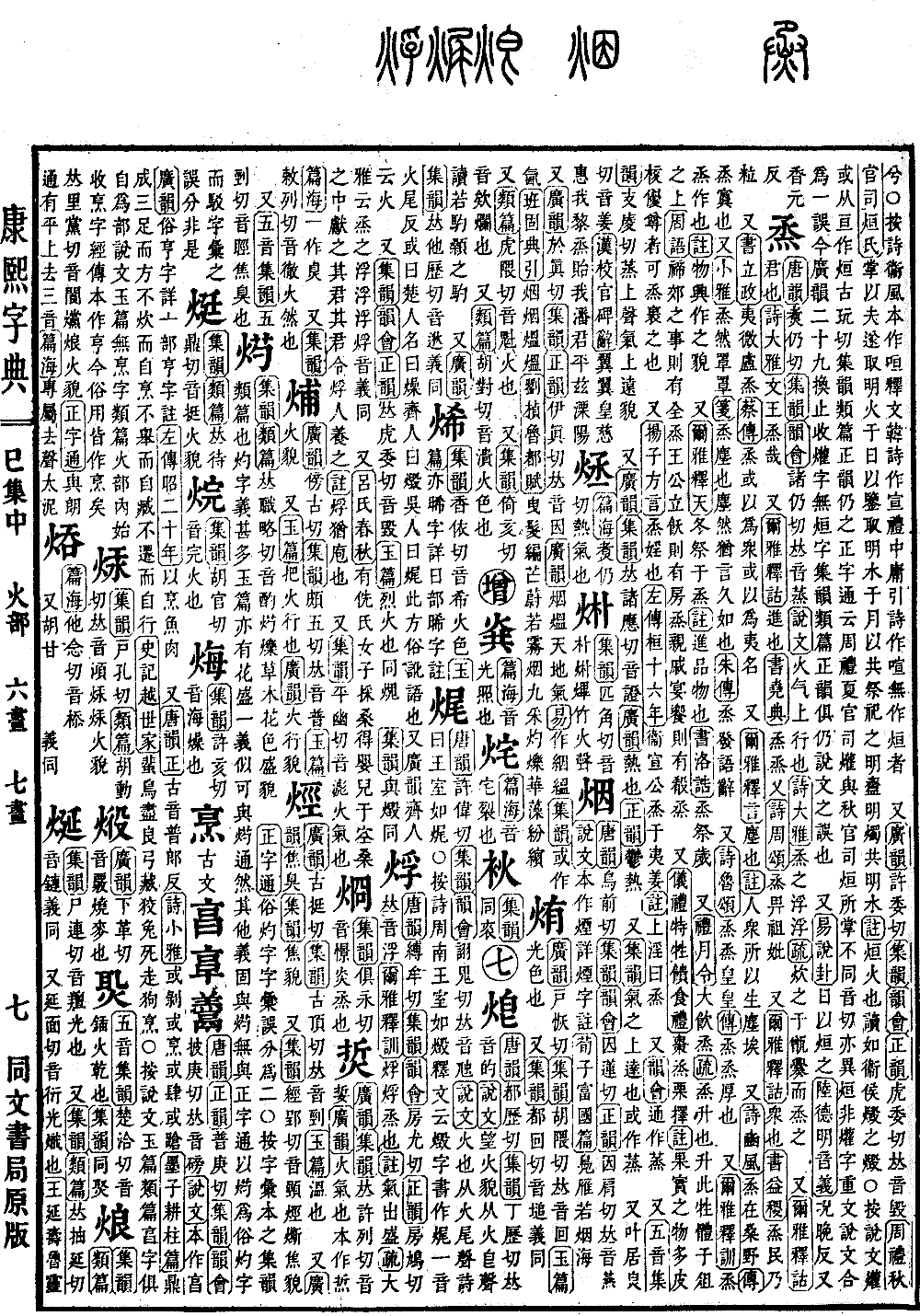
Si Collection, Middle Volume
Radical: Fire (huǒ)
Kangxi Strokes: 10
Page 671, Entry 01
Pronounced zheng
Shuowen Jiezi (Dictionary of Graphic Components): Heat rising upward.
Book of Odes (Shijing), Great Odes (Daya): Steam rising in billows.
Commentary: Placing food in a steamer and cooking it with fire.
Also: Erya (Approaching Elegance), Interpretation of Words: A ruler.
Book of Odes (Shijing), Great Odes (Daya): King Wen is truly a good ruler.
Also: Erya (Approaching Elegance), Interpretation of Words: To offer or present.
Book of Documents (Shangshu), Canon of Yao: The appearance of virtuous and honest conduct.
Book of Odes (Shijing), Eulogies of Zhou (Zhousong): Offering to ancestors.
Also: Erya (Approaching Elegance), Interpretation of Words: Many or numerous.
Book of Documents (Shangshu), Counsels of Yu (Yiji): Only when the people are numerous can they be fed.
Also: Book of Documents (Shangshu), Establishment of Government (Lizheng): Yi, Wei, Lu, and Zheng.
Cai Chen’s Commentary: Regarding Zheng, some believe it means numerous, others believe it is the name of a tribe.
Also: Erya (Approaching Elegance), Interpretation of Phrases: Dust.
Notes: When many people gather, dust is stirred up.
Also: Book of Odes (Shijing), Odes of Bin (Binfeng): Staying in the mulberry fields.
Commentary: Zheng means to place or set aside.
Also: Little Odes (Xiaoya): Covering for a long time.
Note: Zheng means dust; it is used to describe a long duration of time.
Zhu Xi’s Commentary: Zheng is a particle used at the beginning of a sentence.
Also: Book of Odes (Shijing), Eulogies of Lu (Lusong): A magnificent and bright appearance.
Commentary: Zhengzheng means thick and heavy.
Also: Erya (Approaching Elegance), Interpretation of Lessons: A prosperous appearance.
Note: The appearance of things rising and flourishing.
Also: Erya (Approaching Elegance), Interpretation of Heaven: Winter sacrifices are called zheng.
Note: Offering various ritual items.
Book of Documents (Shangshu), Announcement of Luo (Luogao): The year of holding the winter sacrifice.
Also: Book of Rites (Liji), Monthly Ordinances (Yueling): Holding the grand drinking rite.
Commentary: Zheng means to ascend, placing the sacrificial meat onto the ritual stand.
Discourses of the States (Guoyu): When sacrificing to heaven and earth, there is the complete sacrificial offering known as Quanzheng; when kings and dukes hold rites involving standing to drink, there is the partially butchered offering known as Fangzheng; when relatives feast, there is the bony meat offering known as Xiaozheng.
Also: Book of Etiquette and Ceremonial (Yili), Rites for Special Food Offerings: Dates are steamed and chestnuts are selected.
Note: Fruits often have skins and pits; they are steamed and wrapped to honor guests.
Also: Yang Xiong’s Dialects (Fangyan): Zheng means illicit sexual relations.
Zuo Commentary (Zuozhuan), Year 16 of Duke Huan: Duke Xuan of Wei had an illicit relationship with Yijiang.
Note: Illicit relations with a superior are called zheng.
Also: Rhyme Collection (Yunhui): Commonly written as the variant form (zheng).
Also: Five Tone Rhyme Collection (Wuyin Jiyun): Pronounced zheng (rising tone). Describes the appearance of vapor rising and drifting far away.
Also: Expanded Rhymes (Guangyun), Collective Rhymes (Jiyun): Pronounced zheng (falling tone).
Expanded Rhymes (Guangyun): Heat.
Correct Rhymes (Zhengyun): Sultry heat.
Also: Collective Rhymes (Jiyun): Vapor rising and passing through. Sometimes also written in a variant form (zheng).
Also: Rhyming with the character ju: Pronounced jiang.
Han Dynasty School Official Inscription: The imperial grace is vast, benefiting my common people, granting us Lord Pan to govern this Liyang.
Textual Research: In Erya, Interpretation of Heaven, it says winter sacrifice is at zheng. Following the original text, zheng has been corrected to zheng.