Wu Collection, Upper Volume
Radical: Jade (yù)
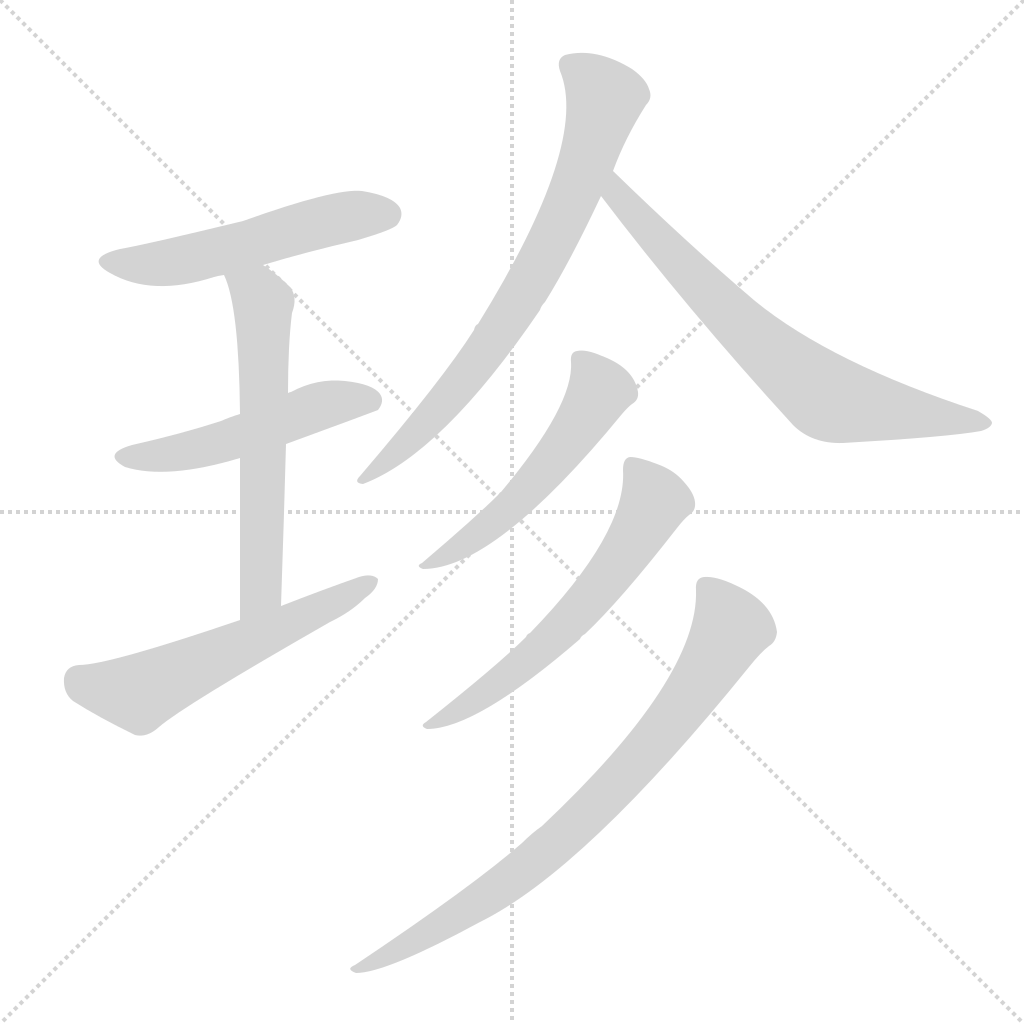
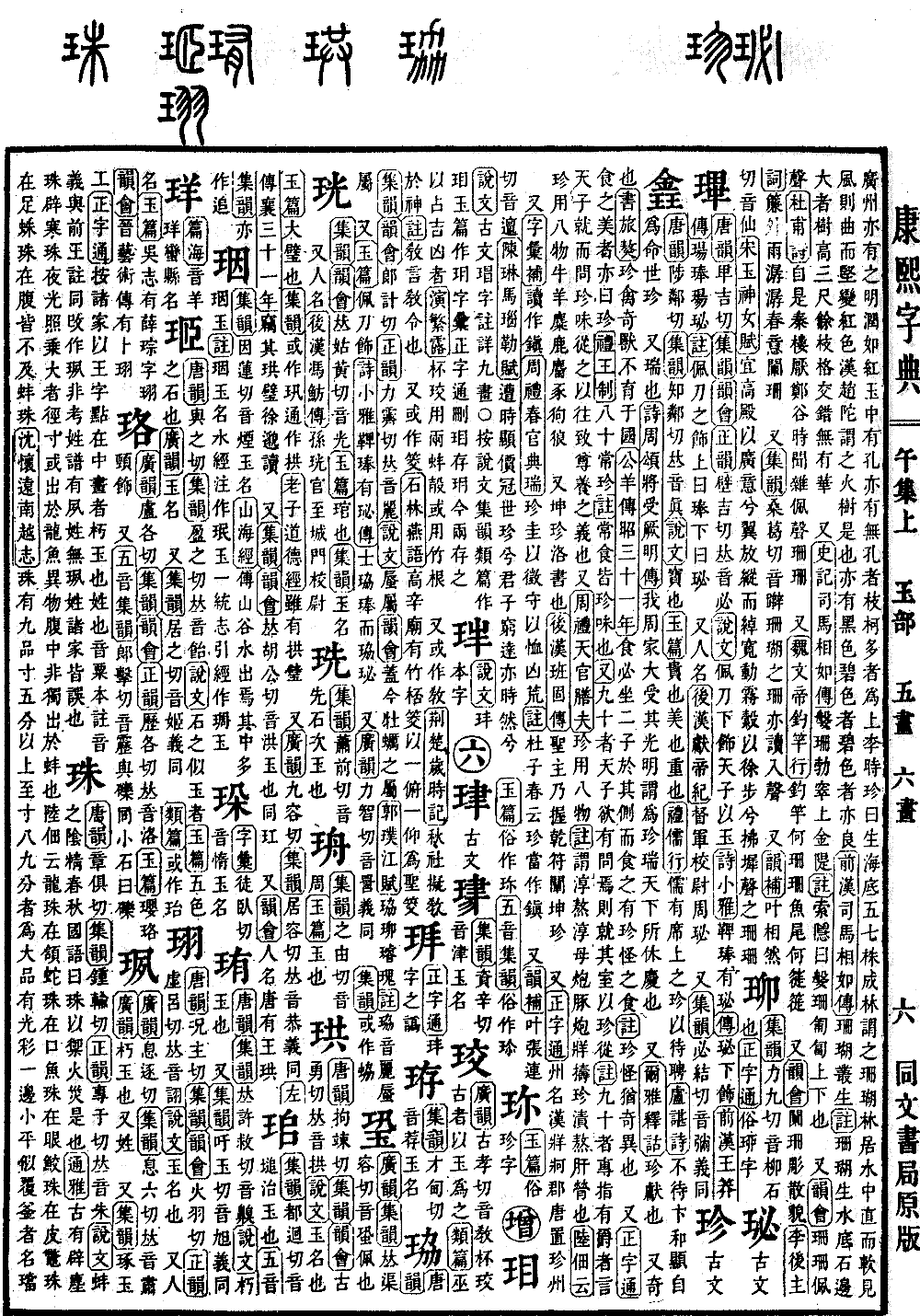
珍
Kangxi Strokes: 10
Page 730, Entry 04
Ancient form is written as 錱.
Pronounced zhēn.
Shuowen Jiezi (Shuowen): Precious objects.
Yupian: Valuable, beautiful, and important.
Book of Rites (Liji), Ruxing: The scholar possesses precious gems on the mat to await a summons for service.
Lu Chen poem: There is no need for Bian He to reveal it; it is already a precious treasure of the world.
Also refers to auspicious omens.
Book of Odes (Shijing), Zhousong, Jiangshoujumingzhuan: Our Zhou house received great light, referred to as precious and auspicious omens, which the world celebrates.
Erya, Shigu: Zhen means to present as an offering.
Also refers to something strange or singular.
Book of Documents (Shangshu), Lü'ao: Strange birds and rare beasts are not bred within the state.
Gongyang Zhuan, Zhao 31st Year: When eating, he would always have his two sons sit by his side to eat together, preparing rare and unusual foods. Note: Zhenguai means something strange.
Zhengzitong: Delicious foods are also called zhen.
Book of Rites (Liji), Wangzhi: Those eighty years of age should eat delicious foods. Note: Daily meals consist of rare delicacies.
Also: For those ninety years of age, if the Son of Heaven has inquiries, he goes to their residence in person and carries rare delicacies with him. Note: Ninety years of age specifically refers to those with titles, meaning the Son of Heaven goes to inquire and brings rare delicacies to express respect and care.
Rites of Zhou (Zhouli), Tianguan, Shanfu: Eight types of precious foods. Note: This refers to chun'ao, chunmu, paotun, paozang, daozhen, zi, ao, and ganliao.
Lu Dian says: The eight precious foods refer to ox, sheep, elk, deer, roe deer, pig, dog, and wolf.
Also Kunzhen: Refers to the Luo River Map (Luoshu).
Book of the Later Han (Houhanshu), Ban Gu Zhuan: The holy emperor therefore grasped the heavenly mandate and expounded on the earth's precious treasures.
Zhengzitong: The name of a prefecture. It was Zangke Commandery in the Han dynasty; Zhen Prefecture was established in the Tang dynasty.
Zihui Bu: Pronounced zhèn.
Rites of Zhou (Zhouli), Chunguan, Dianrui: The zhen scepter is used to summon guarding ministers and to provide relief during famines. Note: Du Zichun said: Zhen should be written as zhen (a stabilizing jade scepter).
Yunbu: Rhymes with zhān.
Lin Manaole Fu: Encountering the time, its value is revealed to surpass the precious treasures of the world; that a gentleman is either distressed or successful is also determined by fate.
Yupian: Commonly written as 珎.
Wuyin Jiyun: Commonly written as.
Textual Research: Book of the Later Han (Houhanshu), Ban Gu Zhuan: The holy master grasped the heavenly symbol and expounded on the earth's precious treasure. Following the original text, the holy emperor is corrected to holy master.