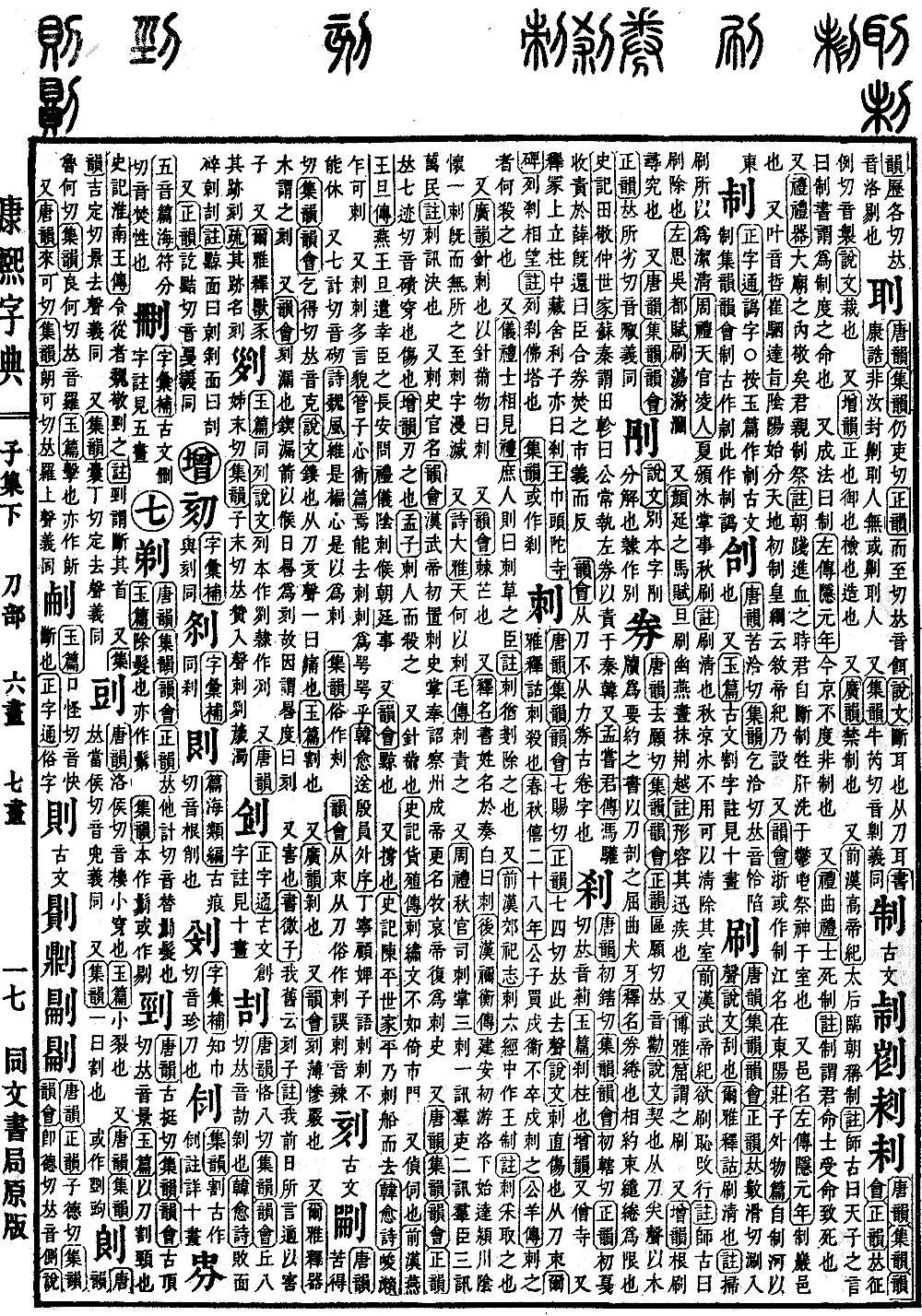
Zi Collection, Page Position: Lower
Radical: Knife (dāo)
Character: zhì
Kangxi Dictionary Strokes: 8
Page: Page 139, Entry 02
Ancient Textual Records:
"Tang Yun," "Ji Yun," "Yun Hui," and "Zheng Yun" provide the pronunciation as "zhēng lì qiè," with the same pronunciation as "zhì."
"Shuowen Jiezi" explains it as: to cut and tailor.
"Zeng Yun" supplements the meaning: to regulate, to control, to restrain, to create.
"Guang Yun" records: to prohibit, to restrain.
"Book of Han (Qian Hanshu) - Annals of Emperor Gao" records: The Empress Dowager presiding over court affairs was called "zhì."
Note: Yan Shigu explains: Documents promulgated by the Son of Heaven were called "zhì shū," referring to decrees that establish systems.
Established laws and regulations are called "zhì."
"Zuo Zhuan - Duke Yin, First Year" records: Now the capital city is not in accordance with the law and does not conform to the system.
"Book of Rites (Liji) - Qu Li" records: A scholar dies for the ruler's command.
Note: Zhì refers to the ruler's command, and a scholar accepts the command without hesitation, even at the cost of their life.
"Book of Rites (Liji) - Li Qi" records: Within the Great Temple, reverence is required, and the ruler personally participates in the sacrificial ceremony.
Note: When presenting the blood of sacrificial animals during the morning procession, the ruler personally cuts the animal's liver, washes it with Yùchàng wine, and sacrifices to the spirits in the inner chamber.
Place Names:
"Zuo Zhuan - Duke Yin, First Year" records: Zhì was a strategic city.
Ye Yin's note: Pronounced the same as "zhé."
Cui Yin's "Da Zhi" records: Yin and Yang first separated, Heaven and Earth first established. The imperial dynasty's order was established, and the emperors' laws and systems were set.
"Yun Hui" records: "Zhe" is sometimes written as "zhì." It is the name of a river located in Dongyang.
"Zhuangzi - External Things" records: East of the "Zhì River."